Carved Dragon Heads
Bergen, Norway
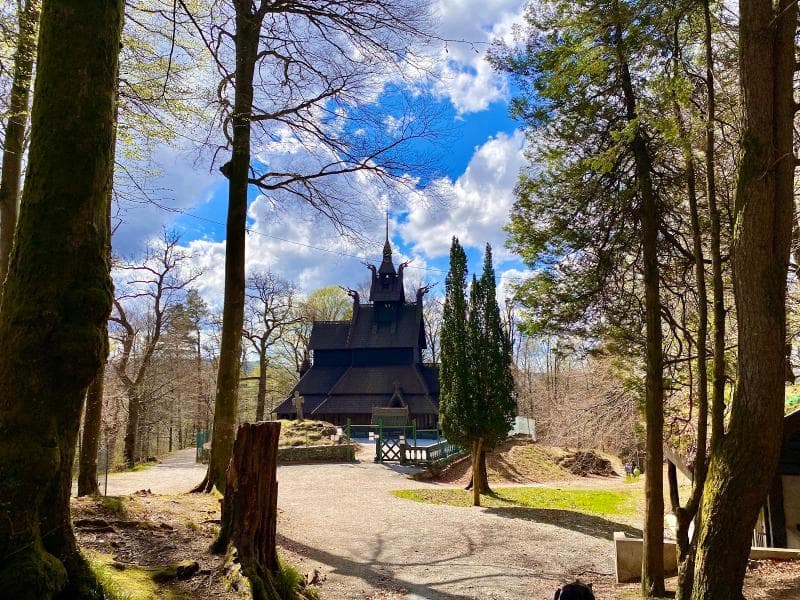
Discover the intricate Carved Dragon Heads at Fantoft Stave Church in Bergen, Norway. Explore their historical and cultural significance in this unique medieval architecture.
Overview
Nestled amidst the lush landscapes just outside Bergen, Norway, the Fantoft Stave Church stands as a remarkable testament to medieval Norwegian architecture and a compelling symbol of cultural resilience. While it appears as an ancient structure, the church today is a meticulously reconstructed replica, renowned for its distinctive dark, tar-treated timber and, most notably, its intricately carved dragon heads. These stylized figures, adorning the gables, are not merely decorative elements but carry profound historical and symbolic weight. Originally built in Fortun, a village in Sogn, around 1150-1170, the church was relocated to Fantoft in 1883 to save it from impending demolition. Its journey took a tragic turn in 1992 when an act of arson destroyed the historic edifice. However, through dedicated craftsmanship and a commitment to authenticity, it was faithfully rebuilt, reopening in 1997, ensuring that its unique blend of Norse and Christian artistry continues to captivate visitors.
History & Cultural Background
The history of stave churches like Fantoft is deeply intertwined with Norway's transition from Old Norse mythology to Christianity. Emerging during the 11th to 13th centuries, these wooden churches represent a unique period where pre-Christian beliefs and symbols were integrated into the new Christian faith, creating a rich tapestry of cultural syncretism. The dragon motif, prominent in Norse art and mythology, found a new context within these sacred Christian spaces. Before Christianity, dragons were potent symbols of protection and strength, often carved onto Viking ships to ward off evil spirits and signify power.
When Christianity arrived, these established beliefs did not simply vanish. Instead, they adapted and merged. Dragon heads, alongside other pre-Christian symbols, continued to be incorporated into church architecture, serving as guardians against malevolent forces. This fascinating blending of old and new is a defining characteristic of stave church art and offers a tangible link to Norway's complex past. The Urnes style, a distinct form of Viking art characterized by intricate animal ornamentation, particularly influenced these carvings, showcasing the continuity of artistic traditions.
What Makes It Special
The 'Carved Dragon Heads' of Fantoft Stave Church are arguably its most distinctive and iconic feature. Rising majestically from the church's gables and roof ridges, these stylized wooden carvings instantly evoke images of Viking longships. They are a signature element of stave church design, distinguishing them visually from other medieval European churches. But their significance extends far beyond mere aesthetics. These dragons symbolize a fascinating intersection of belief systems. On one hand, they recall the protective powers attributed to dragons in ancient Norse sagas and on the prows of Viking vessels, believed to defend against evil. On the other hand, their presence on a Christian church reflects the early Christian period's willingness to incorporate familiar pagan symbols, reinterpreting them within a new religious framework.
Functionally, they served a similar purpose to the gargoyles found on stone cathedrals elsewhere in Europe, acting as protective totems. This dual interpretation—as both a nod to pagan ancestry and a Christian guardian—makes the dragon heads particularly special. They are a silent narrative of cultural evolution, demonstrating how ancient traditions were not eradicated but rather transformed and integrated, forming a unique architectural language that is distinctly Norwegian. The intricate craftsmanship involved in their creation, using centuries-old techniques, further underscores their value as historical and artistic treasures.
Stories, Fun Facts & Local Details
The story of Fantoft Stave Church and its dragon heads is punctuated by drama and rebirth. The church's destruction by arson in 1992 sent shockwaves across Norway, highlighting the fragility of historical monuments. The decision to rebuild it immediately was a testament to its cultural significance. The reconstruction process itself is a remarkable feat; craftsmen painstakingly recreated the church using traditional methods and materials, including 350-400 year old pine trees. This massive undertaking ensured that the rebuilt church, including its dragon heads, faithfully replicated the original medieval design.
Interestingly, very little remained of the original church after the fire, save for a wish stone embedded in one wall and the altar cross. Thus, the dragon heads seen today are a modern-day recreation, yet they embody centuries of design tradition and symbolic meaning. Visitors often note the dark, almost mystical atmosphere surrounding the church, enhanced by the forest setting and the imposing, watchful dragons. This blend of ancient mystique and a powerful story of resurrection makes the Fantoft Stave Church a truly unique and memorable site in Norway.
Visitor Perspective
For the curious traveler, encountering the Carved Dragon Heads at Fantoft Stave Church is an immersive experience. The church's striking exterior, with its dark timber and dramatic dragon ornamentation, evokes a strong sense of history and ancient myths even before one steps closer. While the church is primarily enjoyed from the outside, the detailed carvings of the dragon heads are easily visible and provide ample opportunity for appreciation and photography. Visitors often describe a feeling of stepping back in time, marveling at the craftsmanship and the powerful symbolism these figures convey. The setting, just a short light rail ride from Bergen city center, adds to its appeal, offering a peaceful escape into a unique piece of Norwegian heritage. The dragon heads serve as silent, powerful guardians, inviting contemplation on the rich cultural tapestry that shaped medieval Scandinavia.
Coordinates: 5.3532899984798314, 60.339276535509505
View on Google Maps💬 How Travelers Describe This Place
Based on community votes
Beautiful
995Interesting
839Must See
603Unique
388Photogenic
289
Traveler Stories
Discover memorable experiences shared by travelers who have visited this place.
No traveler stories yet.
Be the first traveler to share what made this place memorable.

Tour
By
Spot
Discover amazing places around the world. Your journey starts here.
Explore
© 2026 TourBySpot. All rights reserved.