Caravaggio Rooms
Florence, Italy
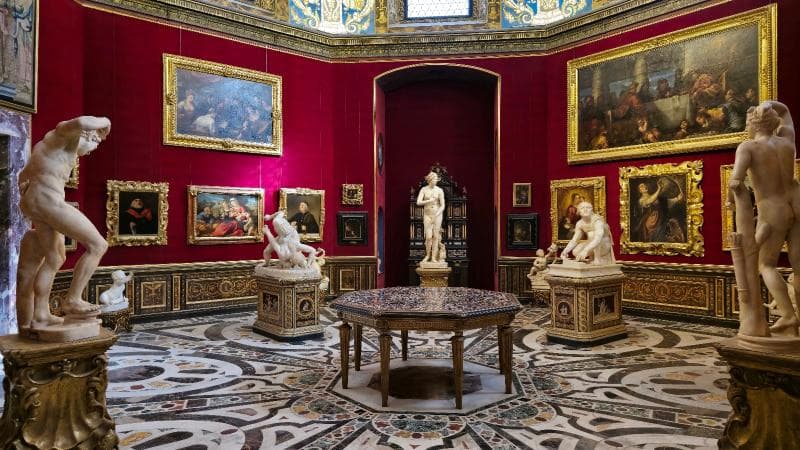
Explore the dramatic 'Caravaggio Rooms' at the Uffizi Gallery in Florence, Italy, featuring masterpieces like 'Medusa' and 'Bacchus'.
Overview
Deep within the illustrious Uffizi Gallery in Florence, Italy, lies a captivating section dedicated to the revolutionary art of Michelangelo Merisi da Caravaggio, commonly known as Caravaggio. These dedicated spaces, often referred to as the 'Caravaggio Rooms', offer a profound journey into the dramatic and intensely realistic world of one of art history's most influential figures. Here, visitors encounter masterpieces that redefined painting in the 17th century, showcasing Caravaggio's masterful use of light and shadow, and his unflinching portrayal of human emotion and physical reality.
The Uffizi Gallery proudly displays three of Caravaggio's pivotal works: 'Medusa', 'Bacchus', and 'The Sacrifice of Isaac'. These paintings are not merely exhibits; they are a testament to the artist's groundbreaking techniques and the lasting impact he had on subsequent generations of painters, often inspiring a school of followers known as the Caravaggisti. The rooms themselves are designed to enhance the viewing experience, preparing the visitor for the raw intensity of his art after passing through centuries of earlier Renaissance brilliance.
History & Cultural Background
While Caravaggio himself never lived in Florence, his extraordinary works found their way into the prestigious Medici collection through the intricate networks of aristocratic patronage. The 'Medusa' and 'Bacchus', two of the Uffizi's most prized Caravaggio pieces, were diplomatic gifts to Grand Duke Ferdinando I de' Medici from Cardinal Francesco Maria Del Monte, one of Caravaggio's earliest and most significant patrons in Rome, around 1598. 'The Sacrifice of Isaac' was acquired by the gallery at a later date.
In February 2018, the Uffizi Galleries unveiled a significant re-arrangement of the rooms dedicated to Caravaggio and 17th-century painting. This expansion saw eight new rooms opened on the first floor of the eastern wing, providing a more expansive and thematic display for approximately 50 masterpieces from this period. These newly designed spaces, with evocative names like 'Caravaggio: Medusa' and 'Caravaggio: Bacchus', emphasize a thematic and artistic approach, aiming to immerse visitors in the atmosphere and history of the Medici's collections, fostering an intellectual experience for both specialists and general enthusiasts.
What Makes It Special
Caravaggio's works stand apart due to their revolutionary approach to naturalism and dramatic realism. He rejected the idealized forms prevalent in Renaissance art, choosing instead to depict subjects with unflinching honesty, often using models from everyday life. His signature technique, known as chiaroscuro, involves stark contrasts between light and shadow, which creates a powerful three-dimensional effect and heightens the emotional intensity of his scenes.
- 'Medusa': This painting is unique not only for its gruesome subject matter—the severed head of the Gorgon at the moment of decapitation—but also for its unusual support: a convex wooden shield. This curved surface makes the horrifying image appear to project outwards, directly engaging the viewer and intensifying the illusion of terror.
- 'Bacchus': This early masterpiece showcases Caravaggio's skill in rendering textures and details, from the translucent glass of wine to the delicate folds of the drapery, all while capturing the god of wine with a distinctly human vulnerability.
- 'The Sacrifice of Isaac': This work exemplifies Caravaggio's ability to convey profound psychological drama, capturing the raw emotion and tension of the biblical narrative with striking realism in the faces of the characters.
Stories, Fun Facts & Local Details
The 'Medusa' has a fascinating backstory, arriving in Florence as a prestigious diplomatic gift. Some scholars even suggest that the screaming face of Medusa might be a youthful self-portrait of Caravaggio himself, adding a layer of personal intensity to the already captivating piece.
Interestingly, Caravaggio's 'Bacchus' was not always prominently displayed. For a long time, it languished in the Uffizi's storerooms, rediscovered only in 1913 by an inspector who recognized its significance. This rediscovery brought one of Caravaggio's most famous works back into the public eye, cementing its place among the Uffizi's treasures.
The current 'Caravaggio Rooms' feature a distinctive design element: deep red walls. This isn't just an aesthetic choice; the pigment used is based on colors prevalent in 17th-century textiles, creating an authentic and immersive atmosphere that reflects the period in which Caravaggio's art flourished. This attention to detail transforms the viewing experience into a sensory journey back in time.
Visitor Perspective
Visiting the Caravaggio Rooms after navigating the earlier Renaissance halls of the Uffizi offers a striking contrast. You transition from the serene beauty of Botticelli and Leonardo to the visceral drama and psychological depth of Caravaggio. The atmospheric lighting in these rooms is intentionally designed to complement Caravaggio's chiaroscuro, allowing his figures to emerge from the darkness with breathtaking intensity.
These rooms provide an intimate encounter with a master who dared to break conventions, making his art feel remarkably contemporary even centuries later. For any art lover or curious traveler, spending time with Caravaggio's works in the Uffizi is an essential part of understanding the trajectory of Western art and experiencing the profound emotional power that painting can convey. It is a journey that reveals not just art, but the very essence of human experience through the lens of a genius.
Coordinates: 11.2553, 43.7683
View on Google Maps💬 How Travelers Describe This Place
Based on community votes
Photogenic
951Unique
748Beautiful
499Interesting
427Must See
94
Traveler Stories
Discover memorable experiences shared by travelers who have visited this place.
No traveler stories yet.
Be the first traveler to share what made this place memorable.

Tour
By
Spot
Discover amazing places around the world. Your journey starts here.
Explore
© 2026 TourBySpot. All rights reserved.