Capuchin Monastery
Salzburg, Austria
Discover the serene Capuchin Monastery on Kapuzinerberg in Salzburg, Austria. Explore its rich history, tranquil architecture, and panoramic city views.
Overview
Nestled high on the picturesque Kapuzinerberg, the Capuchin Monastery (Kapuzinerkloster) stands as a prominent landmark overlooking the enchanting city of Salzburg, Austria. This venerable institution, with its characteristically modest architecture, offers visitors a unique blend of spiritual tranquility and breathtaking panoramic views. Visible from various points across the city, the monastery, perched on its green perch, provides an unparalleled vantage point from which to admire Salzburg's historic Old Town, the winding Salzach River, and the majestic Hohensalzburg Fortress.
The Kapuzinerberg itself, often referred to as Salzburg's 'green lung,' is a beloved recreational area. Its forested slopes are crisscrossed with serene walking paths, inviting locals and travelers alike to escape the urban bustle and immerse themselves in nature. The monastery complex, comprising a church, residential buildings, and a bastion crowned with a large wooden cross, remains an active spiritual hub where Capuchin friars continue their contemplative life.
History & Cultural Background
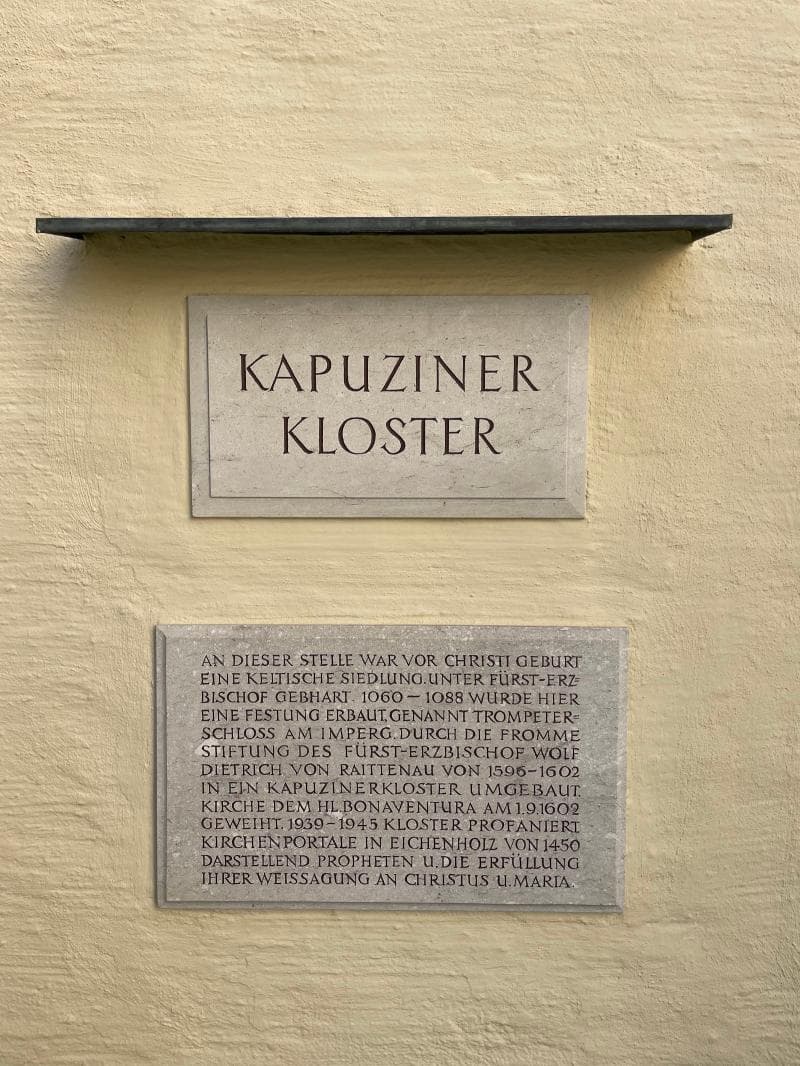
The origins of the Capuchin Monastery trace back to medieval times, when a fortified tower known as the 'Trompeterschlösschen' (Trumpeter's Castle) guarded the site. In 1594, Prince-Archbishop Wolf Dietrich von Raitenau, a pivotal figure in Salzburg's history, invited the Capuchin order to the city. He envisioned transforming this ancient defensive structure into a monastery and church, establishing it as a spiritual stronghold against the Reformation.
Construction commenced between 1599 and 1605, with the monastery church consecrated in 1602. The Capuchins, a branch of the Franciscan order, are known for their commitment to simplicity, poverty, and devotion, ideals reflected in the monastery's understated design. Over the centuries, the cloister expanded, reaching its present form around 1690. Its history, however, has not been without turmoil; the monastery faced occupation and desecration by French and Bavarian troops during the Napoleonic era and, later, the friars were evicted by the Nazis from 1939 to 1945, though plans to replace it with a festival hall never materialized. The resilience of the Capuchin community is evident in their return, and today, the monastery continues its over 400-year-old tradition, serving as a vibrant center for spirituality and a training ground for new friars.
What Makes It Special
The Capuchin Monastery's allure lies in several unique aspects. Foremost among these are the unparalleled, sweeping vistas it provides over Salzburg. From the viewing platform, travelers are treated to a timeless panorama that has changed little since the 17th century, capturing the iconic red rooftops of the Old Town and the formidable Hohensalzburg Fortress.
Beyond its visual splendor, the monastery offers a profound sense of peace. Its architecture, adhering strictly to the Capuchin vows of humility, is free from ostentation, inviting quiet introspection. The ascent to the monastery itself is a journey through history and contemplation: the path from Linzer Gasse is lined with six Baroque chapels, erected between 1736 and 1744, depicting the Stations of the Cross, culminating in a poignant crucifixion group. Inside the church, an impressive Late Gothic oak door, believed to be a relic from the old Salzburg Cathedral, adds a touch of ancient grandeur to the otherwise simple interior.
Moreover, the Kapuzinerberg is a natural sanctuary. Its designation as Salzburg's 'green lung' is well-deserved, with a rich diversity of flora and fauna, including rare species like chamois, deer, badgers, and pine martens. This ecological richness is partly attributed to the mountain's unique geological history, standing as an 'island' above the glaciers during the last ice age.
Stories, Fun Facts & Local Details
The Capuchin Monastery and Kapuzinerberg are interwoven with intriguing stories and cultural notes. One notable figure associated with the hill is the renowned Austrian writer Stefan Zweig, who resided in the 'Paschinger Schlössl' on Kapuzinerberg from 1919 to 1937. A memorial near the monastery entrance commemorates this pacifist author, who found inspiration in the tranquil setting before being forced to leave due to political upheaval.
A fascinating tidbit reveals that Pope John Paul II even resided at the monastery during his visit to Salzburg in 1988, underscoring its spiritual significance beyond the local community. The monastery's resilience is a testament to its enduring spirit, having withstood periods of suppression and serving as a beacon of faith for over four centuries. Today, it not only houses a community of friars from diverse backgrounds but also functions as an important training center for Capuchins. The monks' commitment to outreach is evident in initiatives like 'Study & Pray,' a program offering students a quiet retreat for focused work and spiritual reflection.
Visitor Perspective
For those eager to explore, accessing the Capuchin Monastery is an experience in itself. Multiple scenic paths lead up the Kapuzinerberg, with the most popular starting from Linzer Gasse, guiding you past the historic Stations of the Cross. Another route involves the Imbergstiege, passing by St. John's Chapel. Be prepared for a moderate, sometimes steep, climb that typically takes about 15 to 20 minutes; comfortable shoes are highly recommended to enjoy the ascent fully.
While the private monastic areas remain largely closed to the public in observance of the friars' strict rule, the monastery church welcomes visitors for services. The monastery garden also opens its gates to the public on Saturdays during specific hours, offering another serene spot for contemplation. Many visitors find the viewpoint just below the monastery to be the ideal spot for capturing photographs of the iconic Salzburg skyline. This peaceful retreat, just minutes from the city's bustling heart, offers a timeless haven, inviting moments of reflection, historical discovery, and connection with nature, away from the typical tourist crowds.
Coordinates: 13.04666, 47.80176
View on Google Maps💬 How Travelers Describe This Place
Based on community votes
Beautiful
951Unique
491Must See
427Interesting
414Photogenic
277
Traveler Stories
Discover memorable experiences shared by travelers who have visited this place.
No traveler stories yet.
Be the first traveler to share what made this place memorable.

Tour
By
Spot
Discover amazing places around the world. Your journey starts here.
Explore
© 2026 TourBySpot. All rights reserved.