Buddhist Memorial Areas
Phnom Penh, Cambodia
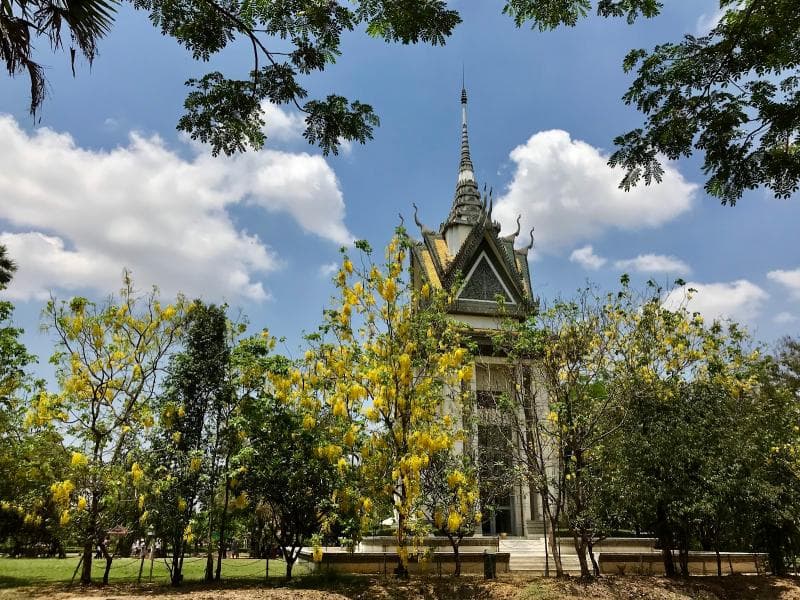
Explore the Buddhist Memorial Areas at Choeung Ek Genocidal Center in Phnom Penh, Cambodia, a solemn tribute to genocide victims.
Overview
The Buddhist Memorial Areas within the Choeung Ek Genocidal Center in Phnom Penh, Cambodia, serve as a poignant and solemn tribute to the countless victims of the Khmer Rouge regime. This site, a former orchard and Chinese cemetery, was tragically transformed into one of the most infamous 'Killing Fields' between 1975 and 1979. Today, it stands as a place of quiet reflection and remembrance, centering around a towering Memorial Stupa that houses the remains of thousands who perished here. It is an essential destination for understanding a dark, yet crucial, chapter of Cambodian history.
The center is not merely a historical site but a living memorial, encouraging visitors to engage with the past in a respectful and contemplative manner. The atmosphere is deliberately maintained for mourning and education, making it a profound experience for anyone seeking to comprehend the atrocities of the Cambodian genocide.
History & Cultural Background
Between 1975 and 1979, Pol Pot's Khmer Rouge regime sought to transform Cambodia into an agrarian socialist society, leading to the Cambodian genocide. An estimated 1.7 to 2 million people died from execution, forced labor, starvation, and disease during this brutal period. Choeung Ek was one of approximately 300 'Killing Fields' across Cambodia, but it became the best-known due to its proximity to the capital and its direct connection to the S-21 detention center (Tuol Sleng prison) in Phnom Penh.
Prisoners from S-21, often suspected intellectuals or those deemed enemies of the state, were transported to Choeung Ek, usually at night, for execution. To conserve bullets, victims were often bludgeoned to death with crude instruments like pickaxes, spades, or bamboo sticks. Loud music was played through loudspeakers to drown out the sounds of the killings.
A memorial was first constructed at Choeung Ek in 1988 by Cambodian authorities. The central Buddhist stupa was built to house the remains exhumed from the mass graves. In Khmer Buddhist tradition, violent deaths are viewed unfavorably, as it's believed the spirits may linger. The stupa, therefore, serves as a significant site for peace and remembrance for these tormented souls.
What Makes It Special
The core of the Buddhist Memorial Areas is the magnificent Memorial Stupa, a 62-meter (203 feet) tall Buddhist monument. It features a transparent acrylic enclosure, revealing over 5,000 human skulls, arranged by age and sex, exhumed from the mass graves at the site. This stark display serves as a powerful and unfiltered testament to the scale of the genocide.
Beyond the stupa, the site retains many of the original mass graves, some of which have been left untouched out of respect. Visitors walk along pathways where fragments of bone and cloth still surface after heavy rains, a raw and persistent reminder of the past. One particularly harrowing spot is the 'Killing Tree,' where children and infants were brutally murdered.
What truly sets Choeung Ek apart is its commitment to education and remembrance. The site provides an exceptional audio guide, narrated by survivors and former Khmer Rouge guards, offering detailed historical context and personal testimonies. This immersive experience ensures that visitors gain a deep, emotional understanding of the events that transpired.
Stories, Fun Facts & Local Details
While 'fun facts' may seem inappropriate for such a somber location, there are poignant details and insights that offer a deeper understanding. For instance, the very landscape of Choeung Ek, once an orchard and a Chinese cemetery, dramatically contrasts with the horrors it witnessed. The presence of ancient Chinese tombs on the grounds even predates its use as a killing field.
The decision to display the skulls in the stupa, rather than reburying them, was made to ensure the truth of the genocide is never forgotten and to honor the victims by making their sacrifice visible. The site is actively managed for preservation and remembrance, with revenues from visitors contributing to its upkeep.
A significant local detail is the annual Genocide Day commemoration held on May 9th at the stupa, where survivors, relatives, and officials gather to pay their respects. This event underscores the ongoing importance of the site for the Cambodian people in their journey of healing and remembrance.
Visitor Perspective
Visiting the Buddhist Memorial Areas at Choeung Ek is a profoundly moving, and often challenging, experience. It is not a typical tourist attraction but a place of dark tourism, intended for reflection and learning. Travelers are encouraged to dress modestly, maintain silence, and approach the site with reverence.
The audio guide is considered indispensable for understanding the site's significance, guiding visitors through the various mass graves, the Killing Tree, and finally to the Memorial Stupa. Many visitors find the experience deeply impactful, leaving with a renewed appreciation for peace and a solemn understanding of humanity's capacity for cruelty and resilience. The center is wheelchair accessible in most areas, striving to accommodate all who wish to pay their respects.
Coordinates: 104.90194, 11.48444
View on Google Maps💬 How Travelers Describe This Place
Based on community votes
Beautiful
894Unique
862Interesting
443Must See
304Photogenic
184
Traveler Stories
Discover memorable experiences shared by travelers who have visited this place.
No traveler stories yet.
Be the first traveler to share what made this place memorable.

Tour
By
Spot
Discover amazing places around the world. Your journey starts here.
Explore
© 2026 TourBySpot. All rights reserved.