Buddha Tooth Relic Temple
Singapore, Singapore
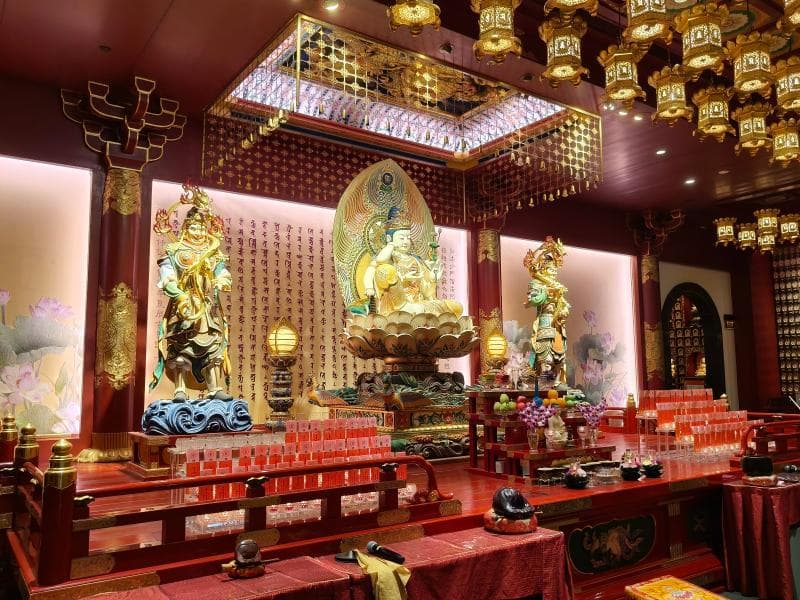
Explore Singapore's Buddha Tooth Relic Temple, a stunning Tang Dynasty-style marvel in Chinatown. Discover its sacred relic, rich history, cultural exhibits, and serene rooftop garden. A must-visit spiritual and cultural landmark in Singapore.
Overview
Nestled in the vibrant heart of Singapore's Chinatown, the Buddha Tooth Relic Temple and Museum stands as a magnificent multi-storey complex, a profound symbol of faith and cultural preservation. Completed in 2007, this grand temple is a relatively recent addition to Singapore's skyline but evokes centuries of Buddhist tradition through its stunning architecture inspired by the Tang Dynasty. More than just a place of worship, it functions as a living museum, offering a deep dive into Buddhist art and history. At its core, the temple reverently houses what is believed to be the sacred left canine tooth of Siddhartha Gautama, the historical Buddha, recovered from his funeral pyre. Its striking appearance, rich interiors, and comprehensive exhibits make it a must-visit destination for anyone seeking spiritual solace, cultural insight, or architectural marvel in the bustling city-state.
History & Cultural Background
While the Buddha Tooth Relic Temple presents an appearance of ancient grandeur, its construction is quite contemporary, having been completed in 2007. The vision for this significant institution began to take shape in the early 1980s, culminating in a dedicated effort by Buddhist leaders in Singapore. A pivotal moment arrived in 2002 when Venerable Shi Fa Zhao received a sacred relic, a tooth believed to be the Buddha's, from Venerable Cakkapala of Myanmar. This relic, purportedly discovered in 1980 within a collapsed stupa in Myanmar, became the impetus for constructing a temple worthy of its veneration.
The temple's design consciously harkens back to the Tang Dynasty, an era widely regarded as a golden age for Chinese Buddhism. This architectural choice bridges modern Singapore with a rich spiritual past, embodying principles of peace, balance, and spiritual growth. Beyond its historical aesthetic, the temple's layout is meticulously crafted based on the Buddhist mandala, a sacred geometric form representing the universe and the path to awakening. This intentional design guides visitors on a journey from the external world towards inner contemplation. Impressively, the temple was constructed using traditional Chinese 'dugong' (cap and block) techniques, allowing for its intricate structure to stand without the use of nails. The entire project cost approximately S$75 million.
What Makes It Special
The primary draw of the Buddha Tooth Relic Temple is, undoubtedly, the sacred relic itself. Housed in the Sacred Light Hall on the fourth floor, the tooth is enshrined within a magnificent stupa crafted from 320 kilograms of gold, with 234 kilograms donated by devout followers. Only monks are permitted into the inner chamber where the relic rests, but visitors can respectfully view it from a public area behind glass.
Beyond its central relic, the temple offers a rich tapestry of cultural and spiritual experiences. It serves as a comprehensive museum, with various floors dedicated to different aspects of Buddhist heritage. The second and third floors feature exhibits like the Eminent Sangha Museum and the Buddhas of the World collection, displaying ancient scriptures, artifacts, and stories that trace Buddhism's journey across Asia. Every corner of the temple, from its exquisitely carved pillars to its ornate ceilings, reflects a deep harmony with Buddhist teachings. The intricate blend of traditional red lacquer, green windows, and gold edges adds to its majestic elegance. The serene rooftop garden, complete with a large Buddha Vairocana Prayer Wheel and lush orchids, offers a tranquil escape from the city's hustle and bustle, inviting quiet contemplation. This space is a testament to the temple's role as a spiritual sanctuary and a monument to enduring Buddhist wisdom.
Stories, Fun Facts & Local Details
The relic housed within the temple is widely believed by many to be the actual left canine tooth of Siddhartha Gautama, retrieved from his cremation pyre in India. However, its authenticity has been a subject of discussion among some experts, who note that its reported size, around 7.5 cm, is considerably larger than a human tooth, suggesting it might potentially be from an animal like a cow or buffalo. This intriguing aspect adds another layer to the temple's mystique, inviting visitors to ponder the nature of faith and relics.
A delightful detail often missed is the rooftop garden's unique orchid, named 'Dendrobium Buddha Tooth,' a tribute to the temple's esteemed relic. For those seeking more than just visual splendor, the temple's basement houses a vegetarian dining hall that offers complimentary meals, a gesture of generosity deeply rooted in Buddhist tradition, though donations are gratefully accepted. The temple's commitment to preserving cultural heritage is also evident in its construction; the absence of nails, achieved through the traditional 'dugong' interlocking wooden support technique, highlights a connection to ancient building practices. The temple's design, inspired by the Tang Dynasty, serves as a powerful symbol, linking modern Singapore to the historical grandeur and spiritual profundity of a bygone era.
Visitor Perspective
Visiting the Buddha Tooth Relic Temple offers a uniquely enriching experience in Singapore. Admission is free, making this cultural and spiritual landmark accessible to all. The temple is open daily, typically from 7:00 AM to 7:00 PM, though specific viewing times for the relic in the Sacred Light Hall are usually available twice a day. Visitors are encouraged to dress modestly, ensuring shoulders and knees are covered as a sign of respect within this sacred space; sarongs are often available at the entrance for those who need them.
The temple is conveniently located at 288 South Bridge Road, right in the heart of Chinatown, and is easily reachable via public transport. The nearest MRT stations are Chinatown Station (NE4/DT19) and Maxwell Station (TE18), both just a short walk away. While photography is generally permitted in most areas, it is strictly forbidden within the relic chamber on the fourth floor to maintain its sanctity. For a quieter experience, weekday mornings are often recommended, allowing for more peaceful contemplation amidst the stunning architecture and exhibits. Exploring the temple's multiple floors, including its museums, can take a good hour or more, so plan your visit accordingly to fully immerse yourself in its tranquility and cultural significance.
Coordinates: 103.84423, 1.2815
View on Google Maps💬 How Travelers Describe This Place
Based on community votes
Must See
517Beautiful
422Unique
394Interesting
269Photogenic
145
Traveler Stories
Discover memorable experiences shared by travelers who have visited this place.
No traveler stories yet.
Be the first traveler to share what made this place memorable.

Tour
By
Spot
Discover amazing places around the world. Your journey starts here.
Explore
© 2026 TourBySpot. All rights reserved.