Buddha Statues Hall
Phnom Penh, Cambodia
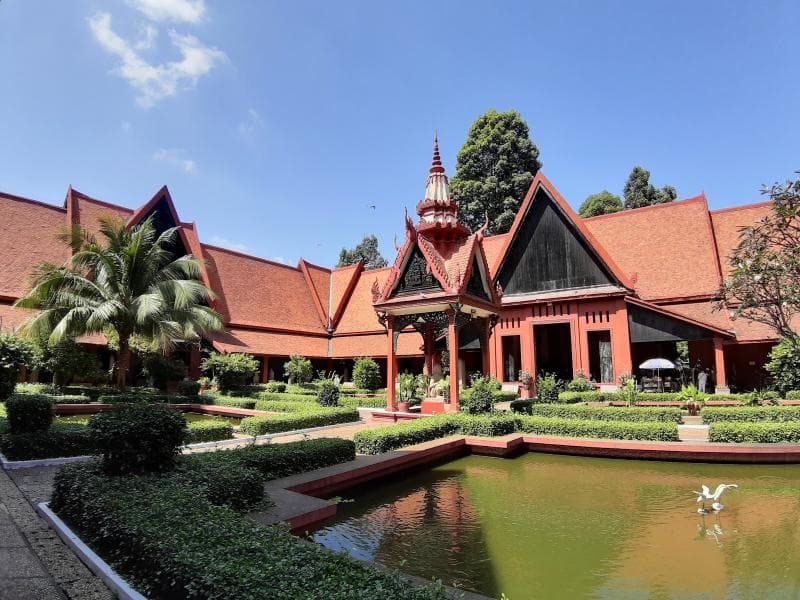
Explore the serene Buddha Statues Hall at the National Museum of Cambodia in Phnom Penh, showcasing centuries of Khmer Buddhist art and spiritual heritage.
Overview
Stepping into the National Museum of Cambodia in Phnom Penh offers a profound journey into the heart of Khmer artistic and spiritual heritage. Among its most captivating displays, the collection of Buddha statues stands as a serene testament to Cambodia's enduring Buddhist faith and exceptional sculptural traditions. This dedicated space, though not always a separate 'hall' by name, gathers an extraordinary array of Buddhist imagery spanning centuries, providing visitors with an immersive understanding of the evolution of devotion and artistry in the region.
Housed within a distinctive terracotta building, inspired by traditional Khmer temple architecture, the museum itself provides a tranquil setting for contemplation. The Buddha statue collection is a central pillar of the museum's mission to preserve and showcase Cambodia's rich cultural legacy, inviting a deep connection with the country's spiritual past.
History & Cultural Background
Buddhism arrived in Cambodia early in its history, often coexisting with and influencing indigenous animist beliefs and the dominant Hinduism that shaped much of the early Funan and Chenla periods. The earliest Buddhist influences appear to have come directly from India. While Hindu deities like Vishnu and Shiva were prominently featured in early Khmer art, Buddhist imagery gradually gained prominence, particularly from the 9th to 13th centuries during the mighty Khmer Empire.
During the Angkorian period, particularly under rulers like Jayavarman VII, Mahayana Buddhism flourished, leading to the creation of magnificent Buddhist complexes such as Bayon. This era saw the emergence of iconic Buddha statues, often characterized by a serene, spiritual intensity. Post-Angkorian periods further developed distinct styles, often employing wood and bronze, as Theravada Buddhism became the predominant faith, a status it largely retains today. The National Museum of Cambodia, inaugurated in 1920, was established to safeguard these invaluable pieces, many of which represent crucial links in Cambodia's religious and artistic narrative.
What Makes It Special
The Buddha statue collection is remarkable for its incredible diversity in materials, styles, and iconic representations. Visitors encounter statues crafted from various mediums including sandstone, bronze, and polychrome wood, each reflecting the artistic prowess and available resources of their respective eras.
One can observe the subtle shifts in artistic expression across different periods – from the more robust and compact forms of the Funan and Chenla periods, to the highly refined and spiritually charged works of the Angkorian era, and the distinctive adorned wooden Buddhas of the post-Angkorian age. The collection showcases a spectrum of Buddha poses, or mudras, each conveying a specific meaning: the seated Buddha in meditation, the standing Buddha with a gesture of fearlessness (abhaya mudra), the reclining Buddha signifying parinirvana, and the earth-touching Buddha symbolizing enlightenment. A particularly compelling motif is the Buddha protected by the multi-headed Naga (mythical serpent), a symbol of immense power and protection, which became especially popular during the Angkorian period.
Stories, Fun Facts & Local Details
Khmer artists, even when depicting Buddhist figures, often imbued them with unique local characteristics. For instance, the 'khlum' style of draping monastic robes, seen on some statues, emphasizes the 'luminosity of the Buddha's body' by clinging closely to the form. Early artisans also created their own interpretations of mythical creatures, like lions, showcasing a creative fusion of local imagination and religious iconography.
A fascinating aspect is how some statues, particularly adorned Buddhas, reflect the concept of the Buddha as a king, wearing crowns, collars, and armbands, similar to those found on Brahmanist deities. This cross-cultural influence highlights the intertwined religious landscape of ancient Cambodia. Many of these invaluable artifacts have survived centuries, enduring periods of conflict and neglect, and their presence in the museum underscores a national commitment to preserving a tangible link to a rich past.
Visitor Perspective
A visit to the Buddha statue collection offers a deeply contemplative experience. The serene expressions carved into the stone, cast in bronze, or sculpted from wood invite visitors to pause and reflect. The careful curation allows for a clear progression through the artistic and religious history of Cambodia, making complex cultural narratives accessible. Multilingual guided tours are available, providing deeper insights into the symbolism, historical context, and artistic techniques behind each masterpiece.
While photography is generally not permitted within the museum galleries to protect the artifacts and the visitor experience, guests are welcome to capture the beauty of the museum's exterior and tranquil courtyard, complete with its reflecting pools and lush greenery. This peaceful atmosphere serves as a perfect complement to the spiritual calm exuded by the ancient Buddha images within.
Coordinates: 104.92111, 11.56944
View on Google Maps💬 How Travelers Describe This Place
Based on community votes
Unique
958Must See
743Photogenic
728Beautiful
719Interesting
382
Traveler Stories
Discover memorable experiences shared by travelers who have visited this place.
No traveler stories yet.
Be the first traveler to share what made this place memorable.

Tour
By
Spot
Discover amazing places around the world. Your journey starts here.
Explore
© 2026 TourBySpot. All rights reserved.