Brunelleschi’s Dome
Florence, Italy
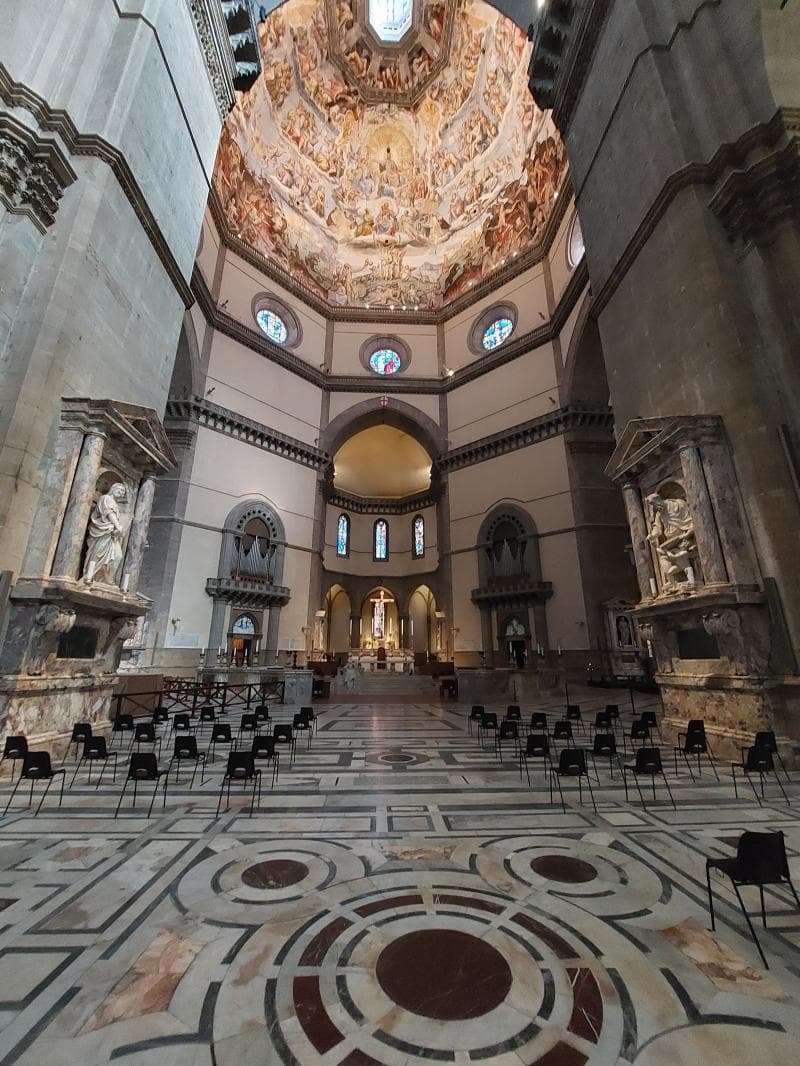
Explore Brunelleschi’s Dome in Florence, Italy – an architectural marvel and the world's largest masonry dome. Discover its history and unique design.
Overview
Dominating the Florentine skyline with its iconic terracotta tiles and imposing silhouette, Brunelleschi’s Dome is a masterpiece of Renaissance engineering and art, situated atop the Florence Cathedral, also known as the Cattedrale di Santa Maria del Fiore. This architectural marvel is not merely a part of the cathedral; it is often considered its crowning glory, a symbol of Florence's ingenuity and the birth of the Renaissance. The dome is an octagonal structure, notable for being the largest masonry vault in the world, a title it has held for centuries. Its immense scale and the revolutionary techniques used in its construction continue to captivate visitors and scholars alike. It forms a central part of the city's historical and cultural identity, recognized globally as a UNESCO World Heritage site.
History & Cultural Background
The story of Brunelleschi’s Dome begins in the late 13th century with the ambitious vision for Florence Cathedral, a project intended to rival the great cathedrals of other Italian city-states. By the early 15th century, the cathedral's massive structure was largely complete, except for its enormous opening for the dome, a challenge that stumped the era's best minds. The traditional methods of constructing large domes, which relied on extensive wooden scaffolding (centering), were deemed impossible due to the sheer size and weight required.
In 1418, a competition was announced to find a solution. Filippo Brunelleschi, a goldsmith and clockmaker with no formal architectural training but with a deep understanding of mechanics and Roman building techniques, presented an audacious, centering-free design. His innovative proposal, initially met with skepticism, ultimately won the commission. Construction began in 1420 and remarkably, without the traditional wooden supports, the dome was completed in 1436. Brunelleschi's methods revolutionized architectural practices, marking a pivotal moment that is often seen as the true beginning of the Renaissance.
What Makes It Special
Brunelleschi’s Dome stands out for several groundbreaking innovations. Firstly, it is a double-shelled dome, consisting of an inner and an outer dome, connected by a network of 24 meridian and 10 parallel ribs. This design provided incredible strength and stability. Secondly, Brunelleschi employed a unique herringbone brick-laying pattern, which allowed the dome to be self-supporting as it was built, spiraling upwards without the need for temporary wooden frameworks. Thirdly, he designed sophisticated lifting machines and innovative scaffolding to hoist massive stones and bricks to unprecedented heights, a feat of mechanical engineering far ahead of its time. These machines were so advanced that even Leonardo da Vinci sketched them in his notebooks.
The sheer scale is also remarkable; with an external diameter of 55 meters and an interior diameter of 45.5 meters, it remains the largest masonry vault ever constructed. The dome's lantern, a white marble tower reaching 21 meters high, was added later and serves to counterbalance the thrust of the dome. The interior of the dome features Giorgio Vasari and Federico Zuccari's monumental fresco of 'The Last Judgment,' painted between 1572 and 1579, which visitors can admire up close during the climb.
Stories, Fun Facts & Local Details
One famous story surrounding Brunelleschi’s commission tells of his refusal to reveal his building plans during the competition, instead challenging rivals to make an egg stand upright on a marble slab. When others failed, he simply cracked the egg's tip to make it stand, demonstrating that the solution would seem easy once revealed. This anecdote captures his genius and his secretive nature. Despite his monumental achievement, Brunelleschi tragically died in 1446 and never saw the lantern completed.
The construction involved over four million bricks and weighs more than 25,000 tons. The rigorous climb to the top, involving 463 steps, winds between the two dome shells, offering an intimate look at the ingenious brickwork and frescoes. This path culminates in breathtaking panoramic views of Florence, its terracotta rooftops, the Arno River, and the surrounding Tuscan hills.
Visitor Perspective
Visiting Brunelleschi’s Dome offers a unique and unforgettable experience, combining an architectural pilgrimage with an active adventure. The climb requires navigating 463 narrow steps and passages; there are no elevators, making it unsuitable for individuals with heart conditions, vertigo, claustrophobia, or mobility issues. Timed reservations are mandatory, and it is highly recommended to book well in advance, especially during peak seasons, through the official Opera del Duomo website.
Visitors should be prepared for a physically demanding ascent and are advised to wear comfortable shoes. Large bags and backpacks must be stored prior to entry. The entrance to the dome climb is typically found on the north side of the Cathedral, at Porta della Mandorla. This journey provides not only spectacular views but also a profound appreciation for the architectural brilliance of Filippo Brunelleschi and the enduring spirit of the Florentine Renaissance.
Coordinates: 11.2549, 43.7726
View on Google Maps💬 How Travelers Describe This Place
Based on community votes
Interesting
951Beautiful
748Must See
499Photogenic
491Unique
427
Traveler Stories
Discover memorable experiences shared by travelers who have visited this place.
No traveler stories yet.
Be the first traveler to share what made this place memorable.

Tour
By
Spot
Discover amazing places around the world. Your journey starts here.
Explore
© 2026 TourBySpot. All rights reserved.