Bronze Statue Area
Split, Croatia
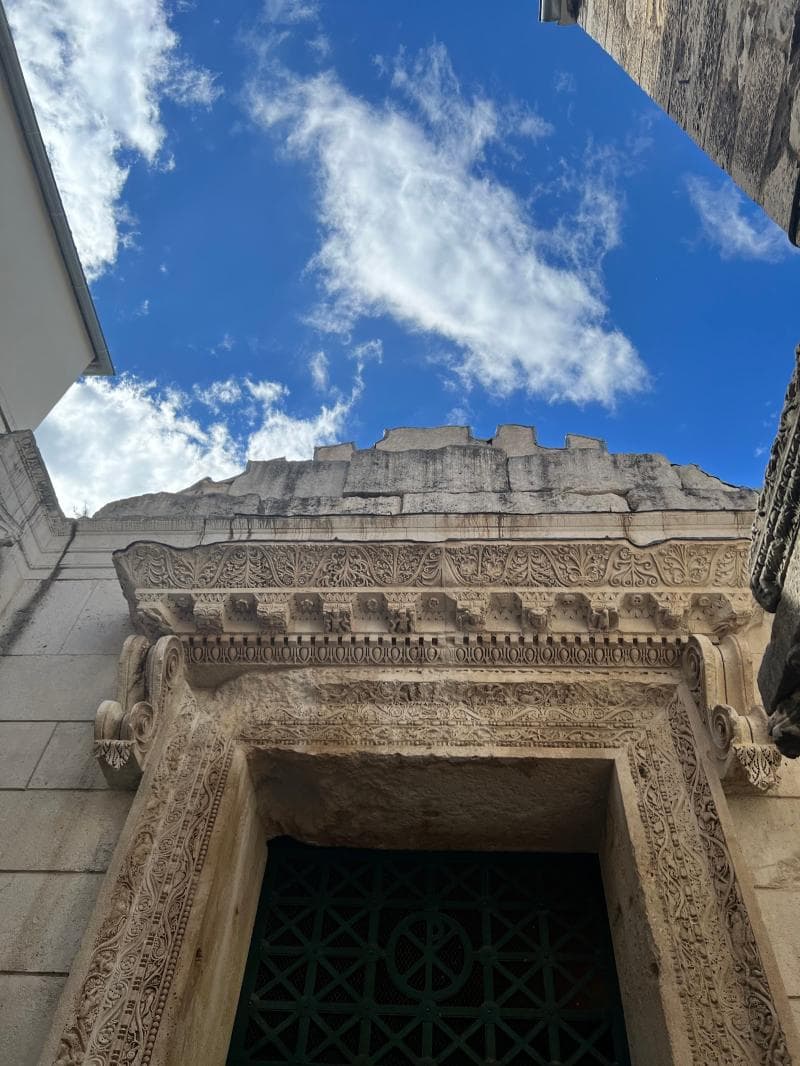
Explore the Bronze Statue Area within Split's Temple of Jupiter, featuring Ivan Meštrović's bronze statue of St. John the Baptist. Discover Roman history and Christian heritage in Croatia.
Overview
Nestled within the ancient heart of Diocletian's Palace in Split, Croatia, lies the remarkable Temple of Jupiter, a testament to millennia of history and transformation. What once served as a sacred space for the Roman god Jupiter now functions as the Baptistery of St. John the Baptist. Within its hallowed interior, a significant highlight for many visitors is the powerful Bronze Statue Area, dominated by a striking sculpture of St. John the Baptist. This bronze masterpiece by the celebrated Croatian sculptor Ivan Meštrović stands as a profound symbol of the site's enduring legacy, bridging its pagan origins with its Christian present.
The temple itself is a marvel of Roman engineering, renowned for its exquisitely preserved barrel-vaulted ceiling and intricate carvings that have inspired architects and artists through the centuries. Flanked at its entrance by an ancient Egyptian sphinx, this small but monumental structure offers a captivating journey through the layers of Split's rich past, inviting travelers to explore a space where Roman imperial power and early Christian devotion converged.
History & Cultural Background
The Temple of Jupiter was constructed between 295 and 305 AD, commissioned by Emperor Diocletian as an integral part of his sprawling retirement palace in Split. Diocletian, who identified Jupiter as his divine father, dedicated this temple to the supreme Roman god, thereby imbuing it with immense religious and political significance within the palace complex. The temple's construction was halted prematurely with Diocletian's unexpected abdication in 305 AD, leaving some elements unfinished.
A pivotal transformation occurred in the 6th century during the early Christian period when the temple was converted into the Baptistery of St. John the Baptist. This conversion reflected the changing religious landscape of the region, marking a profound shift from pagan worship to Christian devotion. The crypt beneath the temple was also dedicated to St. Thomas, adding another layer of spiritual meaning. This adaptability is a defining characteristic of the structure, showcasing how ancient spaces found new purpose and meaning through the ages.
What Makes It Special
The Temple of Jupiter, despite its modest size, is exceptionally rich in features that make it truly unique. Foremost among these is the large bronze statue of St. John the Baptist, created by the internationally acclaimed Croatian sculptor Ivan Meštrović. This 20th-century artwork introduces a modern artistic voice into a deeply ancient setting, making the 'Bronze Statue Area' a compelling point of interest.
Beyond the statue, the temple boasts a remarkably preserved barrel-vaulted, coffered ceiling, a masterpiece of Roman engineering that continues to impress with its aesthetic appeal and structural ingenuity. Its intricate design not only demonstrates the advanced building techniques of the time but also influenced Dalmatian early Renaissance art. At the entrance, visitors are greeted by one of the ancient Egyptian sphinxes, brought to Split by Emperor Diocletian, adding an exotic and enigmatic touch to the Roman grandeur. Furthermore, the doorway is adorned with detailed carvings depicting gods and heroes such as Victoria, Triton, Helios, Hercules, Jupiter, and Apollo, offering a visual narrative of its original pagan dedication.
Stories, Fun Facts & Local Details
Imagine the grand ceremonies once held within these walls, where Diocletian, styling himself as a living god, connected with Jupiter. The contrast between this imperial, pagan past and the temple's later role as a Christian baptistery creates a fascinating narrative of cultural evolution.
One intriguing detail found within the baptistery is the baptismal font, crafted from an 11th-century altar partition. It features one of the oldest known representations of a Croatian king, either Peter Krešimir IV or Demetrius Zvonimir, surrounded by their subjects. This historical engraving provides a rare glimpse into medieval Croatian royalty and art.
The celebrated Scottish architect Robert Adam, known for his Neoclassical designs, regarded the Temple of Jupiter as one of Europe's most beautiful monuments, a testament to its enduring architectural significance. Nearby, you can find the charmingly narrow passage locally known as 'Pusti me proć,' or 'Let me pass,' one of Split's best-known curiosities, offering a playful counterpoint to the monumental history surrounding it.
Visitor Perspective
Stepping into the Temple of Jupiter, now the Baptistery of St. John the Baptist, is like entering a time capsule where Roman imperial might and the nascent Christian faith intertwine. The intimate space allows for close appreciation of the architectural details, from the richly decorated barrel vault above to the ancient baptismal font. Your gaze will inevitably be drawn to Meštrović's bronze statue of St. John the Baptist, whose presence commands attention, inviting contemplation on the passage of faith and art through centuries.
The site's unique atmosphere encourages a moment of quiet reflection, connecting you to the countless individuals who have stood in this very spot over 1,700 years. It's a place that transcends its physical form, offering not just historical facts but also a sense of wonder at human ingenuity and adaptability. This small yet profoundly significant structure is an essential stop for any curious traveler exploring Diocletian's Palace, providing a powerful, memorable experience of Split's layered heritage.
Coordinates: 16.439568, 43.508341
View on Google Maps💬 How Travelers Describe This Place
Based on community votes
Interesting
539Beautiful
424Photogenic
251Unique
234Must See
30
Traveler Stories
Discover memorable experiences shared by travelers who have visited this place.
No traveler stories yet.
Be the first traveler to share what made this place memorable.

Tour
By
Spot
Discover amazing places around the world. Your journey starts here.
Explore
© 2026 TourBySpot. All rights reserved.