Broken Chair Sculpture
Geneva, Switzerland
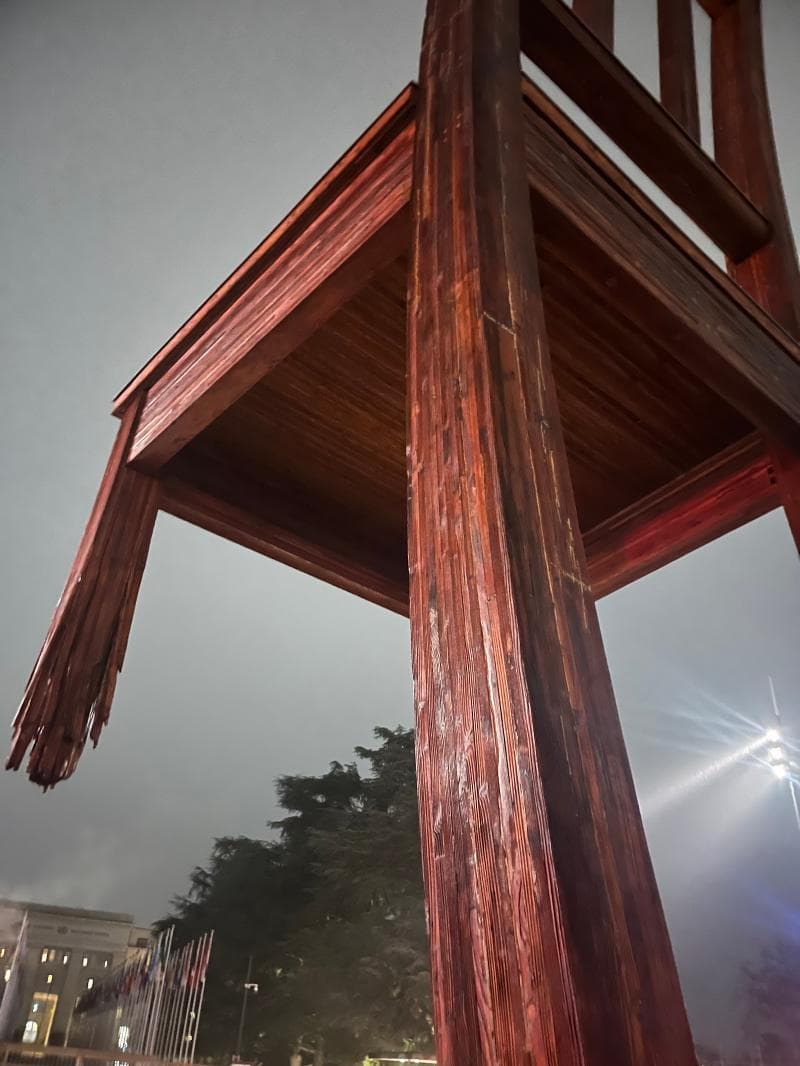
Discover Geneva's powerful Broken Chair Sculpture outside the Palais des Nations, symbolizing opposition to landmines and armed violence. Learn its history.
Overview
In the heart of Geneva, Switzerland, just outside the stately Palais des Nations, stands a profoundly moving and impactful sculpture known as the Broken Chair. This monumental wooden artwork, created by Swiss artist Daniel Berset and constructed by carpenter Louis Genève, rises an impressive 12 meters (39 feet) high and weighs 5.5 tons. It depicts a giant, three-legged chair with a fourth leg dramatically shattered midway, projecting a powerful message of both fragility and resilience. The Broken Chair serves as a poignant symbol and a constant, visual reminder to the world's diplomats and visitors of the devastating human toll of armed conflict, particularly highlighting the victims of landmines and cluster bombs.
History & Cultural Background
The genesis of the Broken Chair dates back to 1997, born from the vision of Paul Vermeulen, co-founder and director of Handicap International (now Humanity & Inclusion). Commissioned by the humanitarian organization, the sculpture was erected on August 18, 1997, on the Place des Nations. Its primary purpose was to urge governments and public opinion to support the Ottawa Treaty, which sought to ban anti-personnel landmines worldwide. Initially, the artwork was intended to be a temporary installation, displayed for just three months until the signing of the treaty in December 1997. However, the profound impact and overwhelming public support for the sculpture ensured its enduring presence. In 2005, the sculpture was temporarily removed for extensive remodeling of the Place des Nations, only to be reinstalled in February 2007. Its reinstallation further expanded its symbolism, advocating for an international treaty to ban cluster munitions, which was subsequently signed in Oslo in December 2008. Over the years, the Broken Chair has evolved into a broader symbol, embodying the desperate yet dignified cry of civilian populations affected by all forms of armed violence, and reminding states of their obligation to protect and assist victims.
What Makes It Special
What truly sets the Broken Chair apart is its ability to communicate a complex humanitarian message with striking simplicity and profound emotional resonance. Its sheer scale—a 12-meter tall chair with a splintered leg—is impossible to ignore, drawing the eye of every passerby. Positioned directly opposite the main entrance of the Palais des Nations, it acts as a constant, silent, and powerful advocate, challenging diplomats and decision-makers to confront the realities of conflict. The sculpture's enduring defiance, standing tall despite its apparent damage, powerfully conveys the resilience and dignity of victims, alongside a universal hope for peace. It is a piece of public art with a clear, active purpose, designed not merely for aesthetic appreciation but to provoke thought, inspire action, and serve as a persistent moral compass in the diplomatic capital of the world.
Stories, Fun Facts & Local Details
- Material and Craftsmanship: The sculpture is meticulously crafted from 5.5 tons of Douglas fir wood, showcasing the skill of carpenter Louis Genève under the artistic vision of Daniel Berset.
- Symbol of Suffering and Resilience: The vividly mangled leg directly represents the horrific injuries and loss of life caused by landmines and cluster bombs, while the three remaining stable legs symbolize the steadfast resilience of survivors and humanity's collective aspiration for peace.
- Enduring Presence: Despite its original temporary status, the Broken Chair's popularity and the continued need for its message ensured its permanent installation, defying initial plans to remove it.
- Ownership and Advocacy: Ownership of the sculpture was transferred from Daniel Berset to Handicap International in 2004, cementing its role as an advocacy tool.
- Recent Events: In December 2024, the sculpture was unfortunately vandalized by activists, resulting in damage to one of its legs. Handicap International swiftly initiated repair work, involving the original creators, underscoring its ongoing importance.
- Dynamic Symbolism: Beyond its initial focus, the Broken Chair has embraced new meanings, including a call for a ceasefire in conflicts, demonstrating its adaptability as a symbol for peace in an ever-changing world.
Visitor Perspective
Visiting the Broken Chair Sculpture offers a unique and thought-provoking experience. Situated in the easily accessible Place des Nations, the sculpture is open to the public 24 hours a day, seven days a week, and requires no admission fee. Its prominent location makes it an ideal spot for photography, especially with the striking backdrop of the Palais des Nations and its impressive fountains. Travelers can reach the Broken Chair conveniently via Geneva's public transport system; Tram 15 and several bus lines (5, 8, 11, 22, 28) all stop at 'Nations', just a minute's walk away. For those driving, an underground parking facility, 'Parking des Nations', is available nearby. Many visitors choose to combine their contemplation of the Broken Chair with a guided tour of the Palais des Nations, the European headquarters of the United Nations, which provides deeper insight into international diplomacy and global issues (advance booking for tours is recommended).
Coordinates: 6.139, 46.2226
View on Google Maps💬 How Travelers Describe This Place
Based on community votes
Must See
276Interesting
152Photogenic
33Beautiful
30Unique
16
Traveler Stories
Discover memorable experiences shared by travelers who have visited this place.
No traveler stories yet.
Be the first traveler to share what made this place memorable.

Tour
By
Spot
Discover amazing places around the world. Your journey starts here.
Explore
© 2026 TourBySpot. All rights reserved.