Black Stone
Mecca, Saudi Arabia
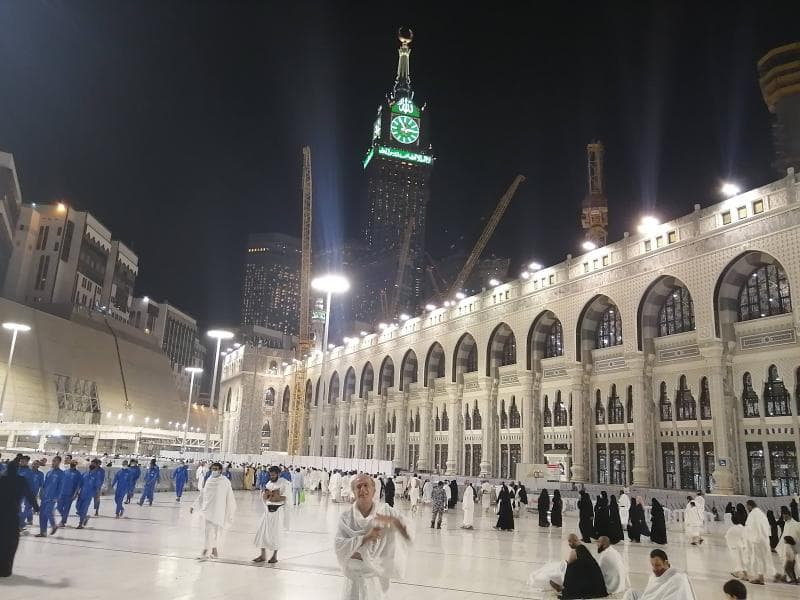
Discover the Black Stone in Mecca, Saudi Arabia, a sacred relic marking the start of Tawaf in Masjid al-Haram's Kaaba.
Overview
The Black Stone, known in Arabic as al-Hajar al-Aswad, is an ancient and profoundly sacred relic nestled within the eastern corner of the Kaaba, the venerable cubic structure at the heart of the Masjid al-Haram in Mecca, Saudi Arabia. It holds immense significance for Muslims worldwide, serving as a pivotal focal point during the Hajj and Umrah pilgrimages. This revered stone marks the precise starting and ending point for each of the seven circumambulations, or Tawaf, that pilgrims perform around the Kaaba.
Far from being an object of worship itself, the Black Stone is honored and respected due to its profound association with Islamic history and the Prophet Muhammad. Its presence imbues the pilgrimage rituals with a spiritual continuity, connecting pilgrims to generations of believers. Today, the Black Stone is not a single, intact piece but rather several fragments, carefully held together within an oval silver frame that is securely fastened to the Kaaba's wall.
History & Cultural Background
The origins of the Black Stone are steeped in rich Islamic tradition and legend, believed by many to trace back to the time of Adam and Eve. One widely held belief suggests it was a gift from God to Adam, intended to grant him forgiveness upon his expulsion from paradise. According to this tradition, the stone was originally pristine white but gradually darkened over centuries, absorbing the sins of countless pilgrims who have kissed and touched it.
Its historical narrative is deeply intertwined with the construction and rebuilding of the Kaaba. Islamic accounts suggest that Prophet Abraham and his son Ishmael originally placed the stone within the Kaaba. A significant event in its history occurred in 605 CE, when the Kaaba was damaged by fire. It was the future Prophet Muhammad who, demonstrating his wisdom and uniting the various tribes, was chosen to place the Black Stone back into its frame. The Black Stone also existed as a venerated object in pre-Islamic faiths, indicating a long-standing historical reverence for this unique stone. Its tumultuous journey through history includes being stolen by the Qarmatian sect in 930 CE and held for approximately two decades before being returned.
What Makes It Special
The exceptional nature of the Black Stone lies in its unparalleled role within the Hajj and Umrah pilgrimages. As the designated beginning and end point of the Tawaf, it is central to one of Islam's most sacred rites. Beyond its ritualistic function, the stone carries immense spiritual weight, embodying a direct connection to a chain of prophets including Adam, Abraham, and Muhammad.
Pilgrims often seek to kiss or touch the Black Stone, an act of reverence believed to emulate the practice of Prophet Muhammad and, for some, thought to contribute to the absolution of sins. However, its significance is spiritual, not magical, and it is understood that the stone itself possesses no inherent power. The enduring mystery surrounding its physical origin also adds to its allure; while scientific analysis is culturally and religiously restricted, it is commonly speculated to be a meteorite.
Stories, Fun Facts & Local Details
- A Symbol of Unity: During a rebuilding of the Kaaba, a dispute arose among tribal leaders over who would have the honor of placing the Black Stone. Prophet Muhammad ingeniously resolved this by having each leader hold a corner of a cloth carrying the stone, thus allowing all to participate in its placement, symbolizing unity.
- The Words of Umar: The second Caliph of Islam, Umar ibn al-Khattab, famously addressed the Black Stone, stating, 'I know that you are a stone, you do not cause harm or benefit; and if it were not that I had seen the Messenger of Allah kiss you, I would never have kissed you.' This highlights that reverence is directed towards the Prophet's practice, not the stone itself.
- Physical Appearance: The Black Stone, approximately 30 cm (12 inches) in diameter, is composed of several fragments. Eight of these pieces are visible, with the largest being roughly the size of a date, all held together by a sturdy silver frame. This silver casing, first crafted by Abdullah bin Zubair, has been meticulously maintained and replaced by various rulers throughout history.
- Positioning: The stone is positioned about 1.5 meters (approximately 5 feet) off the ground, making it accessible to many pilgrims. The paste used to secure the fragments is reportedly a blend of wax, amber, and musk.
Visitor Perspective
For the millions of Muslims who undertake the sacred journeys of Hajj and Umrah each year, visiting the Black Stone within Masjid al-Haram is a profound and deeply emotional experience. The Grand Mosque, with the Kaaba at its core, represents the holiest site in Islam, drawing believers from every corner of the globe to a place of immense spiritual significance.
Due to the immense number of pilgrims, especially during peak seasons, the General Presidency for the Affairs of the Grand Mosque and the Prophet's Mosque implements extensive organizational plans to manage the flow of visitors. While many aspire to touch or kiss the Black Stone, it is emphasized that pilgrims should avoid causing harm to others in their attempt. If reaching the stone is not possible, pointing towards it is an acceptable symbolic gesture. The experience offers a unique connection to Islamic heritage, a moment of profound devotion, and a testament to the enduring faith that has inspired generations. Virtual reality initiatives have even been developed to allow a precise exploration of the Grand Mosque and its sacred elements, including the Black Stone.
Coordinates: 39.82611, 21.4225
View on Google Maps💬 How Travelers Describe This Place
Based on community votes
Photogenic
836Interesting
620Beautiful
594Must See
166Unique
83
Traveler Stories
Discover memorable experiences shared by travelers who have visited this place.
No traveler stories yet.
Be the first traveler to share what made this place memorable.

Tour
By
Spot
Discover amazing places around the world. Your journey starts here.
Explore
© 2026 TourBySpot. All rights reserved.