Birth Room
Frankfurt, Germany
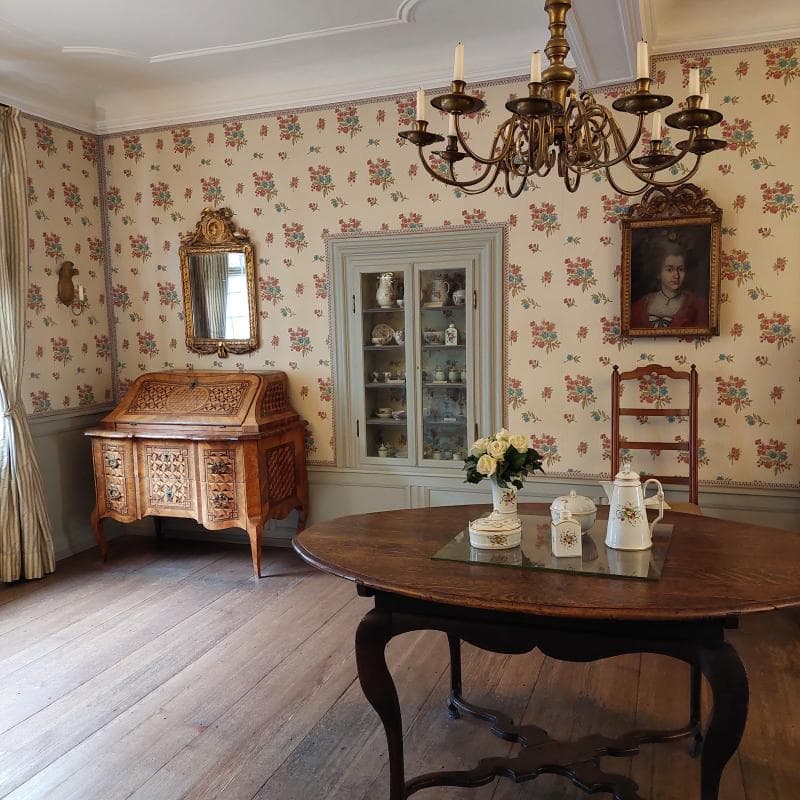
Discover the 'Birth Room' inside Goethe House in Frankfurt, Germany, where Johann Wolfgang von Goethe was born in 1749. Explore his childhood home.
Overview
Deep within the historic Goethe House in Frankfurt, Germany, lies a room that marks the very beginning of an extraordinary life: the 'Birth Room'. This modest, yet profoundly significant, chamber is where Johann Wolfgang von Goethe, one of Germany's most revered poets, playwrights, and thinkers, first drew breath. Situated on the second floor of his family home, the Birth Room stands as a powerful testament to his origins. While the original house was tragically destroyed during Allied bombing in World War II, it was meticulously reconstructed between 1947 and 1951, faithfully recreating the 18th-century environment in which Goethe grew up. Today, the Goethe House operates as a writer's house museum, inviting curious travelers to step back in time and explore the intricately furnished rooms, including this pivotal space that commemorates Goethe's arrival into the world. The address is Großer Hirschgraben 23-25, 60311 Frankfurt am Main, Germany.
History & Cultural Background
The Goethe family's residence, a grand Baroque-style house, was originally formed from two adjoining timber-framed buildings. Goethe's grandmother acquired the property in 1733, and his father later undertook its significant remodeling, shaping it into the elegant home seen today. It was within these walls that Johann Wolfgang von Goethe was born on August 28, 1749, and where he spent his formative years, living there with his family until 1795. The house's journey from a private residence to a public memorial is also significant. In 1863, the Freies Deutsches Hochstift (Free German Foundation) purchased the property, restoring it to its 18th-century state and opening it as the first public memorial dedicated to Goethe. This move cemented its status as a vital cultural institution, preserving the legacy of a literary giant.
What Makes It Special
The 'Birth Room' holds a unique allure as the precise spot where Johann Wolfgang von Goethe, a figure whose influence on German and world literature is immeasurable, began his life. Visiting this room is not merely observing an empty space; it's an opportunity to connect with the very genesis of a genius. It offers profound insight into the environment and circumstances that shaped his early consciousness and inspired his profound works. The faithful reconstruction of the house, drawing upon original records and even Goethe's own autobiographical writings, ensures that visitors experience an authentic representation of his childhood surroundings. The room serves as a powerful memorial, inviting contemplation on the monumental impact of a single birth on human culture and thought.
Stories, Fun Facts & Local Details
Goethe himself provided a vivid account of his birth in his autobiography, 'Dichtung und Wahrheit' (Poetry and Truth). He famously declared, 'On the 28th of August, 1749, at the stroke of twelve noon, that I came into the world in Frankfurt on the Main.' He even delved into astrological details, noting that the 'constellation was auspicious: the Sun was in Virgo and at its culmination for the day. Jupiter and Venus looked amicably upon it, and Mercury was not hostile. Saturn and Mars maintained indifference.' However, he also described a difficult birth, attributing resistance from the Moon, which was 'just then becoming full,' and reported that his grandfather, town mayor Textor, took action by having Frankfurt midwives trained in obstetrics following the event. Interestingly, during a 19th-century refurnishing of the Goethe House, the room traditionally believed to be the birth chamber was specifically designated as a memorial room. While 18th-century bedrooms often featured curtained beds, the current furnishings of the Birth Room do not include one, reflecting the museum's interpretive choices. As a child, his mother affectionately called him 'Hätschelhans,' meaning 'little darling.'
Visitor Perspective
Stepping into the Goethe House, and particularly the Birth Room, offers more than just a historical tour; it's an immersive journey into 18th-century bourgeois life. The meticulously reconstructed interiors, filled with period furniture and artifacts, provide a tangible sense of the Goethe family's world and the era's customs. Beyond the Birth Room, visitors can explore other significant spaces, such as the Music Room, where the family gathered, and Goethe's Writing Room, where he penned early masterpieces like 'The Sorrows of Young Werther'. The Goethe House is seamlessly connected to the adjacent Deutsches Romantik-Museum, offering a broader cultural context to Goethe's era and artistic output. A single ticket grants access to both institutions, enriching the visitor experience. This dual visit allows for a comprehensive understanding of not just Goethe's personal history, but also the artistic and intellectual currents that defined his time, making it a compelling destination for anyone interested in literature, history, and European culture.
Coordinates: 8.67761, 50.111503
View on Google Maps💬 How Travelers Describe This Place
Based on community votes
Interesting
998Beautiful
817Unique
711Photogenic
641Must See
19
Traveler Stories
Discover memorable experiences shared by travelers who have visited this place.
No traveler stories yet.
Be the first traveler to share what made this place memorable.

Tour
By
Spot
Discover amazing places around the world. Your journey starts here.
Explore
© 2026 TourBySpot. All rights reserved.