Binondo Church
Manila, Philippines
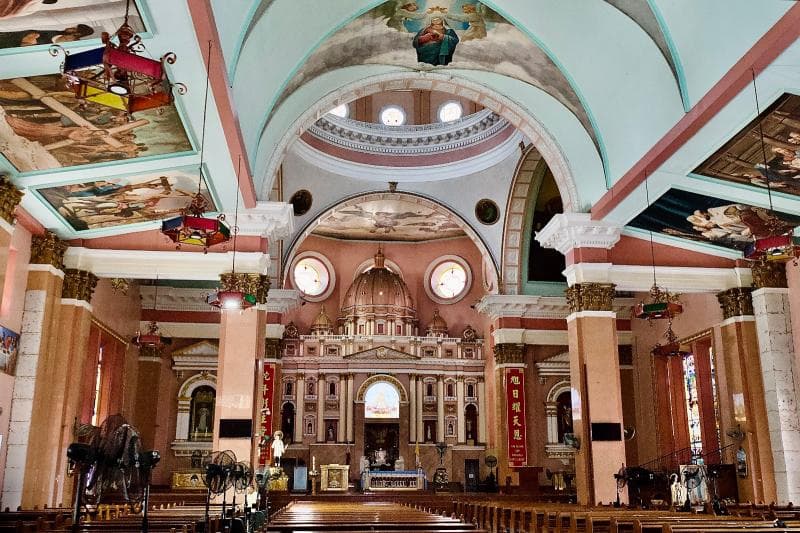
Discover Binondo Church in Manila, Philippines, a historic Minor Basilica and National Shrine, and the spiritual home of the first Filipino saint, San Lorenzo Ruiz.
Overview
Nestled in the bustling heart of Binondo, Manila's historic Chinatown, stands the Minor Basilica and National Shrine of San Lorenzo Ruiz, more commonly known as Binondo Church. This venerable edifice is not merely a place of worship; it is a profound symbol of enduring faith, cultural fusion, and historical resilience in the Philippines. Founded in 1596, the church has served as a spiritual haven for Chinese converts to Christianity and the local community for over four centuries. Its unique architecture, with a distinct octagonal bell tower, beautifully marries Spanish colonial design with subtle Chinese influences, reflecting the vibrant Filipino-Chinese heritage it represents. Today, it remains a lively center of devotion, offering masses in multiple languages, including Filipino, Mandarin, Hokkien, and English, and drawing both pilgrims and curious travelers alike to its sacred grounds.
History & Cultural Background
The story of Binondo Church began in 1596 when Dominican priests established it to minister to the growing community of Chinese immigrants who had converted to Christianity in Manila. This strategic location in Binondo, the world's oldest Chinatown, underscored its mission to bridge cultural and religious divides. The original structure, like many colonial buildings, faced numerous trials. It was first destroyed by British bombardment in 1762 during their occupation of Manila. Rebuilt with granite, the church saw its grand structure completed around 1852, featuring what was once considered one of the country's most beautiful facades. However, it suffered significant damage from an earthquake in 1863 and was devastatingly hit during the American bombing of Manila in 1944, leaving only its western façade and the iconic octagonal belfry standing. After World War II, parishioners worshipped under a roofless church for several years until it was lovingly reconstructed in the 1950s, a testament to the community's unwavering faith and spirit. Major renovations continued between 1946 and 1971, restoring it to its present grandeur.
What Makes It Special
Binondo Church holds immense significance due to its profound connection with San Lorenzo Ruiz, the first Filipino saint. Lorenzo Ruiz, born in Binondo to a Chinese father and a Filipino mother, served as an altar boy and received his religious training within these very walls. His journey led him to missionary work in Japan, where he was martyred in 1637 for refusing to renounce his Christian faith. This deep historical link makes the church a significant pilgrimage site, attracting devotees who seek inspiration from his unwavering devotion. In recognition of its importance, Pope John Paul II elevated Binondo Church to the status of a Minor Basilica in 1992, and in 2024, the Catholic Bishops' Conference of the Philippines further designated it as a National Shrine. Architecturally, the church stands out with its striking octagonal bell tower. This unique design element, reminiscent of traditional Chinese pagodas, is a beautiful visual nod to the Chinese community it was built to serve, blending seamlessly with the dominant Spanish Baroque and Italian High Renaissance architectural styles of the main edifice.
Stories, Fun Facts & Local Details
One of the most compelling stories associated with Binondo Church is that of Saint Lorenzo Ruiz himself, whose humble beginnings as a sacristan here paved his path to sainthood. His martyrdom symbolizes the profound commitment to faith found within the Filipino-Chinese community. In front of the church lies Plaza San Lorenzo Ruiz, where a dignified statue of the saint stands, inviting contemplation and reverence. The church's interior boasts vaulted ceilings adorned with vibrant murals depicting scenes from the life of Christ and the Stations of the Cross, along with grand chandeliers that illuminate the space. The main altar is loosely modeled after the facade of St. Peter's Basilica in Vatican City, adding a touch of international grandeur to this local landmark. The fact that masses are regularly celebrated in Filipino, Mandarin, Hokkien, and English highlights its ongoing role as a multicultural spiritual center, catering to its diverse congregation.
Visitor Perspective
For any curious traveler exploring Manila, a visit to Binondo Church offers a unique blend of historical immersion, cultural appreciation, and spiritual reflection. Standing proudly amidst the bustling streets of Binondo Chinatown, the church provides a serene sanctuary from the vibrant energy outside. Upon entering, visitors are often struck by the peaceful atmosphere and the intricate beauty of its interior, from the detailed altars to the painted ceilings. The surrounding district itself is a treasure trove of experiences, known for its authentic Chinese-Filipino cuisine and bustling markets. Combining a visit to the church with a culinary exploration of Binondo creates a rich and unforgettable journey, connecting visitors with centuries of history, resilience, and the harmonious intertwining of Filipino and Chinese cultures. The church is easily accessible, and there is no entrance fee, making it an open invitation to all who wish to experience its profound legacy.
Coordinates: 120.9747, 14.60021
View on Google Maps💬 How Travelers Describe This Place
Based on community votes
Interesting
879Photogenic
741Beautiful
482Unique
396Must See
274
Traveler Stories
Discover memorable experiences shared by travelers who have visited this place.
No traveler stories yet.
Be the first traveler to share what made this place memorable.

Tour
By
Spot
Discover amazing places around the world. Your journey starts here.
Explore
© 2026 TourBySpot. All rights reserved.