Bell Tower
Tbilisi, Georgia
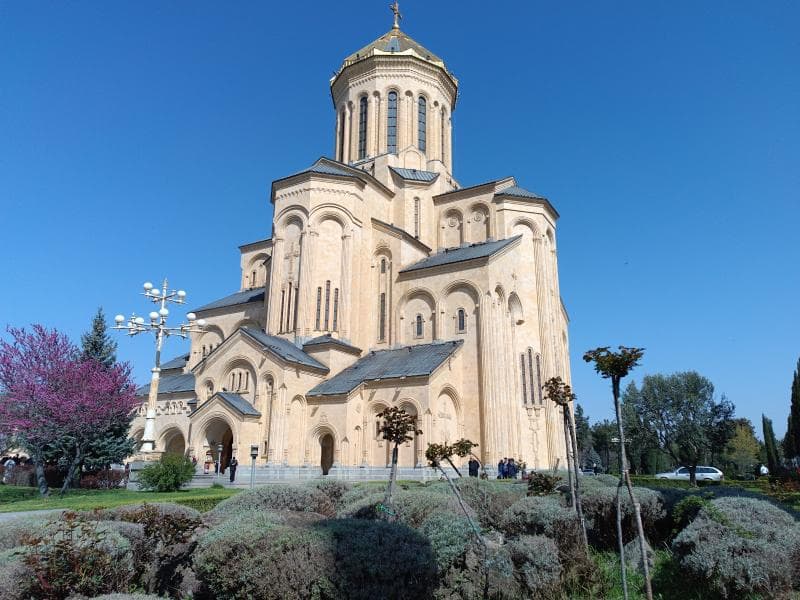
Discover the majestic Bell Tower of Holy Trinity Cathedral (Sameba) in Tbilisi, Georgia, a symbol of national and spiritual revival. Explore its history and unique architecture.
Overview
Perched majestically on Elia Hill in the historic Avlabari district of Tbilisi, Georgia, the Holy Trinity Cathedral complex, affectionately known as Sameba, is a modern marvel of spiritual architecture. While the cathedral itself is a grand sight, its elegant, free-standing Bell Tower stands as a distinct, yet harmoniously integrated, part of this significant religious ensemble. Visible from many vantage points across the city, the Bell Tower contributes to the iconic skyline dominated by Sameba's golden dome, serving as both a functional structure and a symbol of Georgia's enduring Orthodox faith.
The Bell Tower is more than just an architectural element; it is an integral component of the vast Sameba complex, which also encompasses the main cathedral, the residence of the Patriarch, a monastery, a theological seminary and academy, workshops, and beautifully landscaped gardens. It embodies the blend of traditional Georgian ecclesiastical design with a grand contemporary vision, reflecting the nation's spiritual and national revival after the Soviet era.
History & Cultural Background
The entire Holy Trinity Cathedral complex, including its Bell Tower, came into existence during a pivotal period in Georgia's history. The idea to construct a new cathedral emerged in 1989, a time of national awakening as Georgia moved away from Soviet rule. Construction began in 1995 and was completed in 2004, with the consecration taking place on November 23, Saint George's Day.
The project was conceived to commemorate two profound anniversaries: 1,500 years of the autocephaly (self-governance) of the Georgian Orthodox Church and 2,000 years since the birth of Jesus Christ. The construction of Sameba, including its free-standing Bell Tower, became a powerful statement of Georgian resilience, identity, and the rebirth of religious traditions after decades of state-imposed atheism. Architect Archil Mindiashvili's design sought to synthesize traditional Georgian church architecture with Byzantine undertones, creating a structure that is both deeply rooted in history and boldly contemporary.
What Makes It Special
The Bell Tower of Holy Trinity Cathedral is special due to its magnificent scale and its distinct, elegant design that complements the main cathedral without being overshadowed. It stands as an iconic and unique architectural feature within the sprawling Sameba complex. Within its sturdy frame hang nine bells, all meticulously cast in Germany, highlighting a blend of international craftsmanship and local devotion. The largest of these bells is particularly impressive, weighing a hefty 8,000 kilograms, capable of producing a profound sound that resonates across Tbilisi.
Unlike many older Georgian churches where the bell tower might be integrated directly into the main structure, Sameba's Bell Tower stands freely, offering its own visual impact and allowing its architectural nuances to be appreciated independently. Its presence completes the ensemble of the cathedral complex, inviting visitors to experience the full grandeur of this spiritual center.
Stories, Fun Facts & Local Details
While the Holy Trinity Cathedral itself is a relatively new structure, built in the post-Soviet era, the Bell Tower is imbued with the spirit of renewed faith and national pride. A significant detail lies in its bells, which were specially ordered and produced in Germany. The impressive main bell, weighing eight tons, underscores the monumental ambition behind the entire Sameba project. The fact that the Bell Tower, along with the entire complex, was largely funded by anonymous donations from various businessmen and ordinary citizens speaks volumes about the collective desire of the Georgian people for spiritual and national revival.
However, the site's history also holds a more somber note. The cathedral complex was built on the site of a former Armenian cemetery known as Khojivank, much of which was destroyed during the Soviet period. Some reports suggest that graves were disturbed during the construction of Sameba, a detail that has been a point of controversy and a reminder of the complex layers of Tbilisi's past. Despite this, the Bell Tower stands as a beacon, its bells ringing out across a city that cherishes its traditions while looking towards the future.
Visitor Perspective
Approaching the Holy Trinity Cathedral and its Bell Tower offers a striking experience. Visitors typically ascend a long staircase leading to the complex, where the Bell Tower emerges as one of the first grand structures encountered, before the full magnificence of the main cathedral reveals itself. From the grounds surrounding the Bell Tower, there are often panoramic views of Tbilisi, providing a wonderful opportunity for contemplation and photography, especially as the sun sets and the complex becomes beautifully illuminated.
When visiting, it's important to remember that this is an active place of worship. Modest dress is required, with women typically needing to cover their heads with a scarf and wear skirts or dresses that cover the knees, while men are expected to wear long trousers. While photography is generally allowed outdoors and around the Bell Tower, it can be restricted inside the main cathedral, particularly during services. The Bell Tower is an architectural highlight, and listening for the chiming of its German-cast bells can be a memorable part of the spiritual and cultural journey to this iconic Georgian landmark.
Coordinates: 44.8167, 41.6918
View on Google Maps💬 How Travelers Describe This Place
Based on community votes
Photogenic
958Interesting
794Must See
785Unique
571Beautiful
546
Traveler Stories
Discover memorable experiences shared by travelers who have visited this place.
No traveler stories yet.
Be the first traveler to share what made this place memorable.

Tour
By
Spot
Discover amazing places around the world. Your journey starts here.
Explore
© 2026 TourBySpot. All rights reserved.