Bell Tower
Almaty, Kazakhstan
Explore the Bell Tower of Ascension Cathedral in Almaty, Kazakhstan – an architectural wonder, one of the world's tallest wooden structures, known for its earthquake resistance and rich history.
Overview
Soaring majestically into the Almaty skyline, the Bell Tower of the Ascension Cathedral, often called Zenkov Cathedral, stands as a testament to architectural ingenuity and enduring faith. Located within the serene Panfilov Park in Almaty, Kazakhstan, this vibrant wooden structure is far more than just a bell tower; it is an integral part of one of the world's tallest wooden buildings. Its distinctive golden domes and colorful exterior draw the eye, making it an unmistakable landmark that captivates both locals and travelers alike. At an impressive height of 56 meters, the bell tower is part of a cathedral celebrated for its unique construction, primarily from Tian Shan spruce, and its miraculous resilience in the face of devastating seismic activity.
History & Cultural Background
The journey of the Ascension Cathedral and its iconic bell tower began in the late 19th century, with construction taking place between 1904 and 1907. The chief engineer behind this extraordinary edifice was Andrei Pavlovich Zenkov, whose innovative design principles allowed the cathedral to defy the common belief that large wooden structures could not withstand the region's frequent earthquakes. Zenkov's work was particularly significant given that the city of Verny (Almaty's former name) had been ravaged by a massive earthquake in 1887, which had prompted a shift towards wood construction due to its flexibility.
Culturally, the cathedral, including its bell tower, has witnessed significant transformations. Following the Russian Revolution, during the Soviet era, it ceased to be a place of worship for several decades. From 1930 to 1940, the bell tower found an unexpected new purpose: it housed Almaty's first radio transmission center, broadcasting signals across the region. The cathedral itself was repurposed as the Central State Museum of the Kazakh Soviet Socialist Republic, and even served as a concert hall and exhibition center. It was only in 1995 that the building was finally returned to the Russian Orthodox Church, allowing it to reclaim its spiritual role in the community.
What Makes It Special
The Bell Tower of the Ascension Cathedral is renowned for several remarkable features, chief among them being its incredible resistance to earthquakes. The entire cathedral structure, including its bell tower, famously withstood the devastating 7.7-magnitude Kemin earthquake in 1911 with minimal damage. This 'engineering marvel' is attributed to engineer Zenkov's ingenious use of a flexible wooden framework and a special foundation designed to act like a shock absorber, allowing the building to sway with seismic movements rather than crumble.
Another distinguishing characteristic often highlighted is the popular belief that the cathedral was built entirely 'without a single nail'. While the main structural frame utilized advanced carpentry techniques with wooden fasteners, later renovations and some internal components did incorporate metal. Regardless, the predominant use of precisely fitted Tian Shan spruce timber underscores a mastery of traditional wooden construction methods. As one of the tallest wooden structures in the world, its very existence is a testament to the blend of traditional craftsmanship and forward-thinking engineering.
Stories, Fun Facts & Local Details
One of the most compelling stories associated with the Bell Tower centers on its survival of the 1911 earthquake. Locals often recount how nearly every other brick and adobe building in the city of Verny was reduced to rubble, yet the brightly colored wooden cathedral, with its soaring bell tower, remained standing. This resilience earned it a legendary status, with some attributing its survival to divine intervention. Zenkov himself famously described how the bell tower, with its grand height, 'swayed and bent like the top of a tall tree' during the tremors, demonstrating its inherent flexibility.
Beyond its structural feats, the Bell Tower played a unique role in the early 20th century. During the Soviet period, when the cathedral was secularized, the tower was ingeniously adapted to house Almaty's first radio station. Imagine the contrast: a tower originally designed for the solemn pealing of church bells, instead transmitting news and programs across the Kazakh steppe. This transformation highlights the building's adaptability and its continued significance to the city, even during periods of dramatic political and social change.
Visitor Perspective
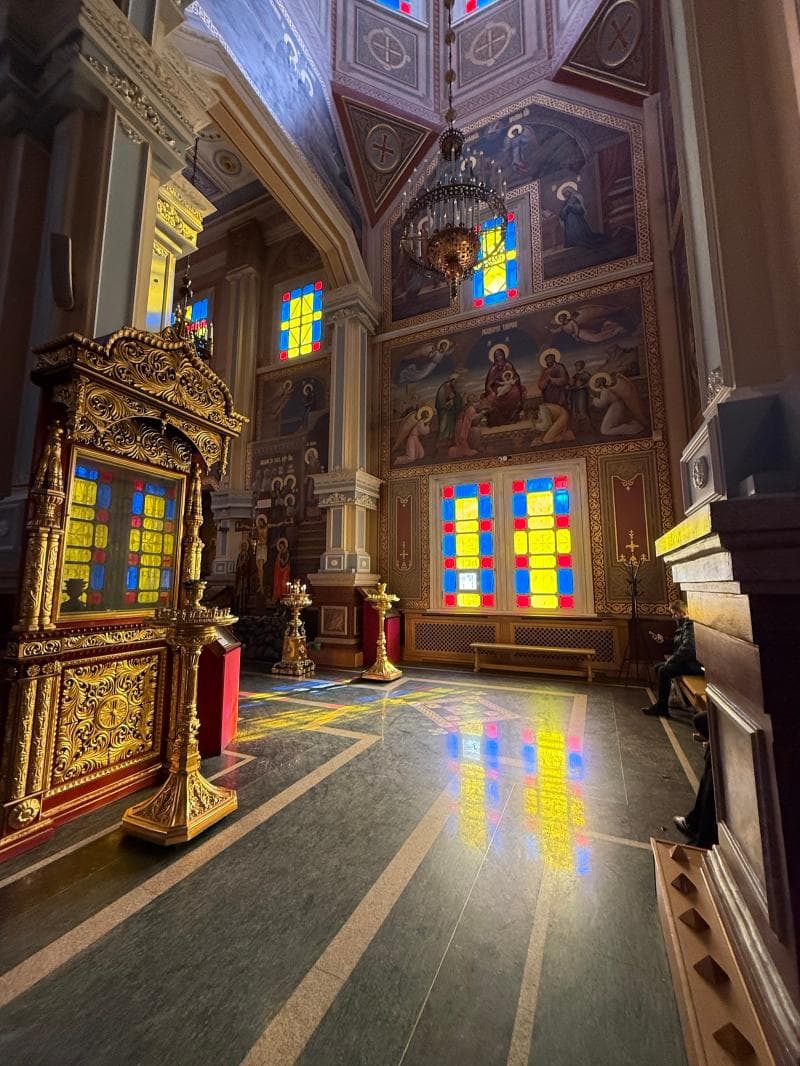
For visitors approaching the Ascension Cathedral, the Bell Tower is often the first element to capture their attention. Its vibrant palette of pastel yellows, blues, and reds, topped with shimmering golden onion domes, creates a visually stunning spectacle against the green backdrop of Panfilov Park and the distant Tian Shan mountains. Walking through the park towards the cathedral, one can appreciate the scale and delicate artistry of the structure. Up close, the intricate wooden details, from the ornate carvings to the detailed painting, reveal the meticulous craftsmanship involved in its creation. Stepping inside, the serene atmosphere, with its beautiful frescoes and iconostasis, offers a glimpse into the spiritual heart of Almaty's Orthodox community. The Bell Tower not only serves as a beacon of architectural heritage but also provides a focal point for understanding Almaty's rich cultural tapestry, from its resilient past to its present-day vibrant identity. Recent large-scale reconstruction work from July 2017 to October 2020 has ensured its continued preservation, allowing future generations to marvel at this wooden wonder.
Coordinates: 76.9532, 43.2588
View on Google Maps💬 How Travelers Describe This Place
Based on community votes
Unique
980Must See
712Beautiful
288Photogenic
247Interesting
130
Traveler Stories
Discover memorable experiences shared by travelers who have visited this place.
No traveler stories yet.
Be the first traveler to share what made this place memorable.

Tour
By
Spot
Discover amazing places around the world. Your journey starts here.
Explore
© 2026 TourBySpot. All rights reserved.