Bath Complex Exterior
Sofia, Bulgaria
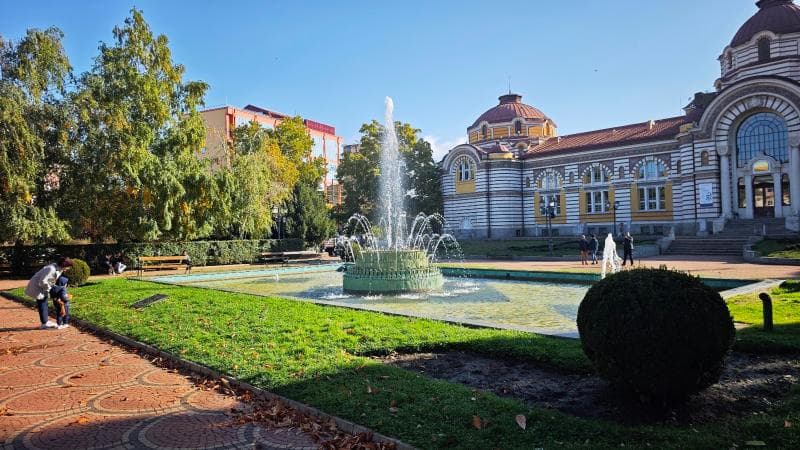
Explore the stunning exterior of Sofia Central Mineral Baths in Sofia, Bulgaria. Discover its unique National Romanticism and Secession architecture, vibrant majolica facade, and rich history as a public bathhouse. Now home to the Regional History Museum, it's a testament to the city's ancient mineral springs.
Overview
The Bath Complex Exterior of the Sofia Central Mineral Baths stands as a magnificent architectural jewel in the heart of Sofia, Bulgaria. More than just a building, it is a grand statement of a city's rich history and enduring connection to its mineral springs. Today housing the Regional History Museum – Sofia, its facade tells stories of past eras, drawing the eye with its vibrant colors and intricate details. While the interior now chronicles Sofia's past, the exterior remains a public spectacle, inviting contemplation of its former life as a bustling public bathhouse. Situated prominently on Banski Square, it forms a picturesque ensemble with the surrounding historical landmarks, marking a place where Roman, Ottoman, and modern Bulgarian legacies converge.
Its striking presence is hard to miss, characterized by a unique blend of architectural styles that reflect Bulgaria's journey through the centuries. The building's exterior is not merely a wall, but a canvas adorned with symbolic artistry and meticulous craftsmanship, hinting at the therapeutic waters that once flowed within and still can be accessed from outside taps.
History & Cultural Background
The story of the Sofia Central Mineral Baths begins long before its current structure was erected. Sofia, known as Serdica in Roman times, was celebrated for its healing mineral waters, with the Romans establishing thermal baths as early as the 1st century AD. Public baths continued to be a fixture through the Middle Ages and Ottoman rule, with several structures existing on or near the current site.
The present-day edifice was constructed between 1906 and 1913, replacing older, less grand facilities. The design was a collaborative effort by distinguished architects Petko Momchilov and Friedrich Grünanger. They conceived a building that brilliantly merged the Vienna Secession style (a form of Art Nouveau) with elements of traditional Bulgarian, Byzantine, and Eastern Orthodox architectural motifs, creating what became known as the National Romanticism style.
The bathhouse served as a central public facility until 1986, when it closed due to its deteriorating condition. After years of abandonment and extensive renovation, it was repurposed to house the Sofia Regional History Museum, officially opening in 2015. This transformation ensures the preservation of this cultural monument, even as its original function as a public bath recedes into history.
What Makes It Special
The Bath Complex Exterior is celebrated for its exquisite and harmonious architectural fusion. Its most distinctive features include the vibrant majolica decorations, primarily by artist Haralampi Tachev, and executed by Stefan Dimitrov. These ceramic tiles adorn the facade with intricate plant and geometric patterns, alongside symbolic images such as Apollo Medicus, the god of health, and Tyche, the goddess of fortune and patroness of cities. This rich ornamentation gives the building its characteristic yellow-and-green hue and fairy-tale silhouette, complete with onion domes.
The multi-winged composition and complex roofing system contribute to its powerful visual impact. It stands as a prime example of early 20th-century Bulgarian architecture, intentionally reflecting a national identity while embracing contemporary European trends. The choice of materials and the meticulous attention to detail in its exterior design make it a standout structure in Sofia's cityscape.
Stories, Fun Facts & Local Details
For centuries, the area around the Central Mineral Baths has been a focal point for social life and healing. Ancient Thracians established a sanctuary here, recognizing the therapeutic properties of the springs. The Romans later built impressive thermal baths, a testament to the enduring appeal of these waters.
In its heyday as a public bathhouse, the Central Mineral Baths was a vibrant social hub where citizens would gather not only for healing and hygiene but also to socialize, share gossip, and relax. It featured separate wings for men and women, each offering various pools and spa procedures.
Even today, although the main building is a museum, the surrounding area remains connected to its thermal heritage. Locals can still be seen queuing at several outdoor spigots around the complex to fill bottles with the warm, mineral-rich water, a cherished tradition passed down through generations. This practice underscores the deep cultural significance of the mineral springs to the people of Sofia.
Visitor Perspective
For a curious traveler, observing the exterior of the Sofia Central Mineral Baths is a journey through time. The best vantage point to appreciate its grandeur and photograph its distinct architecture, including the impressive domes and colorful facade, is from the small square opposite the entrance. Taking time to absorb the intricate majolica work and the blend of styles reveals the layered history of the building and the city itself.
While the internal experience is now that of a museum, the exterior offers a profound connection to Sofia's past. Visitors can still engage with the living history by sampling the mineral water from the public taps, feeling a tangible link to the ancient traditions of wellness and community that have thrived here for millennia. It is a place that encourages lingering, reflection, and appreciation for a landmark that continues to shape Sofia's identity.
Coordinates: 23.323756, 42.6998
View on Google Maps💬 How Travelers Describe This Place
Based on community votes
Unique
556Photogenic
470Must See
269Interesting
254Beautiful
145
Traveler Stories
Discover memorable experiences shared by travelers who have visited this place.
No traveler stories yet.
Be the first traveler to share what made this place memorable.

Tour
By
Spot
Discover amazing places around the world. Your journey starts here.
Explore
© 2026 TourBySpot. All rights reserved.