Basilica Interior
Sofia, Bulgaria
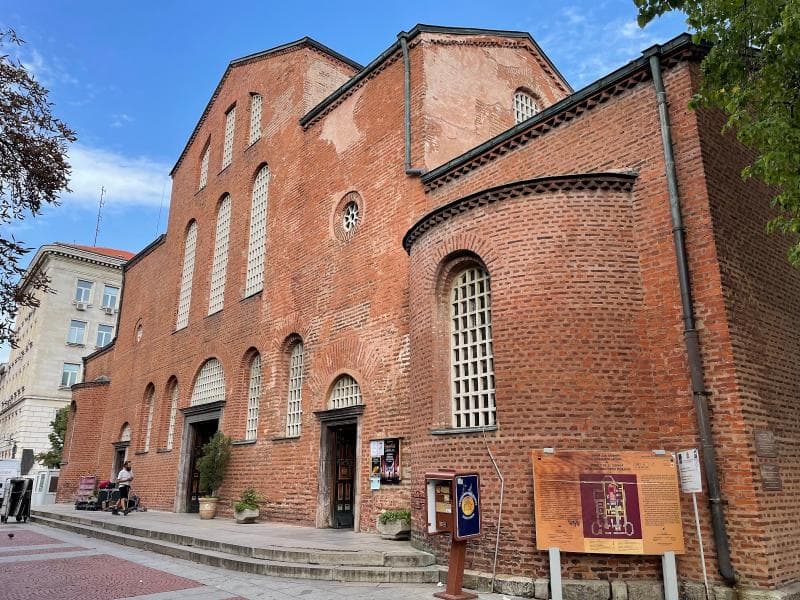
Explore the ancient Basilica Interior of Saint Sofia Church in Sofia, Bulgaria. Discover early Christian mosaics, Roman tombs, and deep history.
Overview
The Basilica Interior of Saint Sofia Church in Sofia, Bulgaria, offers a profound journey through time, revealing layers of history within its ancient walls. This remarkable red-brick basilica is not only one of the oldest churches in the Bulgarian capital but also holds the distinguished honor of lending its name to the city itself. Unlike the grand, ornate interiors of many later Orthodox cathedrals, the Saint Sofia Church presents a more austere yet deeply spiritual ambiance, characteristic of early Byzantine architecture. Its interior is largely unadorned, allowing the historical fabric of the building, including its unique brickwork and preserved archaeological finds, to speak volumes.
While the main church is freely accessible, the true marvel lies beneath: an extensive underground necropolis that serves as a museum. This subterranean world unveils a fascinating archaeological complex, showcasing the remnants of earlier churches, Roman tombs, and intricate mosaics. It stands as a powerful testament to the continuous human presence and spiritual devotion that has shaped this site over millennia, making it an essential destination for any traveler seeking to connect with Sofia's ancient past.
History & Cultural Background
The Saint Sofia Church stands on ground rich with history, having been built over the necropolis of the ancient Roman city of Serdica, Sofia's predecessor. Archaeological excavations have revealed that the current basilica is believed to be the fifth structure constructed on this very site, with the earliest Christian churches dating back to the 4th century. Emperor Justinian I, during the mid-6th century (527-565 CE), commissioned the construction of the present basilica, dedicating it to 'Holy Wisdom' (Hagia Sophia), similar to its more famous contemporary in Constantinople.
Throughout its long existence, the church has witnessed significant transformations. During the 14th century, its profound importance led to the city of Serdica adopting its name, becoming Sofia. In the 16th century, under Ottoman rule, the church was converted into a mosque, its original 12th-century frescoes tragically destroyed, and minarets were added to its structure. However, a series of earthquakes in the 19th century severely damaged one of the minarets, leading to the mosque's abandonment. Following Bulgaria's liberation in 1878, the building was eventually re-established as a church, undergoing significant restoration efforts since the early 20th century to return it as close as possible to its authentic late antiquity and early medieval appearance.
What Makes It Special
The interior of the Saint Sofia Church distinguishes itself through its stark beauty and profound historical depth. Unlike many Orthodox churches that are richly adorned with frescoes, the main basilica features largely unadorned, red-brick walls, which highlight its ancient Byzantine architectural style. This simplicity encourages visitors to appreciate the structural integrity and the enduring spirit of the early Christian era it represents.
A major highlight within the basilica is the preserved floor mosaics with early Christian symbols, offering a tangible link to the past. These intricate patterns, often depicting flora and fauna, reveal the artistic and spiritual traditions of those who worshipped here centuries ago.
However, what truly sets the Saint Sofia Church apart is its extensive underground necropolis, accessible as a museum. Descending into this space is like stepping into a time capsule. Here, you can explore the preserved remains of several earlier churches, Roman-era tombs, stone sarcophagi, and the distinctive masonry tombs typical of late antiquity. The archaeological work has meticulously uncovered multiple layers of history, allowing visitors to see the evolution of the site through transparent flooring and informative displays. This subterranean labyrinth offers a unique and deeply immersive experience, connecting visitors directly with millennia-old ruins and the burial practices of ancient Serdica.
Stories, Fun Facts & Local Details
The Saint Sofia Church is interwoven with fascinating stories and local legends that enrich its historical narrative. One of the most compelling facts is that the city of Sofia itself was named after this very church in the 14th century, a testament to its long-standing significance in the region.
During its conversion into a mosque, a local legend recounts the tragic story of a goldsmith named Georgi, who was reportedly burned alive in front of the church for refusing to convert to Islam. Another poignant tale emerged after the 19th-century earthquakes that led to the mosque's abandonment; it is said that the imam's two sons died during the second earthquake within the building, which was considered a bad omen by the Muslim community at the time.
Within the underground necropolis, one particularly moving discovery is the painted tomb of Honorius, adorned with frescoes depicting biblical themes and symbols of salvation, offering rare insights into early Christian funerary practices. Archaeologists have also unearthed silver reliquaries, which once held sacred remains, underscoring the site's importance as an early Christian religious center. For a period after its abandonment as a mosque, the church even served as a storage room and a watchtower for the local fire brigade, showcasing its varied utilitarian roles throughout history before its restoration.
Visitor Perspective
Visiting the Basilica Interior of Saint Sofia Church offers a wonderfully contemplative experience, distinct from the more opulent nearby Alexander Nevsky Cathedral. Upon entering the main church, the simple yet imposing brick architecture immediately conveys a sense of antiquity and resilience. The modest interior, with its subtle mosaics underfoot and the occasional faded fresco fragment, invites quiet reflection.
The true highlight for many curious travelers is the descent into the underground museum. This experience is often described as both atmospheric and deeply engaging. As you navigate the ancient pathways, you'll encounter tombs, sarcophagi, and the visible foundations of earlier structures, providing a tangible connection to the city's Roman and early Christian past. Holographic plates and informative displays help to reconstruct the history, bringing the excavated objects to life. It is highly recommended to allocate sufficient time for the underground section, as it truly unveils the profound historical layers beneath Sofia. Entry to the main church is typically free, while a modest fee is charged for access to the compelling underground crypt.
Coordinates: 23.331425, 42.6965083
View on Google Maps💬 How Travelers Describe This Place
Based on community votes
Must See
934Beautiful
276Photogenic
152Unique
30Interesting
16
Traveler Stories
Discover memorable experiences shared by travelers who have visited this place.
No traveler stories yet.
Be the first traveler to share what made this place memorable.

Tour
By
Spot
Discover amazing places around the world. Your journey starts here.
Explore
© 2026 TourBySpot. All rights reserved.