Baptistery Area
Split, Croatia
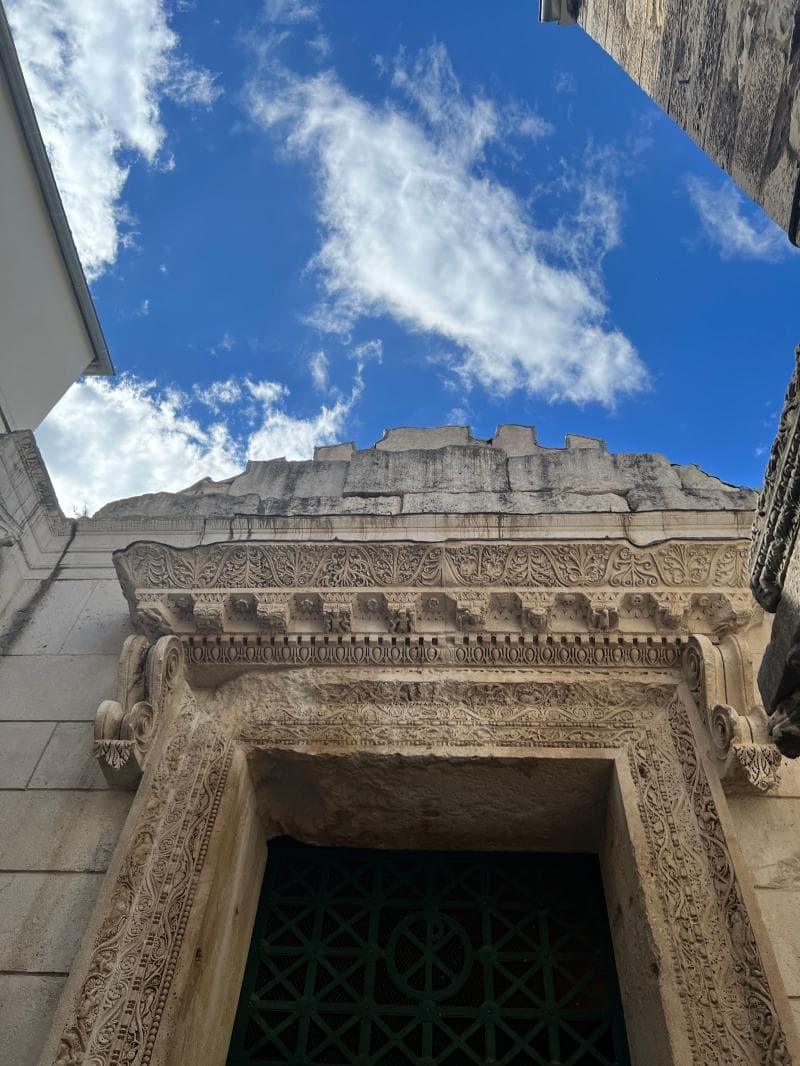
Explore the historic Baptistery Area in Split, Croatia, once the Roman Temple of Jupiter within Diocletian's Palace. Discover its ancient architecture and rich history.
Overview
Nestled within the ancient walls of Diocletian's Palace in Split, Croatia, lies the remarkable Baptistery Area, a site with a layered history that captivates every visitor. What stands today as the Baptistery of St. John the Baptist was once the Temple of Jupiter, a grand Roman edifice dedicated to the king of the gods. This transformation from a pagan temple to a Christian place of worship is a powerful testament to the spiritual and cultural evolution of Split, offering a unique glimpse into nearly two millennia of history and architectural adaptation.
The Baptistery Area is a central highlight of the UNESCO World Heritage Site that is Diocletian's Palace. It is renowned for its exceptional preservation, showcasing elements from both its Roman origins and its Christian repurposing. Visitors step into a space where Roman imperial grandeur harmoniously coexists with early Christian devotion, making it a compelling destination for those eager to explore the ancient past.
History & Cultural Background
The Temple of Jupiter was constructed between 295 and 305 AD as an integral part of Emperor Diocletian's sprawling palace complex. Dedicated to Jupiter, the supreme god of ancient Roman religion and a deity closely linked to Diocletian's imperial identity, the temple held significant religious and political importance. Diocletian, who considered himself a living son of Jupiter ('Jovius'), positioned the temple strategically in the western, religious part of the palace, near the Peristyle and opposite his mausoleum (now the Cathedral of St. Domnius).
With the gradual decline of paganism and the rise of Christianity, the temple underwent a profound transformation in the 6th century. It was converted into a Christian baptistery, dedicated to St. John the Baptist. This repurposing involved significant changes, including the addition of a baptismal font and Christian symbolism, while largely preserving the original Roman architectural structure. A crypt dedicated to St. Thomas was also built beneath it during this period.
The early medieval baptismal font inside is particularly noteworthy. Crafted in the 13th century from parts of an 11th-century altar screen, it features intricate stonework. One of the most historically significant elements on this font is a relief depicting a Croatian king, either Petar Krešimir IV or Demetrius Zvonimir, making it one of the earliest representations of a European monarch on a medieval stone sculpture.
What Makes It Special
The Baptistery Area stands out for its remarkably preserved Roman architecture. The barrel-vaulted coffered ceiling, adorned with Roman reliefs depicting faces and flowers, is a highlight, showcasing the skilled craftsmanship of ancient builders.
At the entrance, a headless black granite Egyptian sphinx, brought by Emperor Diocletian from Egypt, guards the historic space, hinting at the emperor's fascination with Egyptian culture. Inside, dominating the interior, is a powerful bronze sculpture of St. John the Baptist, created by the renowned Croatian sculptor Ivan Meštrović in the 20th century. This juxtaposition of Roman, Egyptian, and modern Croatian artistry within a single space is truly unique.
The transformation from temple to baptistery itself is a rare example of cultural continuity and adaptation, where an ancient structure was given new life and purpose, bridging two vastly different religious eras.
Stories, Fun Facts & Local Details
Diocletian's decision to dedicate a temple to Jupiter reflected his belief in his own divine lineage. He was known as 'Jovius,' meaning 'son of Jupiter,' and the temple served to reinforce his imperial authority and connection to the gods.
The Temple's robust and elegant design, particularly its barrel-vaulted ceiling and embossed portal images, notably influenced Dalmatian early Renaissance architecture, as seen in works by Andrija Alessi and Nikola Firentinac in Trogir. This demonstrates how ancient Roman structures continued to inspire generations of artists and architects long after their initial construction.
The medieval baptismal font with the carved image of a Croatian king offers a tangible link to Croatia's own early statehood, making the site not just a Roman and Christian monument, but also a significant national heritage piece. This detail adds a layer of local storytelling, connecting the grand imperial past to the formation of the Croatian identity.
Visitor Perspective
Visiting the Baptistery Area is an immersive journey through time. As you approach, you'll first encounter the ancient Egyptian sphinx, standing as a silent sentinel to centuries of history. Stepping inside, the preserved Roman architectural elements, like the impressive barrel-vaulted ceiling, immediately transport you to Diocletian's era. The tranquil atmosphere, despite the historical weight, invites contemplation.
The blend of pagan and Christian elements, from the Roman reliefs to the medieval baptismal font and Meštrović's sculpture, creates a compelling narrative of change and continuity. Most visitors find that 10 to 20 minutes are sufficient to explore the interior, marvel at its features, and absorb the unique ambiance. It is highly recommended to visit the Baptistery as part of a larger exploration of Diocletian's Palace, ideally alongside the Peristyle and the Cathedral of St. Domnius, to fully appreciate its context within this living ancient complex.
Coordinates: 16.439568, 43.508341
View on Google Maps💬 How Travelers Describe This Place
Based on community votes
Unique
551Beautiful
547Must See
336Interesting
298Photogenic
212
Traveler Stories
Discover memorable experiences shared by travelers who have visited this place.
No traveler stories yet.
Be the first traveler to share what made this place memorable.

Tour
By
Spot
Discover amazing places around the world. Your journey starts here.
Explore
© 2026 TourBySpot. All rights reserved.