Austrian National Library
Vienna, Austria
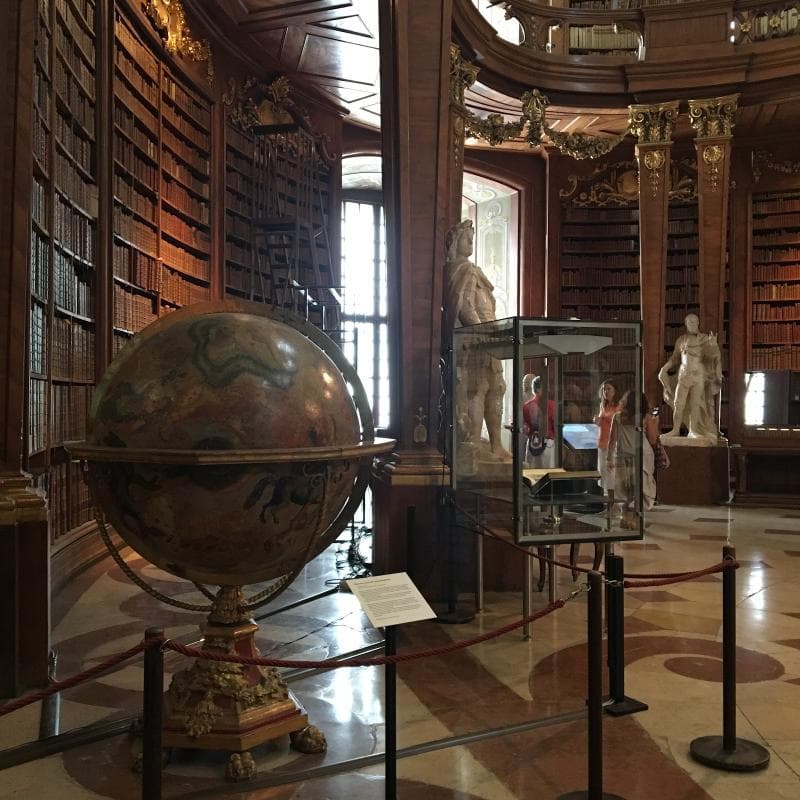
Explore the Austrian National Library, nestled within Vienna's Hofburg Palace. Discover its breathtaking Baroque State Hall and vast historic collections in Austria.
Overview
Nestled within the grandeur of Vienna's Hofburg Palace, the Austrian National Library, or Österreichische Nationalbibliothek, stands as a monumental testament to knowledge and imperial legacy. It is the largest library in Austria, a central memory institution holding over 12 million items across its various collections. While its overall breadth is vast, the most captivating element for many visitors is its magnificent State Hall, known as the Prunksaal. This Baroque masterpiece is not merely a repository of books, but a breathtaking architectural marvel, often regarded as one of the most beautiful library rooms in the world, evoking a sense of awe and reverence for centuries of scholarship and culture.
The library's physical footprint within the Hofburg Palace complex places it at the very heart of Austrian history and governance. Far more than just a place for research, it serves as a public museum, inviting travelers to step into a bygone era where books were symbols of power and enlightenment. Its opulent interior, filled with historic volumes, intricate frescoes, and classical sculptures, offers a unique window into the cultural ambition of the Habsburg dynasty and the enduring value placed on intellectual pursuits.
History & Cultural Background
The story of the Austrian National Library is deeply intertwined with the history of the Habsburg Empire. Its origins trace back to the 14th century, specifically to the book collections owned by the Habsburgs. Duke Albert III, in 1368, is credited with bringing various imperial books into a nascent library, and a gospel book from this year is considered the library's foundation text. Over centuries, these collections grew within various imperial residences. Initially known as the Imperial Court Library (Kaiserliche Hofbibliothek), it served as one of the most extensive universal libraries in the world until the end of the First World War.
The current architectural jewel, the Baroque State Hall, was commissioned in 1722 by Emperor Charles VI. Designed by Johann Bernhard Fischer von Erlach and completed by his son Joseph Emanuel after his father's death in 1723, this grand hall was specifically built to house the Imperial Library. This marked a significant transformation, moving the library from scattered collections to a dedicated, purpose-built structure symbolizing imperial power and enlightenment. Following the dissolution of the Habsburg Monarchy and the establishment of the Austrian Republic in 1920, the institution was formally renamed the Austrian National Library.
What Makes It Special
The State Hall (Prunksaal) is undeniably the crown jewel of the Austrian National Library and what truly makes it special. It is renowned as the largest Baroque library in Europe, stretching almost 80 meters in length, over 14 meters wide, and crowned by a majestic dome nearly 20 meters high. The architectural splendor is immediately striking: towering walnut bookshelves, gilded capitals, marble columns, and intricate Baroque decoration.
High above, the central dome is adorned with a vibrant fresco by court painter Daniel Gran, depicting the symbolic deification of Emperor Charles VI. The hall also houses four enormous 17th-century globes by Vincenzo Coronelli, illustrating both terrestrial and celestial maps. Among its most prized possessions is the 15,000-volume collection of Prince Eugene of Savoy, bound in distinctive red, blue, and yellow Morocco leather, and considered a trove of rare and valuable texts. Beyond the State Hall, the library boasts impressive special collections, including one of the world's most significant papyrus collections with about 180,000 objects, dating from the 15th century BCE to the 16th century CE, and a unique Globe Museum.
Stories, Fun Facts & Local Details
The library's oldest recorded item is the 1368 golden Holy Gospels, commissioned by Duke Albert III. This beautifully illuminated manuscript, written in gold letters, showcases early Habsburg artistic patronage and marks the symbolic beginning of the library's vast holdings. A fascinating detail within the State Hall is its conceptual division into 'war' and 'peace' sides, subtly reflected in Daniel Gran's frescoes and Lorenzo Mattielli's sculptures, corresponding to the original arrangement of the books.
The sheer volume of books within the State Hall is impressive, with approximately 200,000 volumes from 1501 to 1850 lining its shelves. However, these precious texts are too fragile to be read by the public; they are primarily for display, underscoring the hall's role as a showcase of imperial heritage rather than an active lending library. The library continuously maintains its grandeur; the State Hall underwent significant restoration in 2022, which included meticulously cleaning the timber surfaces with lasers and replacing thousands of missing wooden pieces, ensuring its splendor for future generations.
Visitor Perspective
Stepping into the State Hall of the Austrian National Library is often described as an awe-inspiring experience, like entering a 'Baroque temple of the book' or a scene from a fairy tale. The scale and detail can be overwhelming, with soaring frescoes and ornate decorations creating an almost sacral atmosphere. Many visitors report an audible gasp upon entering, captivated by the sheer beauty.
While the State Hall is the main draw, the Austrian National Library complex itself is much larger. It houses several specialized museums, including the Globe Museum, the Papyrus Museum, the Esperanto Museum, and the Literature Museum, each offering unique insights into different facets of knowledge and culture. To make the most of your visit, consider going early in the morning or later in the evening, especially during peak tourist seasons, to experience the tranquility this magnificent space occasionally offers. The library is conveniently located in the center of Vienna, easily accessible by public transport, a short walk from Herrengasse or Stephansplatz subway stations.
Coordinates: 16.36528, 48.20639
View on Google Maps💬 How Travelers Describe This Place
Based on community votes
Beautiful
951Unique
491Must See
427Interesting
414Photogenic
277
Traveler Stories
Discover memorable experiences shared by travelers who have visited this place.
No traveler stories yet.
Be the first traveler to share what made this place memorable.

Tour
By
Spot
Discover amazing places around the world. Your journey starts here.
Explore
© 2026 TourBySpot. All rights reserved.