Auditorium
Barcelona, Spain
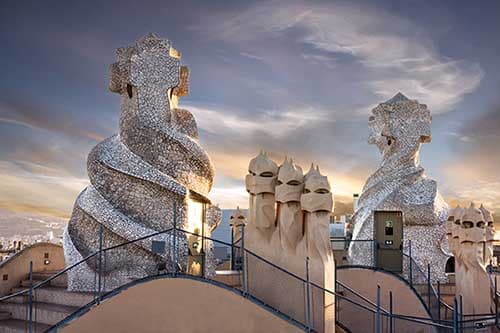
Discover the unique Auditorium within Casa Milà (La Pedrera) in Barcelona, Spain. Explore its history as a former garage and its role as a cultural event space.
Overview
Nestled within the architectural marvel of Casa Milà, famously known as La Pedrera, in Barcelona, Spain, lies the Auditorium—a sub-spot that embodies the building's dynamic transformation from a residential complex to a vibrant cultural hub. Casa Milà, a masterpiece by Antoni Gaudí, was constructed between 1906 and 1912 and was designated a UNESCO World Heritage Site in 1984. The Auditorium itself holds a unique narrative, having been repurposed from the building's original garage in 1994. Today, it serves as a versatile event space, hosting a diverse array of activities such as conferences, presentations, concerts, and cultural gatherings, contributing significantly to Barcelona's rich cultural life.
This space offers an intriguing contrast between its functional origins and its present-day role, reflecting the adaptability and enduring legacy of Gaudí's design. The Auditorium, alongside other restored areas of Casa Milà, allows visitors to delve deeper into the innovative spirit that defined Gaudí's work and continues to inspire awe in countless visitors. It represents a living part of the building, constantly buzzing with activity and reinforcing Casa Milà's status as more than just a historical monument, but a contemporary cultural center.
History & Cultural Background
Casa Milà, Antoni Gaudí's final civil architectural commission, was brought to life between 1906 and 1912 for the wealthy Milà family. Conceived as both a private residence for Pere Milà and Roser Segimon and an apartment building for rent, its unconventional, undulating stone facade quickly earned it the nickname 'La Pedrera', meaning 'The Quarry', from locals. This distinctive appearance, which broke sharply from the architectural norms of its time, initially sparked controversy and even ridicule. Despite its contentious beginnings, Casa Milà's genius was eventually recognized, leading to its inscription as a UNESCO World Heritage Site in 1984.
Following years of varying uses and some neglect, the building was acquired by Caixa Catalunya in December 1986, initiating a meticulous restoration process. A pivotal moment in this revitalization was the conversion of the old garage, originally intended for carriages and later automobiles, into the functional Auditorium. This transformation occurred in 1994, two years after the main floor was opened as an exhibition hall. This conversion showcases a broader trend in the building's history: its evolution from a private residence to a public cultural institution, managed today by the Fundació Catalunya La Pedrera, which is dedicated to preserving its heritage and promoting cultural, environmental, educational, and social projects.
What Makes It Special
The Auditorium within Casa Milà is special not just for its physical attributes, but for its embodiment of Gaudí's revolutionary architectural principles and the building's remarkable adaptability. Gaudí's design for Casa Milà was groundbreaking, featuring a self-supporting stone facade and free-plan floors, which allowed for flexible interior layouts without load-bearing walls. While the Auditorium itself is a modern adaptation, it benefits from being housed within this structural ingenuity. Its former life as a garage highlights Gaudí's forward-thinking vision, as the basement was designed to accommodate the nascent automobile, a truly innovative feature for its time.
Today, the Auditorium serves as a modern cultural amenity within a historic masterpiece. Its walls have witnessed everything from the mundane storage of vehicles to the intellectual discourse of conferences and the emotive performances of music. The transformation from a utilitarian space to a dynamic venue for cultural enrichment underscores the building's continuous relevance and ability to embrace new functions while honoring its past. Its existence allows visitors to appreciate how Gaudí's foundational ideas of fluidity and organic design have enabled such diverse uses over more than a century.
Stories, Fun Facts & Local Details
The journey of Casa Milà, and by extension its Auditorium, is punctuated with fascinating details and local lore. Its enduring nickname, 'La Pedrera' (The Quarry), was initially a derogatory term used by the public due to its unusual, raw-stone appearance, which stood out dramatically on the elegant Passeig de Gràcia. There's even a tale of the Milà family's dispute with Gaudí over the building's cost and perceived lack of adherence to traditional design, with the architect eventually winning a court case to recover his fees.
The transformation of the basement into an Auditorium from a space designed for carriages and early automobiles speaks volumes about the building's progressive design. Gaudí's vision included an underground garage, a concept far ahead of its time, providing a tangible link between the building's origins and its modern adaptations. Beyond the Auditorium, the building's attic houses the 'Espai Gaudí,' the first permanent exhibition dedicated to Antoni Gaudí's life and work, offering insights into the very mind that conceived Casa Milà. During the Spanish Civil War, Casa Milà even served as the headquarters for various departments of the Republican Government, adding another layer to its storied past.
Visitor Perspective
For the curious traveler, visiting Casa Milà offers a deep dive into the world of Antoni Gaudí, and the Auditorium is an integral part of this immersive experience. While the Auditorium primarily functions as an event space for conferences, presentations, and sometimes concerts, its presence within the main visitor route ensures that its history and current role are acknowledged. Visitors exploring Casa Milà typically receive an audio guide, allowing them to traverse the building's various accessible areas, including the iconic rooftop, the Espai Gaudí in the attic, and a recreated tenant's apartment, which offers a glimpse into early 20th-century bourgeois life.
Even if one doesn't attend a specific event in the Auditorium, understanding its evolution from a functional garage to a modern cultural venue enhances the appreciation for Casa Milà's enduring legacy and adaptability. The experience of walking through Gaudí's curving spaces, understanding his innovative structural solutions, and seeing how a century-old building continues to serve contemporary needs through spaces like the Auditorium is truly enriching. Given Casa Milà's popularity, it is highly recommended to purchase tickets online in advance to streamline the visit and fully enjoy this UNESCO World Heritage Site.
Coordinates: 2.157, 41.3905
View on Google Maps💬 How Travelers Describe This Place
Based on community votes
Interesting
836Unique
620Must See
594Photogenic
522Beautiful
83
Traveler Stories
Discover memorable experiences shared by travelers who have visited this place.
No traveler stories yet.
Be the first traveler to share what made this place memorable.

Tour
By
Spot
Discover amazing places around the world. Your journey starts here.
Explore
© 2026 TourBySpot. All rights reserved.