Atrium Courtyard
Dubrovnik, Croatia
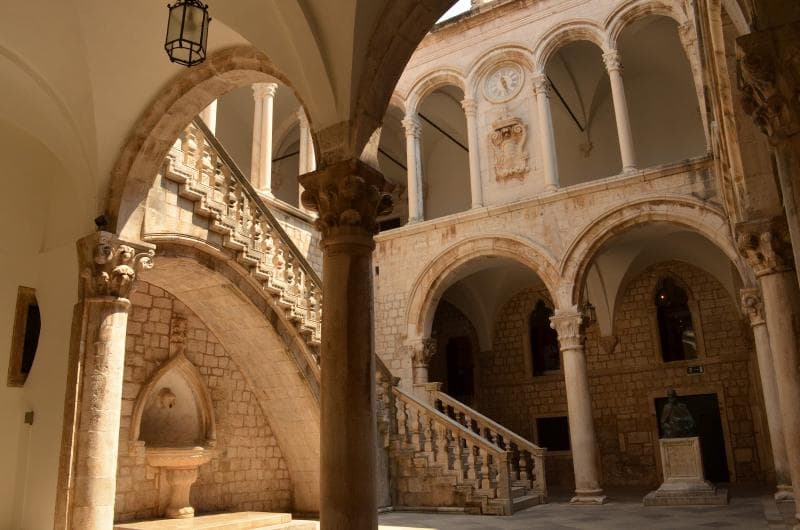
Explore the historic Atrium Courtyard in Rector's Palace, Dubrovnik, Croatia. Discover its Gothic, Renaissance, and Baroque architecture, the unique story of Miho Pracat, and its role as a cultural and concert venue.
Overview
Tucked within the majestic Rector's Palace in the heart of Dubrovnik, Croatia, lies the serene Atrium Courtyard. This architectural gem serves as the literal and metaphorical center of a building that once held the political reins of the powerful Republic of Ragusa. Far more than just an open space, the courtyard is a captivating blend of architectural styles, a testament to resilience, and a vibrant cultural venue today. It is a place where history whispers through ancient stones and where the echoes of classical music now mingle with tales of old.
History & Cultural Background
The Rector's Palace, or Knežev dvor, has a rich and turbulent history, beginning its life as a fortified castle in the 13th century. It became the official residence and workplace for the Rector, the head of the Republic of Ragusa. The Rector's term was remarkably brief—just one month—during which he was not permitted to leave the palace except for official duties, emphasizing the city's commitment to avoiding the accumulation of power by any single individual. His daily responsibilities even included safeguarding the city's keys each night, a powerful symbol of his temporary but absolute authority.
The palace's appearance today is a chronicle of its past, having been repeatedly damaged and rebuilt. Gunpowder explosions in 1435 and 1463, followed by a devastating earthquake in 1667, necessitated extensive reconstructions. These events led to a harmonious blend of Gothic, Renaissance, and Baroque architectural elements throughout the structure. The core Gothic design was successively enriched by Renaissance additions, notably in its portico and capitals, and later with Baroque features like the grand staircase in the atrium.
What Makes It Special
The Atrium Courtyard is distinguished by its intricate architectural details. Visitors are immediately struck by the rows of elegant columns adorned with Corinthian capitals, forming a graceful arcade. A dominant Baroque staircase ascends to an upper gallery, adding a sense of grandeur to the space. Beneath this staircase, a charming 15th-century fountain provides a tranquil focal point, its gentle splashing a soothing contrast to the bustling city outside.
One of the courtyard's most remarkable features is its exceptional acoustics. This natural sound quality transforms the historic space into a world-renowned venue for classical and chamber music concerts, especially during the prestigious Dubrovnik Summer Festival. It's a place where ancient stone witnesses the timeless beauty of music.
Adding to its unique character is the monument to Miho Pracat, a wealthy 16th-century commoner and shipowner who generously bequeathed his entire fortune to the Republic. Erected in 1638, this statue by Italian sculptor Piero Paolo Giacometti is particularly significant as Pracat was the only common citizen to be honored with a public monument within the palace during the Republic's long history, highlighting the values of civic contribution in Ragusa.
Stories, Fun Facts & Local Details
The story of Miho Pracat is a true testament to the spirit of Dubrovnik. While many monuments in the city celebrate nobles or religious figures, Pracat's statue stands as a unique tribute to a self-made man whose philanthropy greatly benefited the Republic. His act of leaving his wealth to the city was a profound gesture of civic duty and trust in the communal good.
Imagine the daily life of the Rector within these walls. Confined for his month-long term, separated from his family, he presided over state affairs in the very chambers surrounding this courtyard. The palace also housed the Minor Council, state administration offices, an armory, a gunpowder magazine, and even a prison on the ground floor. This courtyard, therefore, was not merely a decorative element but the bustling epicenter of a powerful maritime republic, witnessing countless decisions that shaped its destiny.
The blend of architectural styles—Gothic foundations, Renaissance ornamentation, and Baroque additions—tells a story of resilience and continuous adaptation. Each reconstruction brought new artistic influences, resulting in a building that is a living museum of architectural evolution. The Florentine architect Michelozzo Michelozzi, for instance, contributed to the post-explosion rebuilding, although some of his plans for a more pronounced Renaissance style were later modified.
Visitor Perspective
Stepping into the Atrium Courtyard today, one can't help but feel transported through time. The interplay of light and shadow on the ancient columns and the elegant arches creates a contemplative atmosphere, a quiet respite from the vibrant energy of Dubrovnik's Old Town. It offers a tangible connection to the city's rich past, allowing visitors to visualize the Rectors, dignitaries, and citizens who once traversed this very space.
As you wander through the courtyard, take a moment to appreciate the details: the intricate carvings, the 15th-century fountain, and the solemn presence of Miho Pracat's statue. For those interested in history, the Cultural History Museum, housed within the palace, further enriches the experience, displaying artifacts that bring the Republic of Ragusa to life. Attending a classical music concert here during the Dubrovnik Summer Festival is an unparalleled experience, where the historical ambiance enhances every note, creating truly unforgettable memories.
Coordinates: 18.110676, 42.640313
View on Google Maps💬 How Travelers Describe This Place
Based on community votes
Unique
670Beautiful
655Photogenic
594Must See
266Interesting
166
Traveler Stories
Discover memorable experiences shared by travelers who have visited this place.
No traveler stories yet.
Be the first traveler to share what made this place memorable.

Tour
By
Spot
Discover amazing places around the world. Your journey starts here.
Explore
© 2026 TourBySpot. All rights reserved.