Aspendos Aqueduct
Antalya, Turkey
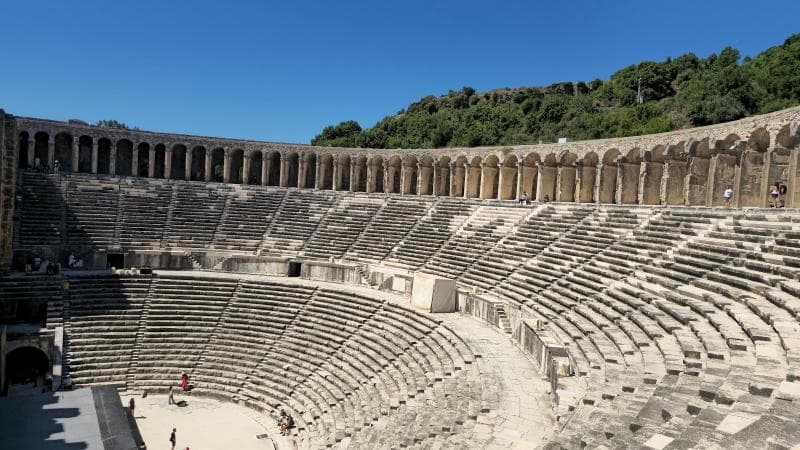
Explore the ancient Aspendos Aqueduct in Antalya, Turkey – a Roman engineering marvel with a unique inverted siphon system that supplied water to the city.
Overview
Stepping into the ancient city of Aspendos in Antalya, Turkey, offers a journey through time, where the echoes of Roman ingenuity resonate not just in its magnificent theatre, but also through the remarkable Aspendos Aqueduct. This engineering marvel, though often overshadowed by its more famous theatrical counterpart, was the lifeblood of ancient Aspendos, ensuring its prosperity by supplying fresh water to its bustling populace. Stretching for approximately 15 to 19 kilometers, the aqueduct stands today as a testament to advanced Roman hydraulic engineering, remaining largely intact and providing a tangible connection to the past.
Situated within the broader archaeological site that also houses the renowned Aspendos Theatre, the aqueduct isn't merely a collection of ruins; it is a profound historical structure that once defied the natural landscape to sustain a thriving city. Its impressive arches and intricate design allowed water to traverse valleys and elevations, a feat of precision and vision nearly two millennia ago.
History & Cultural Background
Aspendos, a significant city in the ancient Pamphylia region, flourished particularly during the Roman period. To support its growing population and maintain its sophisticated urban life, a dependable water supply was crucial. The construction of the vast aqueduct system is attributed to the reign of Roman Emperor Marcus Aurelius (161-180 AD), making it a product of the 2nd century AD.
This ambitious project tapped into two primary spring sources, Gökçepınar and Pınarbaşı, located in the mountains north of the city. From these distant origins, water was channeled through a complex network of buried conduits, bridges, and tunnels, culminating in the city itself. The aqueduct system was not just a technical necessity; it was integral to the organization of public life, supporting fountains, baths, and various public buildings, thereby underpinning the city's social and economic functions.
What Makes It Special
What truly sets the Aspendos Aqueduct apart is its ingenious use of an 'inverted siphon' system. Unlike many aqueducts that relied solely on gravity and gentle slopes, the terrain leading to Aspendos presented significant valleys. Roman engineers overcame this challenge by employing tall stone towers, which acted as pressure regulators. Water would descend into these towers, travel through pressurized stone pipes across the low-lying valleys, and then rise again into another tower on the opposite side, purely through the principles of physics.
This innovative design, particularly the longest inverted siphon on arches in Turkey, spanning about 1.7 kilometers, demonstrates an extraordinary level of hydraulic knowledge for its time. The precision-cut stone pipes, some with an inner diameter of 28 cm, were meticulously fitted together to withstand high water pressure, showcasing the era's sophisticated engineering and material technologies.
Stories, Fun Facts & Local Details
Beyond its technical brilliance, the Aspendos Aqueduct is woven into local folklore. One popular legend tells of a competition for the hand of the city ruler's daughter. Two architects vied for this honor: one constructed the magnificent theatre, and the other, the aqueduct. While historical verification is absent, this tale underscores the immense social value and wonder attributed to the aqueduct by the local populace, placing its importance on par with the grand theatre itself.
The aqueduct, along with the theatre, transformed Aspendos into a prosperous hub, enabling not just daily sustenance but also various industries. The availability of clean, flowing water contributed to the city's reputation and its capacity to host large gatherings in its theatre, which today still hosts international festivals. The sheer scale and enduring presence of the aqueduct make it a powerful symbol of Roman dedication to urban development and public welfare.
Visitor Perspective
Visiting the Aspendos Aqueduct offers a different, perhaps more contemplative, experience than the grandeur of the theatre. While the theatre commands immediate awe, the aqueduct provides a deeper insight into the practical genius that sustained such a civilization. Located just beyond the theatre complex, a walk to the aqueduct's visible sections allows travelers to marvel at its towering arches and the remains of the pressure towers, visualizing the flow of ancient waters.
To truly appreciate this site, comfortable walking shoes are highly recommended, especially for exploring the wider archaeological area. Visiting during the cooler morning or late afternoon hours is advisable, particularly in warmer months, to avoid the midday heat. The Aspendos Ancient City, including its theatre and aqueduct, is on UNESCO's Tentative List of World Heritage Sites, highlighting its global significance and the ongoing efforts for its preservation.
Coordinates: 31.172222, 36.938888
View on Google Maps💬 How Travelers Describe This Place
Based on community votes
Must See
613Photogenic
356Beautiful
290Interesting
261Unique
184
Traveler Stories
Discover memorable experiences shared by travelers who have visited this place.
No traveler stories yet.
Be the first traveler to share what made this place memorable.

Tour
By
Spot
Discover amazing places around the world. Your journey starts here.
Explore
© 2026 TourBySpot. All rights reserved.