Armenian Courtyard
Lviv, Ukraine
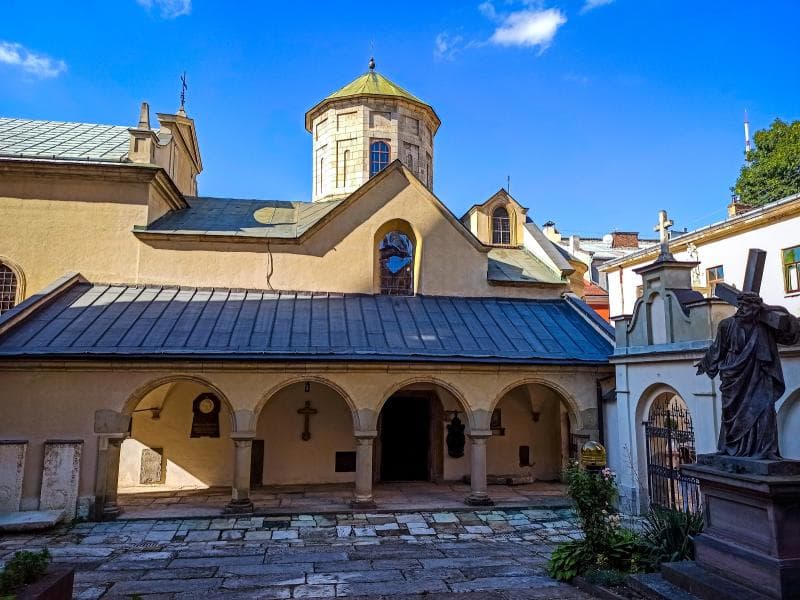
Explore Lviv's Armenian Courtyard at the Armenian Cathedral, a UNESCO site in Ukraine. Discover its rich history, unique architecture, and ancient tombstones. A cultural journey awaits.
Overview
Tucked away within the historic embrace of the Armenian Cathedral in Lviv, Ukraine, lies the enchanting Armenian Courtyard—a truly special sub-spot that captivates with its timeless beauty and profound history. The Cathedral complex, a designated UNESCO World Heritage site, stands as one of Lviv's oldest and most significant religious structures, dating back to 1363-1370. This remarkable ensemble, situated in the city's Old Town, is a testament to the enduring presence and cultural richness of the Armenian community in Lviv. It comprises not only the main cathedral but also a striking bell tower, the former Archbishop's Palace, an Armenian Bank building, a monastery, and the stately memorial column of St. Christopher. The architecture itself is a captivating fusion of Armenian, Byzantine, Gothic, and Romanesque styles, creating a unique aesthetic that sets it apart. The courtyards within this complex offer a serene and enclosed atmosphere, inviting quiet contemplation. While the Cathedral's official address is on Virmenska Street, the entrance to these hidden courtyards is most commonly found from Krakivska Street, acting as a gateway to this historical gem. Recognized for its picturesque qualities, the Armenian Courtyard is also a favored location for photographers seeking evocative backdrops.
History & Cultural Background
The Armenian community established its roots in Lviv as early as the 13th century, becoming pivotal to the city's trade networks and cultural fabric. The Armenian Cathedral, a central spiritual beacon, was constructed between 1363 and 1370 by wealthy Armenian merchants. Its design drew inspiration from the revered Cathedral of Ani, the ancient capital of Armenia, serving as a powerful link to their homeland. Over centuries, the Cathedral complex underwent numerous transformations and expansions, with significant rebuilding efforts in 1437, 1630, 1723, and a major restoration between 1908 and 1927. Surrounding the main cathedral, other structures emerged, including the Armenian Benedictine Monastery built in 1682, the building of the former Armenian bank, and the Archbishop's Palace from the late 18th century. During the Soviet era, the Cathedral faced closure and was repurposed, first as a storage facility and later as a Lenin Museum. However, it was triumphantly returned to the Armenian community in 2000 and subsequently reconsecrated in 2003, reclaiming its spiritual role. Today, it proudly stands as the sole Armenian Apostolic church in western Ukraine, a vital center for its community.
What Makes It Special
The Armenian Cathedral complex is distinguished by its intricate layout, featuring three distinct courtyards: the southern, northern (monastery), and eastern (St. Christopher's) courtyards. A truly unique feature is found in the southern and northern courtyards, where the ground is paved with ancient Armenian tombstones, known as khachkars. These fascinating relics, dating from the 16th to 18th centuries, were relocated from former Armenian cemeteries, literally embedding centuries of history beneath one's feet. The complex also boasts an arcaded gallery, a beautiful architectural element dating back to the 15th and 17th centuries, which adds to its enclosed, mystical ambiance. Within the eastern courtyard, known as St. Christopher's Yard, an elegant commemorative column from 1726 stands as a notable monument. Another profound highlight is the 'Golgotha' chapel, a unique wooden structure with a carved altar depicting the suffering of Christ, located near the eastern courtyard, offering a moment of solemn reflection. Architecturally, the cathedral itself is a marvel, blending distinct Armenian forms with Byzantine, Gothic, and Renaissance influences. Its remarkably thick stone walls, reaching 1.5 meters, and the dome, innovatively resting on hollow clay acoustic jars (holosnyky), contribute to both its structural integrity and exceptional acoustics. The interior is equally breathtaking, adorned with striking early 20th-century frescoes by Jan Henryk Rosen, magnificent dome mosaics by Jozef Mehoffer, and an intricately carved wooden ceiling that whispers tales of its rich past.
Stories, Fun Facts & Local Details
Stepping into the Armenian Courtyard is often described as entering another era entirely, a journey back in time where the weight of history is palpable. The ancient cobblestone pavement within the courtyards bears faint inscriptions, and near one of the arcade gates, the date '1667' can still be discerned, offering a direct connection to the past. One particularly poignant detail is the tombstone of Patriarch Stephan V of Armenia, who passed away in Lviv in 1551, embedded in one of the walls. This carving is notably considered the oldest example of Gothic carving in Lviv. The entire complex is a beautiful symbol of Lviv's historical role as a crossroads of cultures, where the integration of Oriental and European architectural elements feels perfectly at home. Interestingly, the courtyards themselves were built upon the site of an ancient cemetery, a reminder of the layers of history beneath one's feet. The initial construction of the cathedral consciously sought to replicate the distinct ancient Armenian architecture of Ani, showcasing a deep reverence for ancestral heritage. This complex is not merely a collection of buildings but a living narrative of the Armenian diaspora's ability to preserve and express their rich culture far from their historical homeland.
Visitor Perspective
For the curious traveler, the Armenian Courtyard and Cathedral offer an incredibly enriching experience. As an active church, admission to the cathedral itself is free, though voluntary donations are welcome to support its upkeep. The most common and recommended entry point to the serene courtyards is via Krakivska Street, guiding visitors directly into this tranquil oasis. Exploring the various courtyards, the unique 'Golgotha' chapel, and marveling at the intricate architectural details provides a profound sense of connection to Lviv's multicultural past. Many visitors report a sense of being transported back in time, losing 'the dimension of time' amidst the historical grandeur and peaceful atmosphere. As part of the UNESCO World Heritage List for the historic city center, a visit here is not just a casual stroll but an immersion into a site of global cultural importance.
Coordinates: 24.03083, 49.84333
View on Google Maps💬 How Travelers Describe This Place
Based on community votes
Interesting
896Must See
102Beautiful
102Unique
95Photogenic
28
Traveler Stories
Discover memorable experiences shared by travelers who have visited this place.
No traveler stories yet.
Be the first traveler to share what made this place memorable.

Tour
By
Spot
Discover amazing places around the world. Your journey starts here.
Explore
© 2026 TourBySpot. All rights reserved.