Arènes de Lutèce
Paris, France
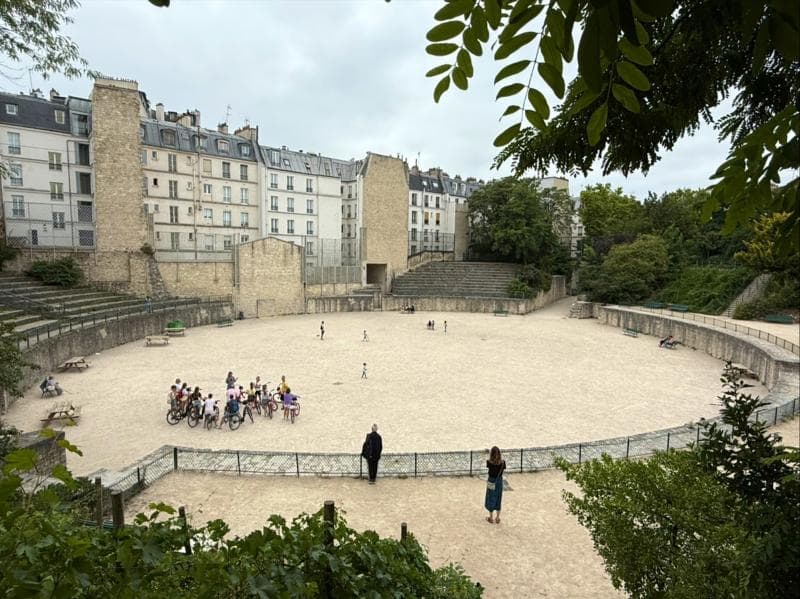

Explore the Arènes de Lutèce in Paris, France – an ancient Roman amphitheater in the Latin Quarter. Discover its rich history and cultural significance.
Overview
Hidden within the vibrant Latin Quarter of Paris, France, lies the captivating Arènes de Lutèce, a profound echo of the city's Roman past. This ancient Gallo-Roman amphitheater, a true architectural hybrid, stands as one of the oldest and most significant Roman remnants in the French capital. Unlike grand, overtly advertised monuments, the Arènes de Lutèce offers a peaceful escape, a vast open-air space where history breathes freely. Often overlooked by casual tourists, it serves as a cherished spot for locals and curious travelers seeking a tangible connection to Lutetia, the Roman city that predated modern Paris. Admission is free, inviting all to step back in time and explore its ancient stones.
History & Cultural Background
The Arènes de Lutèce was constructed between the 1st and 2nd centuries AD, during the Roman era when Paris was known as Lutetia. This impressive structure was designed as a versatile entertainment venue, functioning as both a traditional theater with a long stage and an arena for more dramatic spectacles. Spectators, numbering between 10,000 and 17,000, would gather here to watch theatrical performances, gladiatorial combats, wild animal fights, athletic competitions, and even horse races. Its existence points to a thriving Roman settlement on the banks of the Seine, far removed from the city of lights we know today. However, the site's glory was not to last forever. In the late 3rd century AD, with the decline of the Roman Empire and increasing barbarian threats, parts of the amphitheater were dismantled, and its stones were repurposed to reinforce the city's defenses, particularly around the Île de la Cité. The arena gradually fell into disuse and was eventually buried under centuries of urban development, its existence fading from public memory.
It was not until 1869, during Baron Haussmann's extensive renovation of Paris and the construction of Rue Monge, that the Arènes de Lutèce was accidentally rediscovered. This surprising find sparked significant interest, leading to a public campaign for its preservation. A prominent figure in this movement was none other than the famed writer Victor Hugo, who advocated passionately for the site's restoration. Thanks to such efforts, major restoration work was undertaken in the late 19th and early 20th centuries, ensuring that this invaluable piece of Roman history would be preserved for future generations.
What Makes It Special
The Arènes de Lutèce is uniquely special for several reasons. Primarily, it is a rare and remarkably preserved example of Gallo-Roman architecture in Paris, offering a direct window into the city's ancient past. What sets it apart from many other Roman amphitheaters is its hybrid design, combining a theatrical stage at one end with a large elliptical arena. This dual functionality meant it could host a wide range of public entertainments, from dramatic plays to gladiatorial contests. Historians believe its stage, measuring approximately 41 meters (135 feet) long, was one of the longest in the Roman world. Furthermore, its massive scale, capable of accommodating up to 17,000 people, positioned it among the largest structures of its type built in Gaul. Its circular layout also provides a striking contrast to the predominantly linear and monumental urban planning introduced by Haussmann in the 19th century, making it a compelling study in urban evolution and historical layers.
Stories, Fun Facts & Local Details
Imagine the roar of the crowd as gladiators battled or chariots raced across the sandy floor thousands of years ago. The Arènes de Lutèce was more than just a venue; it was a social hub. Historical accounts suggest that slaves, the poor, and women were seated in the higher tiers, while Roman male citizens enjoyed the lower, more prominent sections. For comfort against the Lutetian sun, a linen awning would have provided shade to the spectators. Archeological findings include nine niches along the stage that likely housed statues, and five small rooms beneath the lower terraces, some of which are thought to have been cages for the wild animals featured in arena games. Today, these remnants spark the imagination, allowing visitors to visualize the scenes of ancient life. The site's dramatic rediscovery during the 19th-century urban renewal of Paris is a testament to how deeply buried history can be found beneath our feet. Victor Hugo's impassioned plea for its survival highlights the profound connection the city's heritage holds for its people. In a delightful twist of fate, the arena that once hosted fierce combat now serves as a cherished public park. It's common to see locals playing pétanque, children kicking soccer balls, students studying, or families enjoying picnics on the grassy slopes – a testament to its enduring role as a communal gathering space.
Visitor Perspective
Visiting the Arènes de Lutèce is like stepping into a peaceful, open-air museum. It's entirely free to enter and explore, offering an accessible historical experience. While it may not have the imposing grandeur of other Parisian landmarks from the outside, its charm lies in its authenticity and the quiet atmosphere it provides. You can access the site from several points, including unobtrusive entrances on Rue Monge, Rue des Arènes, and Square Capitan. The nearest Métro stations, such as Jussieu, Place Monge, and Cardinal Lemoine, make it easily reachable within the Latin Quarter. Once inside, visitors are encouraged to wander the ancient grounds, sit on the restored stone steps, and simply absorb the tranquility. It's a perfect spot to relax, read a book, or observe daily Parisian life unfolding against a backdrop of ancient stones. The Arènes de Lutèce offers a unique opportunity to connect with Paris's deepest roots, providing a profound sense of continuity between the Roman past and the modern city. While it might initially seem understated, taking a moment to reflect on the millennia of history it represents makes it an incredibly rewarding and memorable destination.
Coordinates: 2.352865, 48.845084
View on Google Maps💬 How Travelers Describe This Place
Based on community votes
Unique
961Beautiful
555Interesting
448Must See
387Photogenic
156
Traveler Stories
Discover memorable experiences shared by travelers who have visited this place.
No traveler stories yet.
Be the first traveler to share what made this place memorable.

Tour
By
Spot
Discover amazing places around the world. Your journey starts here.
Explore
© 2026 TourBySpot. All rights reserved.