Archaeological Remains
Sofia, Bulgaria
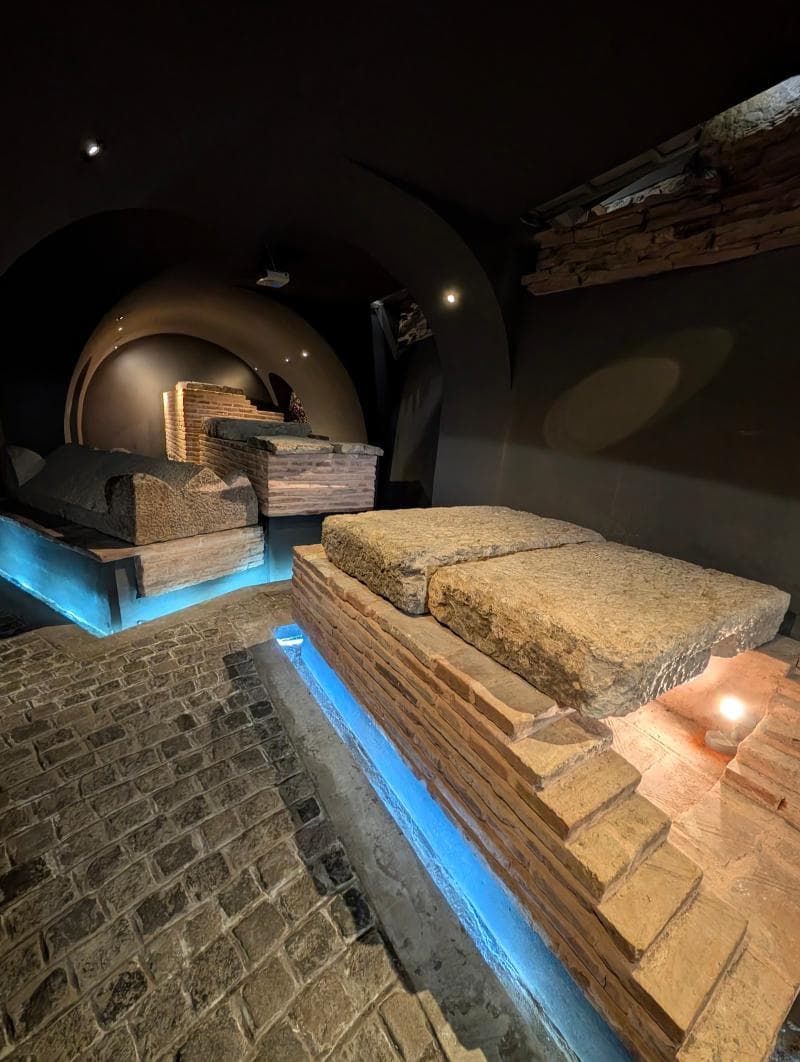
Explore the ancient Archaeological Remains beneath Saint Sofia Church in Sofia, Bulgaria, revealing a Roman necropolis, early Christian tombs, and historic mosaics.
Overview
Deep beneath the majestic Saint Sofia Church in Sofia, Bulgaria, lies a remarkable archaeological level known simply as the 'Archaeological Remains'. This subterranean complex offers a profound journey through time, revealing the layers of history that predate the current basilica. Far from being merely a foundation, this space served as the eastern necropolis of ancient Serdica—the Roman city that grew to become modern Sofia. Visitors can explore a labyrinth of ancient tombs, the remnants of earlier churches, and captivating mosaics, all meticulously preserved and presented to tell the story of a city's enduring past. It's a truly immersive experience that provides an unparalleled glimpse into early Christian life and Roman funerary practices in the Balkans.
History & Cultural Background
The history of the Archaeological Remains intertwines deeply with the very origins of Sofia. Long before the current Saint Sofia Church, the site was part of a bustling Roman necropolis, or burial ground, of the ancient city of Serdica. Archaeological excavations have unearthed a wealth of funerary structures dating predominantly from the 3rd and 4th centuries. These include a variety of burial facilities such as tomb pits, stone sarcophagi, and distinctive late antiquity masonry tombs, some with semi-cylindrical vaults. Over the centuries, several Christian churches were constructed on this sacred ground, often built directly atop the remains of their predecessors after periods of destruction by invading forces like the Goths and Huns. The present-day Saint Sofia Church is believed to be the fifth iteration of a religious building on this spot, constructed during the reign of the Byzantine Emperor Justinian I in the mid-6th century.
What Makes It Special
What sets the Archaeological Remains apart is the tangible, multi-layered history visitors can literally walk through. As you descend into the crypt, the walls themselves reveal the distinct architectural layers of the various churches that stood here, offering a visual timeline of religious building in Sofia over centuries. The underground space is home to around 50 excavated graves and tombs, some of which still bear traces of ancient frescoes and decorative elements. Particularly striking are the fragments of early Christian mosaics, with their geometric patterns and symbolic motifs, discovered from the floors of the older structures. To enhance the experience, holographic displays provide reconstructions of artifacts found during excavations, bringing the ancient context to life without cluttering the historic environment. This meticulous preservation allows for a genuine understanding of the site's evolution and its continuous sacred significance.
Stories, Fun Facts & Local Details
One of the most compelling narratives associated with the site is the discovery of the tomb of Honorius, a 5th-century burial chamber renowned for its mural paintings. A red inscription on the lunette of this tomb reads 'Honorius, servant of God', providing a rare personal touch from late antiquity. It is fascinating to note that, unlike the 4th century, the 5th century saw a predominant use of Christian symbols in these burial decorations. Perhaps the most significant 'fun fact' is that the entire city of Sofia takes its name from this very church. Though the church was named after 'Holy Wisdom' (Saint Sophia) in the 6th century, it was much later, in the 14th century, that the city officially adopted its name. The current basilica, a contemporary of the more famous Hagia Sophia in Constantinople, stands as a testament to remarkable survival, enduring invasions, transformations (including being a mosque during Ottoman rule), and earthquakes, giving it a profound sense of accumulated history.
Visitor Perspective
A visit to the Archaeological Remains beneath Saint Sofia Church is an undeniably moving experience. Descending from the brightly lit church into the cooler, atmospheric underground levels feels like stepping back through the annals of time. Modern staircases and transparent flooring have been thoughtfully integrated, allowing visitors to navigate the different historical strata while protecting the delicate archaeological surfaces below. The quiet reverence of the space, punctuated by informative display panels in both Bulgarian and English, encourages a contemplative exploration of Roman-era tombs, early Christian mosaics, and the foundations of ancient basilicas. It's an immersive journey that typically takes about 45 to 60 minutes, transforming what might otherwise be a brief visit to the church into a deeply engaging and educational encounter with Bulgaria's rich heritage.
Coordinates: 23.331355, 42.696512
View on Google Maps💬 How Travelers Describe This Place
Based on community votes
Photogenic
794Beautiful
785Interesting
571Unique
546Must See
103
Traveler Stories
Discover memorable experiences shared by travelers who have visited this place.
No traveler stories yet.
Be the first traveler to share what made this place memorable.

Tour
By
Spot
Discover amazing places around the world. Your journey starts here.
Explore
© 2026 TourBySpot. All rights reserved.