Ancient Temple Chamber
Split, Croatia
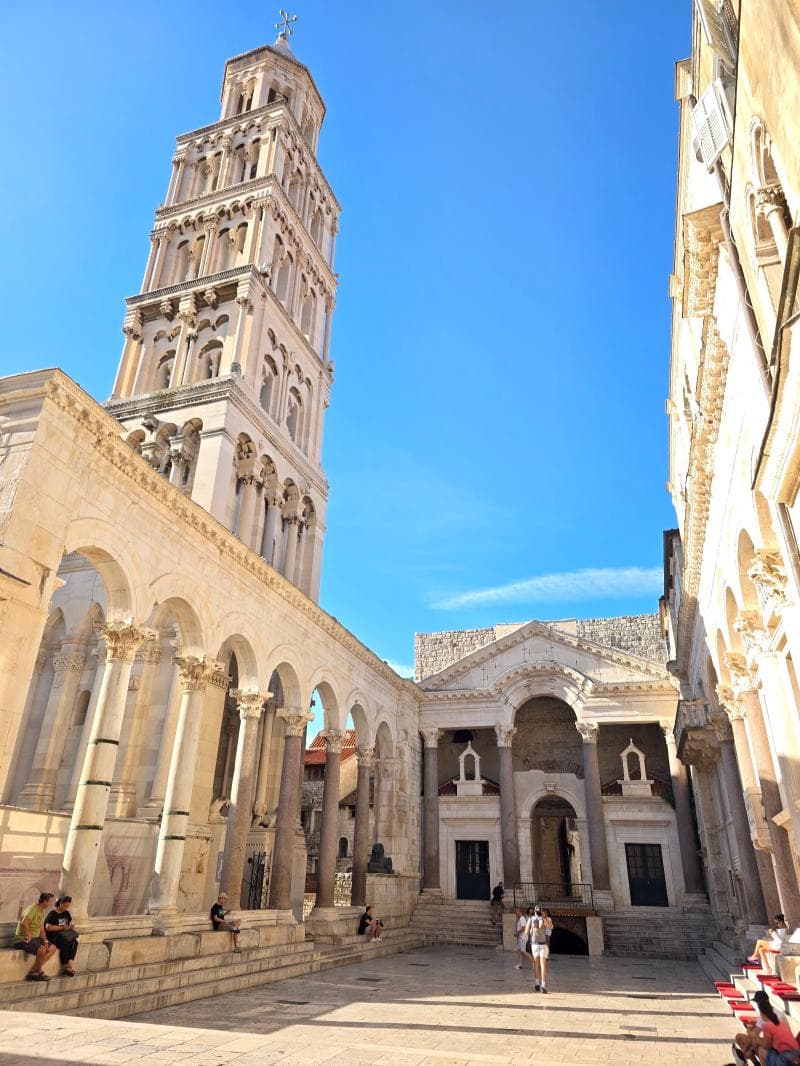
Explore the Ancient Temple Chamber, once the Temple of Jupiter, now a Baptistery, within Split's Diocletian's Palace, Croatia. Discover Roman architecture, headless sphinxes, and ancient history.
Overview
Deep within the ancient walls of Diocletian's Palace in Split, Croatia, lies a remarkable testament to Roman ingenuity and enduring history: the Ancient Temple Chamber. This historic sub-spot, originally the Cella of the Roman Temple of Jupiter, now serves as the Baptistery of St. John the Baptist. Constructed between 295 and 305 AD, it stands as a superbly preserved example of late Roman architecture, captivating visitors with its unique blend of pagan origins and Christian transformation. The chamber is famed for its exquisitely carved barrel-vaulted ceiling, considered a masterpiece of its era, and is guarded at its entrance by a centuries-old headless sphinx.
As you step into this chamber, you're not merely entering a building; you're traversing nearly two millennia of human history, from the powerful Roman Empire to the rise of Christianity in the region. Its strategic location within the western part of Diocletian's imperial complex, near the Peristyle, highlights its original significance as a religious focal point within the emperor's retirement residence.
History & Cultural Background
The story of this Ancient Temple Chamber begins with Emperor Diocletian, who ruled the Roman Empire from 284 to 305 AD. A native of Dalmatia, Diocletian commissioned the construction of his sprawling palace in Split, intending it as a lavish retreat for his abdication. He held a profound reverence for Jupiter, the supreme Roman deity, whom he considered his 'divine father' and personal protector. Thus, a magnificent temple dedicated to Jupiter was an essential component of his palace's religious precinct.
Construction of the temple, along with other parts of the palace, abruptly ceased in 305 AD when Diocletian unexpectedly abdicated and arrived at his unfinished residence. Centuries later, in the 6th century, a monumental shift occurred. With the widespread adoption of Christianity, the pagan Temple of Jupiter underwent a profound transformation, repurposed and consecrated as the Baptistery of St. John the Baptist. This conversion symbolizes the powerful transition from classical paganism to the new Christian faith, allowing much of its ancient Roman architectural integrity to be preserved.
What Makes It Special
The Ancient Temple Chamber is a treasure trove of historical and artistic significance, distinguished by several unique features:
- The Barrel-Vaulted, Coffered Ceiling: This is arguably the most breathtaking element of the chamber. This finely carved barrel-vaulted ceiling is considered a masterpiece of Roman engineering and one of the best-preserved Roman interiors in Split. Its intricate coffered design not only showcases advanced construction techniques but also profoundly influenced early Renaissance architecture in Dalmatia.
- The Headless Sphinx: Standing sentinel before the temple entrance is a striking black granite sphinx. This ancient artifact was one of several brought from Egypt by Emperor Diocletian, adding an exotic, mystical dimension to the Roman site. Its missing head is a stark reminder of historical changes and iconoclasm.
- The Baptismal Font: Inside, the medieval baptismal font is another highlight. Crafted in the 13th century from parts of an 11th-century altar partition, it features carved marble screens. One particular screen bears what is believed to be the oldest known representation of a Croatian king, either Peter Krešimir IV or Demetrius Zvonimir, alongside his subjects, offering a rare glimpse into early Croatian royalty.
- Statue of St. John the Baptist: Dominating the interior is a bronze sculpture of St. John the Baptist, a powerful and expressive work by the renowned Croatian sculptor Ivan Meštrović. This 20th-century addition seamlessly integrates with the ancient surroundings, marking the temple's enduring religious purpose.
Stories, Fun Facts & Local Details
Imagine the grandeur of the Roman Empire when this chamber was abuzz with pagan rituals, incense wafting through its barrel-vaulted space in honor of Jupiter. It's said that reliefs depicting various Roman gods and heroes, such as Victoria, Triton, Helios, Hercules, Jupiter, and Apollo, adorned the temple's exterior and doorways, further emphasizing its mythological importance.
A fascinating detail is the high regard held for this temple by Scottish architect Robert Adam, who, in the 18th century, considered it one of Europe's most beautiful monuments. This international recognition speaks volumes about its architectural significance and enduring appeal.
Just outside the temple, you can find one of Split's charming curiosities: a famously narrow passage locally known as 'Pusti me proć,' which translates to 'Let me pass.' It's a fun, quirky detail that adds to the layered experience of exploring Diocletian's Palace, where ancient monumental structures stand side-by-side with intimate, centuries-old urban spaces.
Visitor Perspective
Visiting the Ancient Temple Chamber is an essential part of any journey through Split's historic heart. As an integral component of the UNESCO-listed Diocletian's Palace, it offers a compelling narrative of continuous habitation and adaptation, where Roman imperial glory gives way to early Christian piety.
The chamber is conveniently located within walking distance of the Peristyle and the Cathedral of St. Domnius (Diocletian's Mausoleum), making it easy to include in a self-guided tour of the palace complex. Stepping inside, one is immediately enveloped by the cool, stone interior, with the intricate ceiling drawing the eye upwards. It offers a moment of quiet contemplation amidst the bustling palace streets. While modest in size compared to some Roman temples, the sheer preservation of its architectural details, particularly the ceiling and the historical artifacts within, provides a profound connection to the past. Many find themselves imagining the diverse worshippers and ceremonies that have unfolded here over the centuries. An entrance fee typically applies, contributing to the preservation of this remarkable historical site.
Coordinates: 16.439568, 43.508341
View on Google Maps💬 How Travelers Describe This Place
Based on community votes
Unique
799Must See
526Photogenic
424Beautiful
181Interesting
30
Traveler Stories
Discover memorable experiences shared by travelers who have visited this place.
No traveler stories yet.
Be the first traveler to share what made this place memorable.

Tour
By
Spot
Discover amazing places around the world. Your journey starts here.
Explore
© 2026 TourBySpot. All rights reserved.