Amir Timur Monument
Tashkent, Uzbekistan
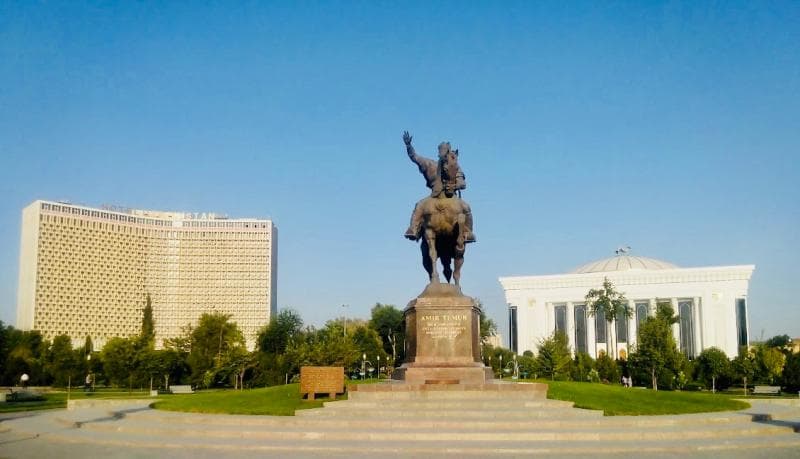
Explore the iconic Amir Timur Monument in Tashkent, Uzbekistan, a bronze equestrian statue of the national hero and founder of the Timurid Empire, Amir Timur. Discover its rich history, cultural significance, and the vibrant square it calls home.
Overview
The Amir Timur Monument stands proudly at the heart of Amir Timur Square in Tashkent, Uzbekistan, serving as a powerful symbol of the nation's rich heritage and a tribute to its revered historical figure, Amir Timur. This bronze equestrian statue depicts the legendary conqueror in imperial regalia, mounted on a rearing horse, gazing forward as if leading his people into the future. It is the focal point of a bustling urban space, where eight main avenues of the city converge, making it a natural crossroads for both locals and travelers. The monument's pedestal is famously inscribed with Timur's motto: 'Power is in Justice' or 'Strength is in justice', a maxim that encapsulates his philosophy of governance and is displayed in four languages.
History & Cultural Background
Amir Timur, known in the West as Tamerlane, was a Turco-Mongol conqueror born in 1336 near Shahrisabz, in what is present-day Uzbekistan. He founded the vast Timurid Empire in the 14th century, stretching from the Mediterranean Sea to India, and is celebrated not only as an undefeated military leader but also as a significant patron of the arts, sciences, and architecture. His reign ushered in a period known as the Timurid Renaissance.
The square itself boasts a storied past, originating in 1882 under Russian imperial rule as Konstantinovskaya Square, a central park designed by General M. Chernyaev. Over the decades, the central plinth of the square became a stage for shifting political ideologies, hosting a succession of monuments. It first featured General Konstantin Kaufman, then various revolutionary obelisks, followed by statues of Joseph Stalin in the 1940s, and Karl Marx in 1968. Following Uzbekistan's independence in 1991, Timur was re-evaluated from a historical figure often dismissed as a warlord during the Soviet era to a national hero. In 1993, the square was renamed Amir Timur Square, and the iconic bronze equestrian statue of Amir Timur, sculpted by Ilkhom Jabbarov (also known as Ilkhom Djabbarov or Kamol and Ilkhom Dzhabbarov), was unveiled on August 31, 1994, marking the third anniversary of Uzbekistan's independence.
What Makes It Special
The Amir Timur Monument is a masterpiece of public sculpture, capturing the grandeur and strategic vision of its subject. The bronze figure of Timur, astride his horse, with one hand raised, symbolizes his leadership and foresight. The inscription on the pedestal, 'Power is in Justice', is a powerful statement of principle, rendered in multiple languages to resonate with a diverse audience.
Beyond the monument itself, the square's design is noteworthy. It functions as the radial center of Tashkent, with eight tree-lined alleys extending outwards, creating an aesthetically pleasing and highly functional urban hub. Surrounding the square are several architecturally significant buildings that reflect different epochs of Tashkent's development. These include the distinguished Uzbekistan Hotel, the Tashkent State University of Law (once a women's gymnasium from the 19th century), the impressive Amir Timur Museum, and the iconic Tashkent Chimes. The Forums Palace, a monumental structure built in 2009 with a towering dome, also contributes to the square's grand ambiance.
Stories, Fun Facts & Local Details
The square has been a witness to significant transformations, not all without controversy. A notable event occurred in November 2009 when a major reconstruction project led to the felling of centuries-old maple trees that had long graced the square. This sudden removal of trees, carried out without public consultation, sparked widespread outrage among environmentalists and local residents, who decried it as a 'genocide of trees'. Despite the controversy, the area was revitalized with new plantings and fountains, creating the open, green space seen today.
Another fascinating detail is the Tashkent Chimes, a twin clock tower that stands near the square. The original chime, erected in 1947, was built using a clock mechanism brought from Königsberg (now Kaliningrad) as a war trophy after World War II, a unique piece of history now intertwined with Tashkent's urban fabric. Amir Timur himself was not just a military genius; he was also known for his intellect and love for the arts, even inventing a more complex version of chess, sometimes referred to as Tamerlane Chess.
Visitor Perspective
Amir Timur Square and its central monument offer visitors a compelling blend of historical immersion and modern urban life. The monument is easily accessible, and its open public area allows for visits at any time. Many travelers find the early morning or late evening particularly appealing for photography, as the monument takes on a special allure under different lighting conditions. It serves as an ideal starting point for exploring Tashkent, with roads radiating out to other parts of the city and major attractions nearby, such as the State Museum of Timurid History, which delves deeper into the life and legacy of Amir Timur and his dynasty. The square is a favored spot for residents to relax, meet, and enjoy the greenery and fountains, making it a vibrant and memorable experience for anyone visiting Tashkent.
Coordinates: 69.27952832497279, 41.31110281460375
View on Google Maps💬 How Travelers Describe This Place
Based on community votes
Photogenic
951Unique
748Beautiful
499Interesting
427Must See
94
Traveler Stories
Discover memorable experiences shared by travelers who have visited this place.
No traveler stories yet.
Be the first traveler to share what made this place memorable.

Tour
By
Spot
Discover amazing places around the world. Your journey starts here.
Explore
© 2026 TourBySpot. All rights reserved.