Access To Museumsufer
Frankfurt, Germany
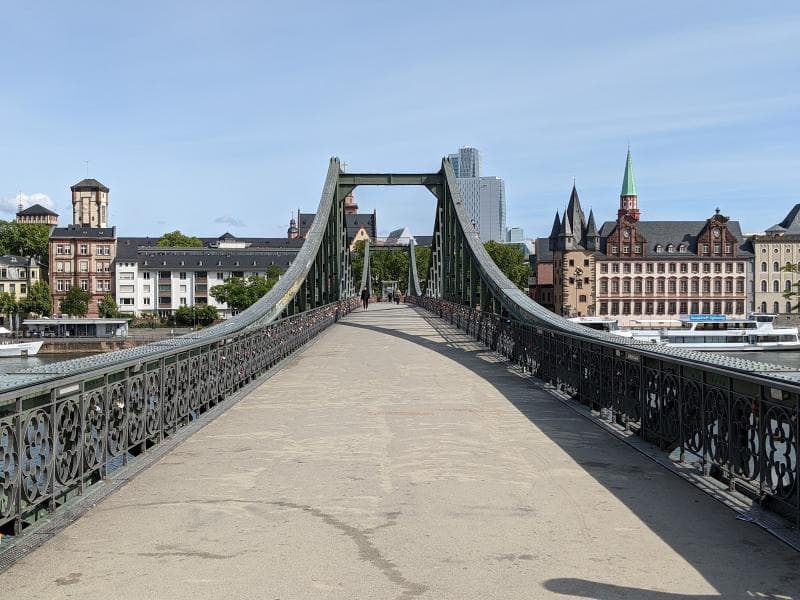
Discover Frankfurt's Museumsufer via the Eiserner Steg, a cultural promenade with world-class museums along the Main River in Germany.
Overview
Frankfurt's Museumsufer, or Museum Embankment, is a remarkable cultural hub situated predominantly along the southern bank of the Main River in the Sachsenhausen district. This unique collection of institutions transforms the riverside into one of Europe's most significant cultural landscapes. Accessing this vibrant area is often an experience in itself, particularly when crossing the iconic Eiserner Steg, a pedestrian bridge that serves as a historic and beloved gateway from the city's old town to the heart of the museums.
The Museumsufer comprises a diverse array of museums, featuring collections that span art history, film, architecture, communication, and ethnology, making it a destination that caters to a wide range of interests. Its strategic location, easily reachable via public transport and a pleasant stroll, underscores its importance as a central point for cultural exploration in Frankfurt.
History & Cultural Background
The vision for Frankfurt's Museumsufer began to materialize in the late 1970s, largely spearheaded by cultural politician Hilmar Hoffmann. His initiative led to a significant period of development between 1980 and 1990, during which existing museums were expanded, and many new ones were either constructed or established within repurposed historic villas. This ambitious project attracted internationally acclaimed architects such as Richard Meier and Oswald Mathias Ungers, who contributed to the distinctive architectural blend visible today.
The Eiserner Steg, pre-dating the Museumsufer concept, has been a crucial link across the Main River for over a century. The original wrought iron bridge was completed in 1868. Though replaced by a larger cantilever structure in 1911-1912, it faced destruction when blown up by the Wehrmacht in the final days of World War II. Its swift rebuilding in 1946 symbolized Frankfurt's resilience. A major renovation in 1993 further modernized the bridge, adding accessibility features like lifts.
What Makes It Special
What sets the Museumsufer apart is its extraordinary concentration and thematic breadth of museums within such close proximity. Visitors can explore the Städel Museum, housing 700 years of European art, the German Film Museum's interactive exhibits, the German Architecture Museum's avant-garde displays, and the Liebieghaus's ancient sculpture collections, all within walking distance.
The Eiserner Steg itself offers breathtaking panoramic views. From its vantage point, one can admire Frankfurt's striking 'Mainhattan' skyline to the north and the serene green banks of Sachsenhausen, dotted with museums, to the south. This blend of urban modernity and cultural richness, visible from the bridge, makes it a truly special experience.
Stories, Fun Facts & Local Details
The Eiserner Steg is affectionately known as the 'Love Lock Bridge', a tradition adopted by countless couples who attach padlocks to its railings as a symbol of their enduring affection. A fascinating detail on the bridge is a Greek inscription from Homer's Odyssey, believed to represent Frankfurt's diverse population and its openness to the world.
The Museumsufer is not just about its permanent collections; it's a dynamic cultural space. It hosts annual major events, most notably the three-day Museumsuferfest in late August. This festival transforms both riverbanks into a lively celebration of art, culture, music, and cuisine, attracting millions of visitors. Another highlight is the 'Nacht der Museen' (Night of the Museums), where many institutions open their doors into the late hours.
Visitor Perspective
For a curious traveler, accessing the Museumsufer via the Eiserner Steg offers an immersive introduction to Frankfurt's cultural heart. The pedestrian-only bridge provides a leisurely walk, offering ample opportunities for photographs of the cityscape and river. The bridge is free to cross and accessible at all times.
Upon crossing, visitors find themselves directly on Schaumainkai, the main promenade of the Museumsufer. For convenience, lifts have been installed on the Eiserner Steg, making it accessible for wheelchairs and strollers. To make the most of multiple museum visits, travelers can purchase the MuseumsuferTicket or MuseumsuferCard, which offer cost-effective access to many participating institutions. The area is well-served by public transportation, including trams and U-Bahn stations, ensuring easy connectivity from any part of Frankfurt.
Coordinates: 8.687960198243896, 50.107003383241974
View on Google Maps💬 How Travelers Describe This Place
Based on community votes
Must See
276Interesting
152Photogenic
33Beautiful
30Unique
16
Traveler Stories
Discover memorable experiences shared by travelers who have visited this place.
No traveler stories yet.
Be the first traveler to share what made this place memorable.

Tour
By
Spot
Discover amazing places around the world. Your journey starts here.
Explore
© 2026 TourBySpot. All rights reserved.