Accademia Bridge
Venice, Italy
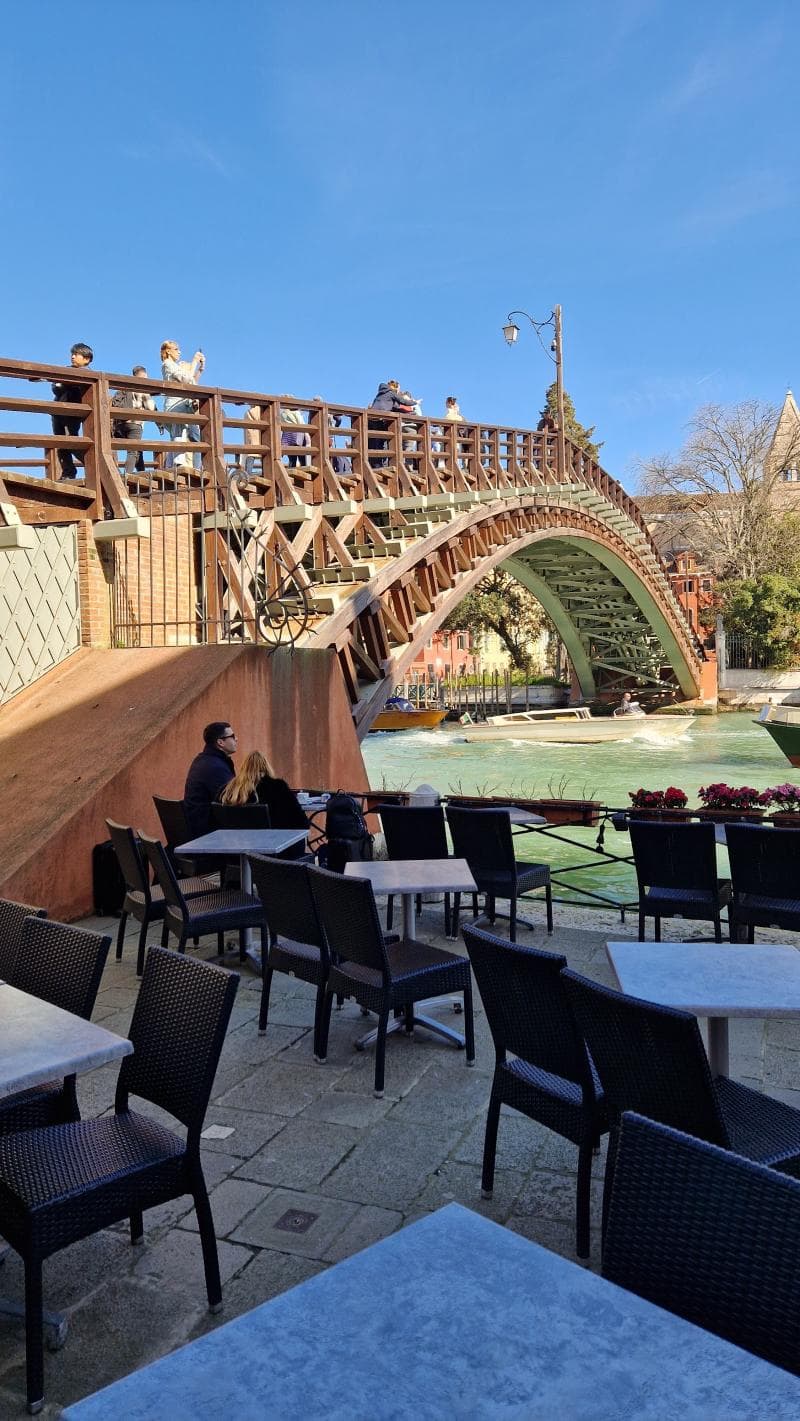
Explore Venice's Accademia Bridge (Ponte dell'Accademia), a unique wooden bridge offering stunning Grand Canal views. Discover its history and artistic surroundings.
Overview
The Accademia Bridge, known locally as Ponte dell'Accademia, is one of only four bridges that gracefully span the Grand Canal in Venice, Italy. This iconic pedestrian crossing connects the sestieri, or districts, of San Marco and Dorsoduro, making it a crucial pathway for both locals and curious travelers navigating the city's labyrinthine charm. Unlike Venice's more famous stone bridges, the Accademia Bridge is distinctively constructed of wood, offering a unique aesthetic and tactile experience as one traverses its gentle arch. It derives its name from its proximity to the renowned Gallerie dell'Accademia, an esteemed art museum housed in the former Scuola della Carità, which sits at one of its ends in the Dorsoduro district.
Standing on the Accademia Bridge provides some of the most breathtaking panoramic views of the Grand Canal, showcasing the ceaseless ballet of gondolas, vaporetti, and water taxis, flanked by historic palaces and the distant, majestic dome of the Santa Maria della Salute Basilica. Its strategic location makes it an essential link to major cultural institutions like the Gallerie dell'Accademia and the Peggy Guggenheim Collection, solidifying its role as a gateway to artistic and historical exploration within Venice.
History & Cultural Background
The idea of a bridge at this specific location across the Grand Canal was first floated as early as 1488 by Luca Tron, a provveditore, though his proposal was met with derision and never came to fruition. For centuries, the Rialto Bridge remained the sole crossing point of the Grand Canal. The first bridge to actually be built here was a steel structure, designed by English engineer Alfred Neville, which opened to the public on November 20, 1854. However, this iron bridge was not well-received by Venetians.
By 1932, the steel bridge was deemed temporary and was replaced by a new wooden bridge, designed by Eugenio Miozzi. This wooden structure, intended only as a provisional solution while a more permanent, grander stone bridge was debated, captivated the hearts of Venetians with its elegant arch and warmer material. Despite widespread hopes and even a competition for a stone replacement, the 'temporary' wooden bridge persisted. Over time, the wood deteriorated, leading to its reconstruction in 1985 with a replica wooden structure, maintaining its beloved appearance. The bridge underwent its latest significant restoration, costing €1.7 million and funded by the Luxottica Group, which was completed in 2018. This enduring 'temporary' nature has become a part of the bridge's unique identity, a testament to its charm and the city's adaptability.
What Makes It Special
What truly sets the Accademia Bridge apart in a city renowned for its bridges is its material and the unparalleled views it affords. Unlike the imposing stone of the Rialto Bridge, the Accademia Bridge is primarily constructed of wood, giving it a distinct, almost rustic, character that blends seamlessly with the historic surroundings. This wooden composition, reinforced with steel, lends it a lighter, more inviting presence compared to other Grand Canal crossings.
From its apex, the bridge offers one of Venice's most celebrated vistas. Visitors are treated to an expansive, unobstructed panorama of the Grand Canal, stretching towards the iconic Santa Maria della Salute Basilica on one side and the bustling activity of the canal's central stretch on the other. The high arch of the bridge provides an elevated perspective of the surrounding palazzi, a view not commonly available from other vantage points in the city. This visual spectacle, combined with its central role in connecting two vibrant Venetian districts, transforms a simple crossing into an unforgettable moment of appreciation for Venice's timeless beauty.
Stories, Fun Facts & Local Details
The Accademia Bridge's unofficial title, the 'temporary' bridge, has been a running joke and a point of endearment for Venetians for decades. Its wooden predecessor from 1932 was built in a remarkably swift 37 days, showcasing an impressive feat of engineering for its time. Its name is a direct nod to the nearby Accademia di Belle Arti di Venezia, the academy of fine arts, and the Gallerie dell'Accademia, a world-class museum housing a priceless collection of Venetian painting. Sometimes, it's also referred to as the Ponte della Carità, after the Campo della Carità where the museum is located.
For many years, like other romantic spots around the world, the Accademia Bridge became a site for 'love locks,' where couples would attach padlocks to its railings as a symbol of enduring love. However, Venetian authorities have since taken measures to remove these locks to protect the bridge's structure and aesthetics. The bridge is also known for its distinct steps – 50 ascending and 50 descending – which can be quite a workout, but are well worth the effort for the views. Its wooden construction is said to give it a slight 'vibration' or 'resonance' when crossed, adding a unique, living quality to the experience.
Visitor Perspective
For visitors, the Accademia Bridge is far more than just a means to cross the Grand Canal; it is an experience in itself. Its central location makes it an indispensable pedestrian link, providing easy access between the lively San Marco district and the more bohemian, art-filled Dorsoduro. It serves as a natural starting point for exploring the artistic treasures of the Gallerie dell'Accademia and the modern art at the Peggy Guggenheim Collection.
Photographers flock to the bridge, particularly during sunrise and sunset, to capture the Grand Canal bathed in golden light, with gondolas gliding below and historic buildings reflected in the water. While it can get busy, especially during peak tourist season, the sheer beauty of the vistas it offers makes it a must-visit spot. A vaporetto stop, conveniently named Accademia, is located nearby on the Dorsoduro side, making it easily accessible by public transport. Despite its functional importance, the bridge primarily acts as a window into the soul of Venice, inviting contemplation and admiration of its unique beauty.
Coordinates: 12.329, 45.4317
View on Google Maps💬 How Travelers Describe This Place
Based on community votes
Photogenic
996Must See
953Beautiful
658Interesting
585Unique
69
Traveler Stories
Discover memorable experiences shared by travelers who have visited this place.
No traveler stories yet.
Be the first traveler to share what made this place memorable.

Tour
By
Spot
Discover amazing places around the world. Your journey starts here.
Explore
© 2026 TourBySpot. All rights reserved.