Wat Chedi Luang
Chiang Mai, Thailand
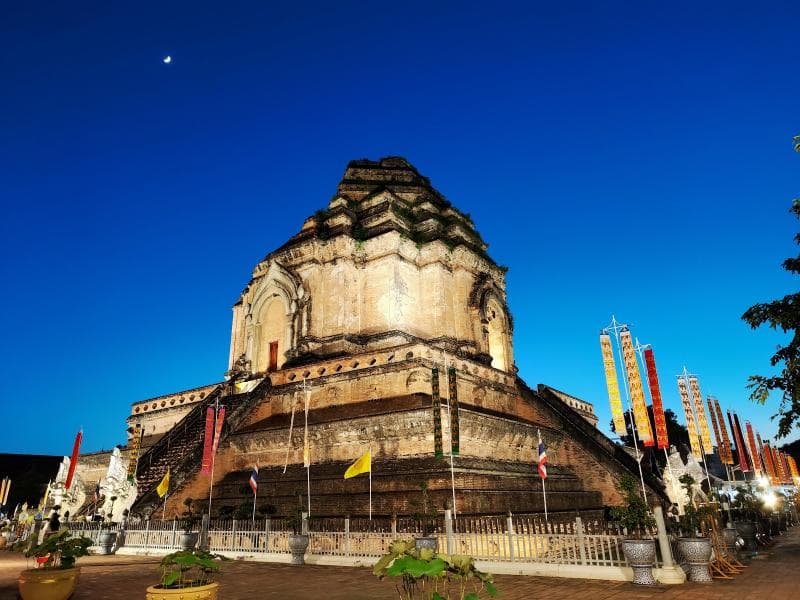
Wat Chedi Luang in Chiang Mai, Thailand, is a historic temple featuring a massive ancient stupa, home to the revered City Pillar, and offering unique Monk Chats.
Overview
Nestled in the historical heart of Chiang Mai's Old City, Wat Chedi Luang stands as a monumental testament to the Lanna Kingdom's rich heritage and spiritual devotion. Its name, translating to 'Temple of the Great Stupa' or 'Royal Stupa Temple', perfectly encapsulates the grandeur of its central feature: a colossal, ancient chedi (stupa) that once dominated the city's skyline. This revered temple complex, over 600 years old, offers a profound glimpse into Thailand's past, showcasing distinctive Lanna-style architecture and housing significant cultural artifacts. [2, 6, 8, 18, 19]
Despite partial damage from an earthquake centuries ago, Wat Chedi Luang remains a powerful symbol of Chiang Mai's enduring legacy and architectural beauty. Visitors are drawn to its serene grounds, intricate carvings, and the opportunity to engage with Buddhist culture. The temple complex is not just a collection of historical structures; it's a living spiritual hub where ancient traditions continue to thrive. [2, 10, 18, 19]
History & Cultural Background
The origins of Wat Chedi Luang trace back to the late 14th century. Construction began in 1391 under the command of King Saen Muang Ma, who intended for the chedi to be the final resting place for his father's ashes. The ambitious project was not completed during his lifetime, but was continued by his wife and finally finished in 1475 during the reign of King Tilokarat. At its zenith, the chedi was an imposing structure, reaching approximately 80 to 85 meters in height and spanning 60 meters at its square base, making it the tallest building in the Lanna Kingdom of its time. [2, 3, 5, 6, 8, 9, 11, 12, 18, 20]
A pivotal moment in its history occurred in 1468 when Wat Chedi Luang became the temporary home for Thailand's most sacred object, the Emerald Buddha. This revered jade statue resided in the chedi's eastern niche for nearly a century. However, disaster struck in 1545 when a powerful earthquake significantly damaged the chedi, causing its upper 30 meters to collapse. Soon after, the Emerald Buddha was moved, eventually finding its permanent home in Wat Phra Kaew in Bangkok. A replica of the Emerald Buddha, made of black jade, now sits in the reconstructed eastern niche, commemorating its historical presence and the temple's 600th anniversary. [2, 3, 4, 5, 6, 7, 9, 12]
What Makes It Special
What truly distinguishes Wat Chedi Luang is its remarkable blend of historical depth and spiritual vibrancy. The massive, partially ruined chedi itself is a breathtaking sight, featuring grand staircases on each of its four sides, guarded by mythical Naga serpent creatures. At the base, stone elephant sculptures, some of which are original, add to its architectural marvel. [2, 5, 9, 14, 18]
Beyond the chedi, the temple grounds host a complex of other significant structures, including the main Viharn Luang, which houses the magnificent Phra Chao Attarot, an 18-cubit tall standing Buddha statue dating back to the late 14th century. [2, 5, 8, 9, 14, 18, 20] The temple is also home to the Sao Inthakin, Chiang Mai's City Pillar, enshrined within a dedicated pavilion. This sacred wooden pillar is believed to protect the city and its inhabitants, and is honored annually during the Inthakhin Festival in May or June, offering a profound insight into local spiritual customs. [3, 4, 6, 7, 8, 9, 14, 20]
Stories, Fun Facts & Local Details
- The current temple grounds are an amalgamation of three original temples: Wat Chedi Luang, Wat Ho Tham, and Wat Sukmin. [2, 7, 8, 23]
- The design of the chedi is thought by some to have been inspired by a chedi called Ku Phaya in Bagan, Myanmar. [8]
- For nearly a century, from 1468 to 1545/1551, Wat Chedi Luang held the Emerald Buddha, making it one of the most important religious sites in the region. [2, 3, 4, 5, 6, 7, 9, 12]
- The City Pillar Shrine at Wat Chedi Luang is unique; unlike many other city pillar shrines in Thailand, it does not feature a typical column of acacia wood but rather a tall plinth under a Buddha statue. [20]
- The restoration efforts in the 1990s, funded partly by UNESCO and the Japanese government, aimed to stabilize the structure. However, some elements of the restoration faced criticism for not strictly adhering to the original Lanna style. [3, 7, 12, 14, 21]
Visitor Perspective
Visiting Wat Chedi Luang offers a serene and enriching experience for any traveler. The temple is conveniently located in the center of Chiang Mai's Old City, making it easily accessible, often within walking distance from other attractions. [5, 8, 10, 11, 19] It is generally open daily from 6 AM to 6 PM, with some main halls closing earlier. An entrance fee of 40-50 THB is typically required for foreigners. [2, 8, 9, 10, 11, 15] To fully appreciate its tranquility and beauty, especially for photography, it's recommended to visit early in the morning or late in the afternoon to avoid crowds and the midday heat. [2, 10, 11]
Modest dress is required out of respect for the sacred site; visitors should ensure their shoulders and knees are covered. [3, 5, 10] A highlight for many is the 'Monk Chat' program, held daily, where visitors can engage in conversations with resident monks (often novices). This unique opportunity allows for a deeper understanding of Buddhism, monastic life, and Thai culture directly from those living it, fostering cultural exchange and mutual respect. [2, 3, 4, 7, 8, 9, 13, 14, 15, 18, 21]
Coordinates: 98.98651602444616, 18.78692357971049
View on Google Maps💬 How Travelers Describe This Place
Based on community votes
Unique
896Photogenic
550Must See
102Beautiful
95Interesting
28
Traveler Stories
Discover memorable experiences shared by travelers who have visited this place.
No traveler stories yet.
Be the first traveler to share what made this place memorable.

Tour
By
Spot
Discover amazing places around the world. Your journey starts here.
Explore
© 2026 TourBySpot. All rights reserved.