Vestibule Access
Split, Croatia
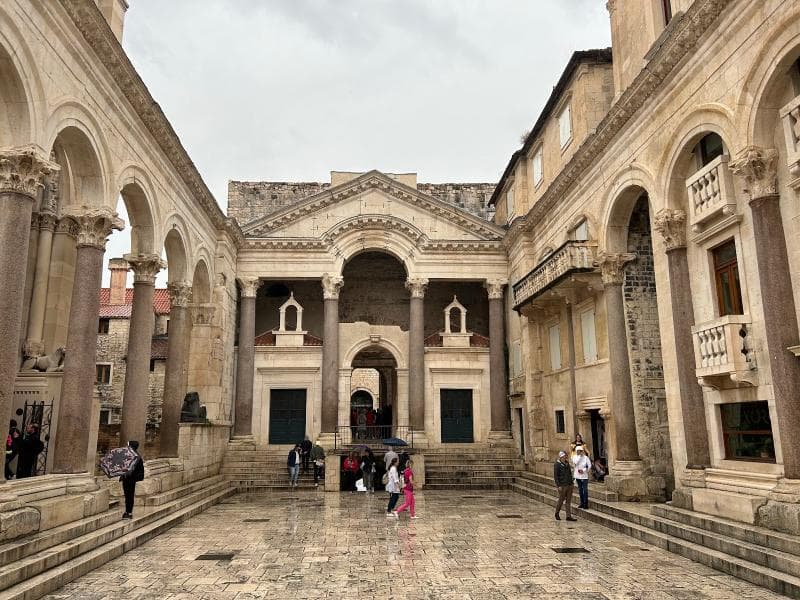
Explore the Vestibule Access in Split, Croatia, an ancient ceremonial entrance to Emperor Diocletian's private quarters within Peristyle Square, known for its stunning Roman architecture and unique acoustics. Discover its rich history and cultural significance.
Overview
Stepping just beyond the bustling Peristyle Square in the heart of Split, Croatia, one encounters the monumental Vestibule Access, a profound gateway into the imperial past of Diocletian's Palace. This circular hall, known simply as the Vestibul, once served as the grand ceremonial entrance to Emperor Diocletian's private residential quarters. While its ancient grandeur of lavish decorations has faded, the Vestibule remains an evocative and striking feature of the UNESCO World Heritage site. Today, it stands as an open-air space, where history resonates not only through its ancient stones but also through its remarkable acoustics, often filled with the harmonious sounds of traditional Dalmatian a cappella groups. It is a place of transition, designed to impress and usher visitors from the public life of the palace into the emperor's secluded world.
History & Cultural Background
The Vestibule's construction dates back to the early 4th century AD, forming an integral part of Diocletian's sprawling retirement palace. Emperor Diocletian, a unique figure in Roman history for voluntarily abdicating his throne, designed this seaside residence as a fortified military camp and a luxurious villa. The Vestibule was conceived as a 'prothyron,' a grand entrance hall meticulously separating the public sphere of the Peristyle from the highly private imperial apartments. Its original design was meant to project immense power and wealth upon anyone who entered.
Imagine this space as it once was: a soaring circular chamber, approximately 17 meters in height and 12 meters in diameter, crowned by a magnificent domed roof. This dome, long since collapsed and open to the sky, was once adorned with vibrant mosaics and gleaming gold leaf, meant to create an awe-inspiring impression. The interior walls featured four semicircular niches, likely housing statues of Roman deities or members of the imperial family, further enhancing the sense of divine authority. The grand entrance was marked by a large, relief-decorated door. Every detail was orchestrated to prepare visitors, such as ambassadors, for an audience with the emperor, underscoring his status as a living god.
What Makes It Special
What truly sets the Vestibule apart today is its unique blend of ancient Roman engineering and its modern-day role as a vibrant cultural stage. Architecturally, it presents an intriguing contrast: while its exterior appears rectangular, the interior reveals a perfectly circular hall. The most striking feature, however, is the open oculus where the original dome once stood, framing the sky above, much like the Pantheon in Rome. This design, whether intentional or a result of time's passage, creates a powerful connection between the ancient structure and the heavens.
Beyond its visual appeal, the Vestibule is renowned for its extraordinary acoustics. The circular stone walls and open ceiling create a natural echo chamber that amplifies sound in a truly magical way. This sonic quality transforms the ancient space into an impromptu concert hall, especially popular with local performers. It's a living testament to 1,700 years of history, seamlessly integrating Roman grandeur with the rhythm of contemporary Split life.
Stories, Fun Facts & Local Details
The Vestibule was, in essence, the emperor's antechamber – a place where guests would pause, perhaps rehearse their greetings, and mentally prepare to stand before one of the most powerful men in the Roman Empire. It was a 'deliberate piece of imperial theatre,' designed to psychologically prime visitors before they encountered Diocletian himself. The lavish decorations and the sheer scale of the space would have undoubtedly conveyed an overwhelming sense of imperial might and divine presence.
Today, this historical echo is most vividly brought to life by the impromptu performances of Dalmatian *klapa* groups. Their polyphonic harmonies, sung without instrumental accompaniment, fill the Vestibule, creating an ethereal and deeply moving experience for visitors. These performances are not scheduled events but rather spontaneous moments that capture the soul of Dalmatian culture and provide a direct, emotional link to the past. It's a fun fact that these local singers intentionally seek out the Vestibule for its perfect natural sound enhancement.
Interestingly, some accounts suggest that in centuries past, before its current appreciation, parts of the Vestibule were even used by residents living within the palace walls to keep poultry or cultivate small gardens, showcasing how the ancient structure was adapted into the daily lives of the city's inhabitants. This intimate integration of ancient ruins into everyday life is a defining characteristic of Diocletian's Palace itself.
Visitor Perspective
Visiting the Vestibule offers a uniquely immersive experience. Unlike many ancient ruins that require tickets or specific visiting hours, the Vestibule is openly accessible 24/7, inviting travelers to step inside and absorb its atmosphere at any time. Many choose to visit early in the morning to enjoy a quieter, more reflective moment, or in the evening when the ancient walls are subtly illuminated, creating a romantic setting.
As you stand within its circular embrace, look up through the oculus to the sky above and feel the cool, ancient stones around you. Imagine the ambassadors and dignitaries who once stood on the very same spot, awaiting their audience with the emperor. And if you're lucky, you might just stumble upon a *klapa* group, their voices rising and intertwining, transforming the historic space into a vibrant canvas of sound. It's a place where history isn't just observed; it's felt, heard, and deeply experienced, making it an unforgettable stop on any journey through Split.
Coordinates: 16.440139, 43.508194
View on Google Maps💬 How Travelers Describe This Place
Based on community votes
Interesting
623Photogenic
343Unique
302Must See
250Beautiful
88
Traveler Stories
Discover memorable experiences shared by travelers who have visited this place.
No traveler stories yet.
Be the first traveler to share what made this place memorable.

Tour
By
Spot
Discover amazing places around the world. Your journey starts here.
Explore
© 2026 TourBySpot. All rights reserved.