Týn Church
Prague, Czech Republic
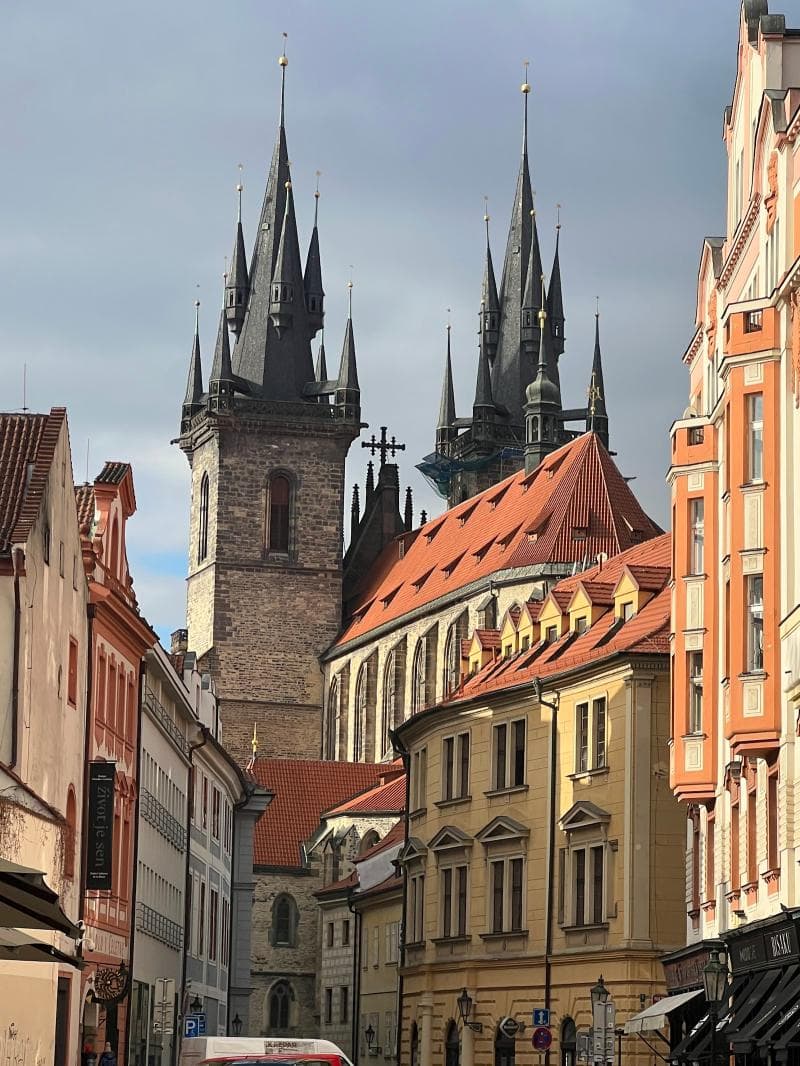
Discover Týn Church in Prague's Old Town Square, a Gothic masterpiece with asymmetrical spires and a rich history, home to Tycho Brahe's tomb. Explore its unique blend of Gothic and Baroque artistry.
Overview
Dominating Prague's Old Town Square with its striking twin spires, the Church of Our Lady before Týn, often simply called Týn Church, stands as an iconic symbol of the city's rich history and architectural grandeur. This Gothic masterpiece, whose full Czech name is Kostel Matky Boží před Týnem, has been a central religious edifice in Prague's Old Town since the 14th century. Its dark, fairytale-like towers, reaching 80 meters high, are a familiar and beloved part of the Prague skyline, visible from many vantage points across the city. While its exterior is predominantly Gothic, a journey inside reveals a lavish Baroque interior, a testament to its long and evolving story.
History & Cultural Background
The site where Týn Church now stands has a deep historical lineage, with a Romanesque church present as early as the 11th century, catering to foreign merchants of the nearby Týn Courtyard. This was later replaced by an early Gothic structure around 1256. The construction of the present church, in the late Gothic style, began in the 14th century, influenced by master architects like Matthias of Arras and Peter Parler. By the early 15th century, the main structure was largely complete, though the towers, gable, and roof were still being finished. For two centuries, the church served as a significant stronghold for the Hussite movement, a pre-Reformation religious reform movement in Bohemia. Jan Rokycana, the only elected Hussite archbishop, served here. During this period, a sculpture of Hussite King George of Poděbrady, accompanied by a large golden chalice—a powerful symbol of the Hussite movement—adorned the church's gable between its towers.
However, following the Battle of White Mountain and the subsequent re-Catholicization in 1626, the Hussite symbols were removed. The chalice was melted down, and a statue of the Madonna and Child was placed in its stead, with the melted chalice's gold forming her halo. A fire in 1679 caused significant damage, leading to Baroque renovations that reshaped much of the interior, creating the intriguing blend of Gothic exterior and Baroque interior seen today.
What Makes It Special
What sets Týn Church apart is its striking blend of styles and its profound historical resonance. Its twin Gothic spires are instantly recognizable, yet a closer look reveals a fascinating detail: they are not symmetrical. One tower, traditionally referred to as 'Adam,' is slightly larger and more robust than the other, 'Eve,' a common feature in Gothic architecture representing masculine and feminine principles. The church's main entrance is surprisingly inconspicuous, tucked away through an arcade of buildings on Old Town Square, adding to its mysterious allure. Inside, the church houses a wealth of artistic treasures, including the monumental main altarpiece by Karel Škréta, a prominent Baroque painter, depicting 'The Assumption of the Virgin Mary.' It is also the final resting place of the esteemed Danish astronomer Tycho Brahe, whose tombstone can be found near the main altar.
Stories, Fun Facts & Local Details
Týn Church is steeped in captivating stories and intriguing details. The asymmetry of its towers, with 'Adam' and 'Eve,' isn't just an architectural quirk; it's a symbolic representation deeply embedded in medieval thought, reflecting the masculine and feminine aspects of creation. A popular, though unverified, legend suggests that the distinctively spiky towers of Týn Church inspired Walt Disney's iconic Sleeping Beauty Castle. The church's long association with the Hussite movement is a crucial part of its identity, and the story of the golden chalice being melted down to adorn the Madonna's halo is a powerful symbol of the religious shifts that swept through Bohemia. Another lesser-known fact is that the church boasts Prague's oldest baptistery, dating back to 1414, and its oldest organ, built in 1673. Adding to its local charm, it's noted that Franz Kafka lived in a house with a window on the church's southern wall from 1896 to 1907.
Visitor Perspective
Experiencing Týn Church as a visitor is a journey through time. From the bustling Old Town Square, its imposing Gothic facade rises majestically above the surrounding buildings, offering an unforgettable silhouette, especially when illuminated at night. Many visitors are surprised to discover that the main entrance is not directly on the square but hidden within an alleyway behind the front row of houses, making its discovery a small adventure in itself. Once inside, the atmosphere shifts from the grandeur of its Gothic exterior to the rich, ornate beauty of its Baroque interior, with its impressive altars, paintings, and historical artifacts. Taking time to explore the interior allows one to appreciate the intricate details, from the artworks by Karel Škréta to the tomb of Tycho Brahe, offering a deep dive into centuries of Czech art and history. It's a place where history whispers from every stone, inviting contemplation amidst the vibrant heart of Prague.
Coordinates: 14.4227, 50.0876
View on Google Maps💬 How Travelers Describe This Place
Based on community votes
Must See
545Unique
211Photogenic
123Interesting
74Beautiful
20
Traveler Stories
Discover memorable experiences shared by travelers who have visited this place.
No traveler stories yet.
Be the first traveler to share what made this place memorable.

Tour
By
Spot
Discover amazing places around the world. Your journey starts here.
Explore
© 2026 TourBySpot. All rights reserved.