Tower
Basel, Switzerland
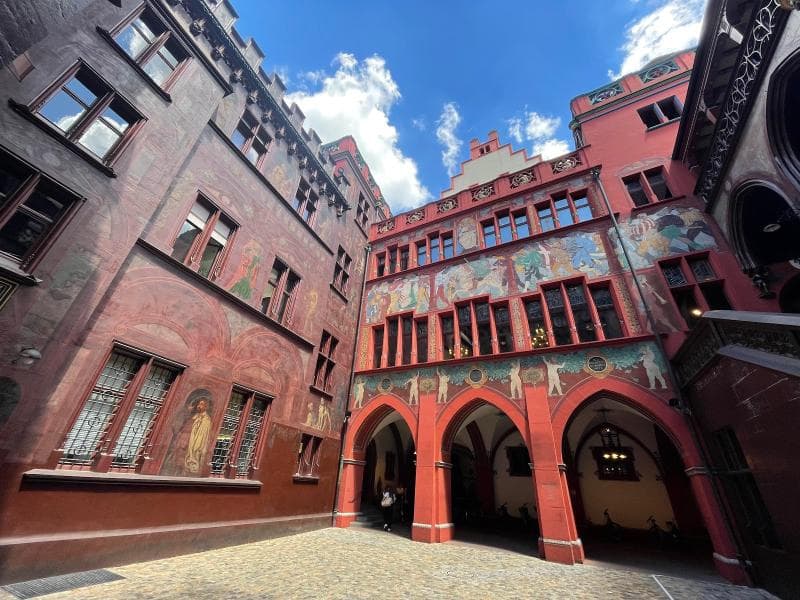
Discover the iconic Tower of Basel Town Hall in Basel, Switzerland, a controversial 19th-century addition to the vibrant red historic seat of government.
Overview
The Tower of Basel Town Hall, known locally as the Rathaus, stands as a prominent and distinctive feature of Basel's historic Marktplatz in Switzerland. This striking red edifice, the seat of the Basel government and parliament, instantly captivates visitors with its vibrant facade and intricate detailing. While the main building dates back to the early 16th century, the imposing tower is a later, yet integral, addition that significantly reshapes the building's profile and presence on the city square. It is a symbol of both civic pride and architectural evolution, inviting curious travelers to delve into its rich history and discover the stories etched into its stones.
Functioning not merely as a historical relic, the Basel Town Hall, including its tower, continues to serve as an active center of local governance. The cantonal parliament and government still conduct their meetings within these walls, making it a living monument where the past and present of Basel seamlessly intertwine.
History & Cultural Background
The story of the Basel Town Hall begins in the early 16th century. After Basel proudly joined the Swiss Confederation in 1501, there was a clear desire to construct a new, grander seat of government to visibly express the city's newfound political importance. The core of the current Rathaus was built between 1504 and 1513, replacing an older structure damaged by the 1356 earthquake and reflecting a period of significant growth and ambition for Basel.
However, the characteristic tower that dominates the Marktplatz today was not part of this initial Renaissance design. It was a much later addition, constructed between 1899 and 1901. This expansion became necessary due to the city's extensive growth in the 19th century and the need for more administrative space, following the creation of a new Cantonal constitution in 1875. The addition of such an imposing structure was not without debate; its significant height sparked controversy, and a public vote was ultimately required before its construction could proceed. This detail highlights a fascinating aspect of Basel's civic engagement and its democratic processes, even in matters of urban development.
What Makes It Special
The Tower of Basel Town Hall, along with the entire Rathaus complex, is special for its distinctive aesthetic and its role as a narrative canvas of Basel's heritage. Its vivid red sandstone facade, a striking contrast against the cityscape, is adorned with elaborate frescoes, intricate carvings, and symbolic figures. These decorations are far more than mere ornamentation; they are visual storytellers, celebrating themes of justice, unity, and the governance of the city.
The tower's Neo-Gothic and Neo-Renaissance elements, characteristic of the late 19th-century additions, beautifully complement the older Renaissance sections of the building. This blend of styles offers a unique architectural journey, showcasing how different eras have contributed to the Rathaus's grandeur. The controversy surrounding its construction also makes it special, offering a glimpse into the democratic spirit of Basel residents who had a say in shaping their city's skyline. Its commanding presence on the Marktplatz, where daily markets bustle below, firmly roots it as a central focal point and an enduring landmark.
Stories, Fun Facts & Local Details
- A Democratic Addition: One of the most intriguing stories surrounding the tower is that its very existence was subject to a public vote. The proposal for its imposing height was initially controversial, underscoring Basel's deep-rooted democratic traditions where citizens actively participate in decisions impacting their city's landscape.
- Architectural Dialogue: The tower represents a fascinating architectural dialogue across centuries. While the main building embodies the Renaissance spirit of the early 1500s, the tower, added in the late 1800s, incorporates Neo-Gothic and Neo-Renaissance styles. This later addition was designed to harmonize with the existing structure while meeting contemporary needs for space and representation.
- Symbol of Continuity: The Rathaus, with its tower, has continuously served as the seat of Basel's government for over 500 years. This unbroken lineage of civic function within the same historic walls is a powerful testament to the city's enduring governance and identity.
- Festive Backdrop: During special occasions, particularly in December, the Basel Town Hall and its tower become a magical backdrop for the city's Christmas markets, illuminated beautifully and adding to the festive atmosphere of the Marktplatz.
Visitor Perspective
For a curious traveler, the Tower of Basel Town Hall serves as an unforgettable landmark and a gateway to understanding Basel's spirit. While the exterior, with its vibrant red color and detailed frescoes, is freely accessible and can be admired at any time, exploring the inner courtyard is highly recommended. The courtyard features more stunning murals and often bustles with local life.
To truly appreciate the history and artistry within, guided tours are available. These tours often provide access to areas like the council chamber and other historically significant rooms, offering deeper insights into the building's political and cultural role. It is advisable to check with Basel Tourism for tour schedules and to book in advance, as internal access is typically restricted to guided visits, especially on weekends and public holidays when the working government offices are closed. Even without a formal tour, standing in the Marktplatz and gazing up at the impressive tower offers a profound connection to centuries of Basel's vibrant history.
Coordinates: 7.588056, 47.558056
View on Google Maps💬 How Travelers Describe This Place
Based on community votes
Photogenic
972Unique
726Interesting
720Must See
597Beautiful
300
Traveler Stories
Discover memorable experiences shared by travelers who have visited this place.
No traveler stories yet.
Be the first traveler to share what made this place memorable.

Tour
By
Spot
Discover amazing places around the world. Your journey starts here.
Explore
© 2026 TourBySpot. All rights reserved.