The Times Square Ball
New York, United States
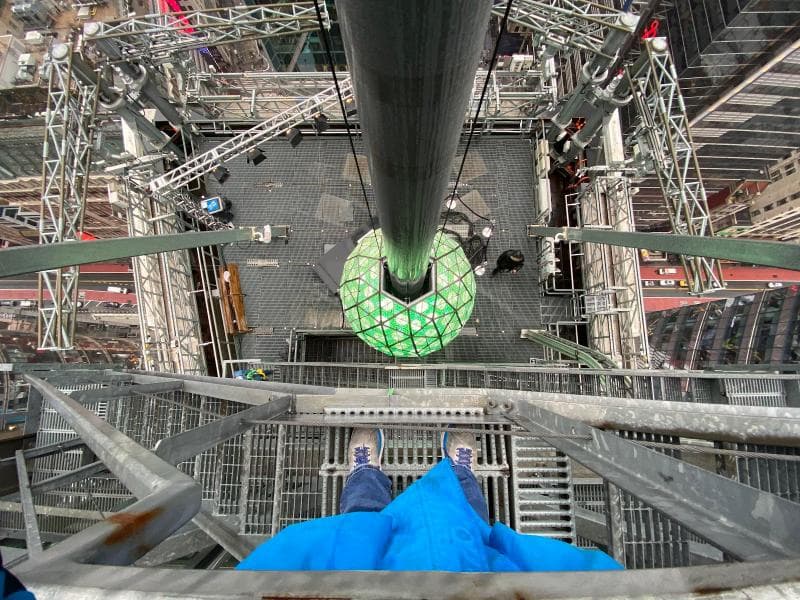
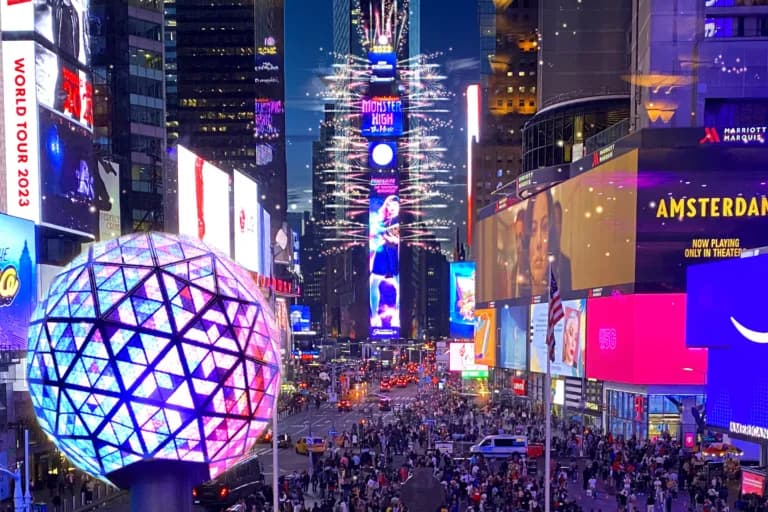
Discover the iconic Times Square Ball in New York, United States, a global symbol of New Year's Eve celebrations with a rich history and dazzling design.
Overview
High above the bustling heart of Times Square in New York, United States, an iconic geodesic sphere known as The Times Square Ball captivates global attention every New Year's Eve. Situated atop One Times Square, this dazzling spectacle descends precisely at 11:59 p.m. ET, marking the final sixty seconds of the old year and ushering in the new. This beloved tradition draws over a million revelers to the streets of Midtown Manhattan, while billions more watch from around the world, making it one of the planet's most anticipated annual celebrations.
More than just a time-keeping device, the Times Square Ball has evolved into a powerful symbol of new beginnings, collective hope, and the vibrant spirit of New York City itself. Its continuous transformation over more than a century reflects advancements in technology and a persistent desire to create an ever-more breathtaking display for onlookers near and far.
History & Cultural Background
The genesis of The Times Square Ball tradition dates back to 1907, an initiative sparked by Adolph S. Ochs, then owner of The New York Times newspaper. After the city banned fireworks displays due to safety concerns following grand New Year's Eve celebrations Ochs had hosted since 1904, he sought an equally spectacular alternative to draw crowds to the newly renamed Times Square, where his newspaper's headquarters stood.
The concept itself was inspired by an older maritime practice of 'time balls.' These devices, first used in places like Greenwich, England, in 1833, would drop at a specific time each day, allowing ship captains to accurately set their chronometers—a critical navigation instrument. The first Times Square Ball, crafted from iron and wood by immigrant metalworker Jacob Starr, was five feet in diameter, weighed 700 pounds, and was illuminated by one hundred 25-watt light bulbs. Since its inaugural drop to welcome 1908, the Ball has only been paused twice, in 1942 and 1943, during World War II's wartime 'dimout' restrictions. Even then, crowds still gathered, greeting the new year with a moment of silence.
What Makes It Special
Today's Times Square Ball, the 'Constellation Ball' which debuted for the 2025-2026 celebration, is a marvel of engineering and artistry. This ninth iteration is the largest and heaviest yet, measuring 12.5 feet in diameter and weighing a staggering 12,350 pounds – more than the average car. It is adorned with 5,280 circular Waterford crystals, a significant design change from previous triangular crystals, designed to evoke celestial bodies. These crystals are intricately carved, and each year features new thematic designs, such as 'Infinite Joy,' 'Infinite Light,' and 'Infinite Beginnings' for 2025, or 'Infinite Life,' 'Infinite Liberty,' and 'Infinite Happiness' for 2026.
The Ball's brilliance comes from 32,256 energy-efficient LED lights, capable of displaying over 16 million vibrant colors and billions of kaleidoscope patterns. This cutting-edge technology allows for stunning visual effects, transforming the night sky above One Times Square into a dynamic canvas of light. The sheer scale and intricate detail of the Ball, combined with its historical lineage, make it a truly unique global icon.
Stories, Fun Facts & Local Details
The Times Square Ball has a storied past filled with fascinating transformations. While the current Ball is a heavyweight, earlier versions included a 400-pound wrought iron ball in the 1920s and a 150-pound aluminum ball in 1955. In a memorable era from 1981 to 1988, the Ball was modified to resemble an apple, complete with a green stem, as part of New York City's 'I Love New York' tourism campaign.
Beyond its physical attributes, the event surrounding the Ball Drop is rich in detail. An estimated 3,000 pounds of confetti, translating to roughly 30 million pieces of colored paper, are released over the crowd at midnight. The annual clean-up effort following the festivities requires hundreds of workers to restore Times Square. The New Year's Eve celebration has seen its share of extreme weather; the coldest Ball Drop on record was a frigid one degree Fahrenheit in 1917, while the warmest was a mild 58 degrees Fahrenheit in 1965 and 1972. The event is globally televised, most famously through 'Dick Clark's New Year's Rockin' Eve,' which brings the countdown to millions of homes worldwide.
Visitor Perspective
For those who brave the elements to witness the Times Square Ball Drop in person, it is an unforgettable, albeit demanding, experience. Arriving many hours before midnight is essential to secure a viewing spot in the penned-off sections. The atmosphere is electric, charged with anticipation and camaraderie as people from all walks of life gather, often enduring cold temperatures for hours. Despite the challenges, the moment the Ball begins its sixty-second descent, culminating in the explosion of light and sound at midnight, is described as a powerful, unifying experience. It is a shared moment of celebration, where the energy of the crowd and the spectacle of the Ball create a profound sense of connection and shared hope for the year ahead. Beyond the New Year's Eve event, Times Square itself is a year-round tourist magnet, offering a dazzling array of entertainment, dining, and shopping options.
Coordinates: -73.9864883, 40.756421
View on Google Maps💬 How Travelers Describe This Place
Based on community votes
Interesting
989Unique
613Photogenic
581Must See
514Beautiful
207
Traveler Stories
Discover memorable experiences shared by travelers who have visited this place.
No traveler stories yet.
Be the first traveler to share what made this place memorable.

Tour
By
Spot
Discover amazing places around the world. Your journey starts here.
Explore
© 2026 TourBySpot. All rights reserved.