The High Altar and Baldacchino
London, United Kingdom
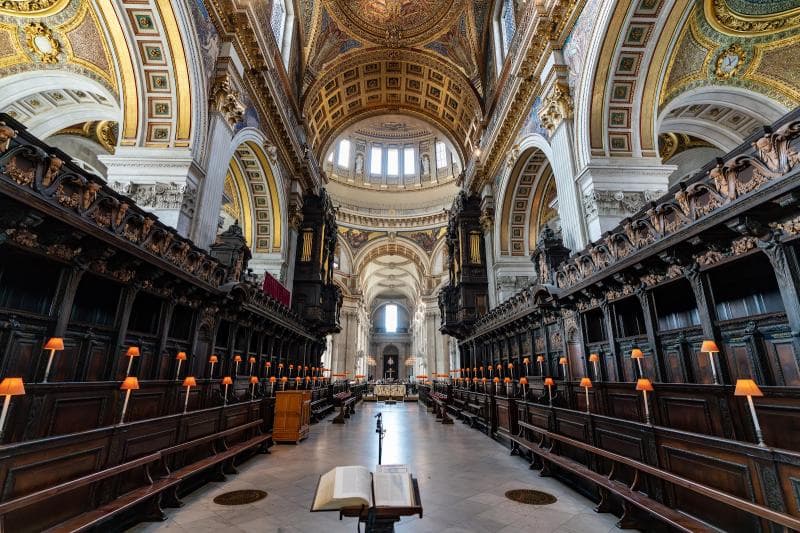
Discover the stunning High Altar and Baldacchino at St. Paul's Cathedral, London, UK. Explore its history, unique features, and hidden stories.
Overview
At the very heart of St. Paul’s Cathedral in London, nestled within the magnificent east end of the Quire, stands 'The High Altar and Baldacchino'. This breathtaking ensemble serves as the spiritual and visual focal point of Sir Christopher Wren’s architectural masterpiece, guiding the gaze of all who enter towards the sacred space. It is a powerful symbol of worship and remembrance, embodying centuries of history and artistic ambition within its intricate design. The High Altar is where the Eucharist is celebrated, while the Baldacchino, an ornate canopy, elevates and frames this most sacred part of the cathedral.
History & Cultural Background
The story of St. Paul’s High Altar and Baldacchino is one of evolution, destruction, and enduring vision. When Sir Christopher Wren completed the cathedral in the early 18th century, the altar was much simpler, and while he envisioned a grand canopy or 'baldacchino', no definitive designs were left by him, and the idea was initially considered too decorative by the clergy of his time. For many years, the east end remained relatively unadorned. However, Victorian tastes led to a significant change. In 1888, a grand, ornate High Altar and a monumental marble reredos (a screen behind the altar), designed by architects Bodley and Garner, were installed. This elaborate Victorian addition became a prominent feature, adorned with a crucifix and various biblical scenes.
Tragedy struck during World War II. In October 1940, a German bomb severely damaged the 1888 reredos and High Altar, leaving the east end scarred. Following the war, a comprehensive restoration effort began. The current High Altar and Baldacchino were conceived as part of this post-war rebuilding, completed and dedicated in 1958. This new design, by Stephen Dykes Bower and Godfrey Allen, sought to honor Wren’s original spirit for a grand canopy, creating a focal point more in keeping with the cathedral's Baroque style while incorporating contemporary significance.
What Makes It Special
The present High Altar and Baldacchino are remarkable for their sheer scale, the richness of their materials, and their profound symbolic meaning. The High Altar itself is made of white Sicilian marble. Its base is a colossal four-tonne slab of Italian marble. Dominating the ensemble is the magnificent Baldacchino, rising dramatically above the altar. It features a gilded figure of Christ with his right hand extended in blessing, drawing the eye upwards towards the cathedral's soaring dome.
Beyond its aesthetic grandeur, the High Altar carries a solemn significance. It stands as a powerful memorial 'To the Glory of God and in memory of the Overseas Members of the Commonwealth and Empire who gave their lives in war 1914-1918 R.I.P 1939-1945'. This dual role as a place of worship and a tribute to sacrifice makes it deeply moving. The design cleverly incorporates classical architectural elements, such as spiraling columns and intricate carvings, creating a sense of both majesty and reverence that perfectly complements Wren’s grand design.
Stories, Fun Facts & Local Details
The area around the High Altar holds several fascinating stories. On either side, visitors will notice two enormous carved candlesticks. These are not merely decorative but are copies of a pair originally commissioned by Cardinal Wolsey in the 16th century for his own burial casket. However, following a dispute with King Henry VIII, the king confiscated them. After being repurposed with Tudor emblems and eventually sold abroad during the Commonwealth period, copies now stand proudly in St. Paul's.
Directly behind the High Altar lies the American Memorial Chapel, consecrated in 1958. This chapel commemorates the 28,000 American servicemen and women who lost their lives while based in the United Kingdom during World War II. Within its intricate carvings, a particularly fun and discreet detail can be found: a small, almost hidden, 1950s-style space rocket, a subtle nod to America’s burgeoning contributions to space exploration at the time. This unexpected detail adds a touch of modern history to the otherwise ancient surroundings.
Visitor Perspective
Upon entering St. Paul’s Cathedral and gazing eastward, the High Altar and Baldacchino immediately command attention. Its prominent position and impressive scale make it a natural focal point, visible even from the far west end of the nave. The sheer artistry and intricate details invite closer inspection, from the symbolic carvings to the rich textures of the marble and the warm gleam of the gilded elements. Visitors often feel a profound sense of awe and reverence in its presence, recognizing it not only as a masterpiece of craftsmanship but also as a powerful spiritual anchor within the vastness of the cathedral. It serves as a poignant reminder of both artistic achievement and solemn sacrifice, encouraging contemplation and reflection for all who encounter it.
Coordinates: -0.0984, 51.5138
View on Google Maps💬 How Travelers Describe This Place
Based on community votes
Interesting
953Beautiful
695Photogenic
658Must See
396Unique
22
Traveler Stories
Discover memorable experiences shared by travelers who have visited this place.
No traveler stories yet.
Be the first traveler to share what made this place memorable.

Tour
By
Spot
Discover amazing places around the world. Your journey starts here.
Explore
© 2026 TourBySpot. All rights reserved.