The Great Court
London, United Kingdom
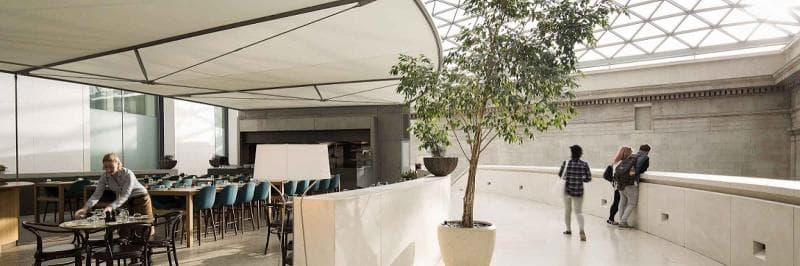

Explore The Great Court at the British Museum, London, United Kingdom – Europe's largest covered public square with a stunning glass roof and rich history.
Overview
At the heart of the British Museum in London, United Kingdom, lies the Queen Elizabeth II Great Court, more commonly known as The Great Court. Opened by Queen Elizabeth II in 2000, this magnificent space serves as the central covered quadrangle of the museum. Designed by the renowned architectural firm Foster + Partners, it transformed what was once an enclosed courtyard into Europe's largest covered public square. It provides a welcoming and awe-inspiring entrance for millions of visitors each year, offering a seamless transition between the museum's diverse galleries.
The Great Court encompasses a two-acre area, elegantly enclosed beneath a tessellated glass and steel roof. This architectural marvel surrounds the iconic British Museum Reading Room, making it a focal point for both access and contemplation. It functions not merely as a passageway but as a civic space, inviting people to gather, relax, and begin their journey through two million years of human history and culture.
History & Cultural Background
The history of The Great Court is one of remarkable transformation. In the original 19th-century design by Robert Smirke, the central courtyard was intended to be an open garden. However, from 1852 onwards, this vision changed dramatically. The courtyard was gradually filled with the British Library's immense collection of books, becoming home to three stories of bookshelves, known as the 'book stacks,' and the famed Reading Room. For over 150 years, this space was inaccessible to the general public, accessible primarily by scholars, and was even referred to by one assistant as a 'dead loss.'
The opportunity for its redevelopment arose when the British Library relocated to its new building at St Pancras in 1997. This move cleared the book stacks and revealed a 'lost' space, prompting an architectural competition to reimagine the courtyard. Foster + Partners won the competition with a design that aimed to reveal hidden spaces, revise old ones, and create new facilities. The £100 million project, supported by grants from the Millennium Commission and the Heritage Lottery Fund, culminated in the opening of the Great Court in 2000.
What Makes It Special
The defining feature of The Great Court is its breathtaking glass and steel roof. This undulating gridshell structure, engineered by Buro Happold and built by Waagner-Biro, consists of 3,312 individual panes of glass, no two of which are exactly the same shape. It spans 6,100 square meters (approximately two acres) and is the largest covered public square in Europe. The roof's complex geometry and the sheer scale of its construction are a testament to modern engineering, yet it appears light and airy, seemingly floating above the classical architecture of the museum without visible supports.
At its core sits the former British Museum Reading Room, a circular structure that once hosted literary giants and thinkers. The redevelopment integrated this historic room, now restored, into the new visitor experience, transforming it into an information center accessible to all. The Great Court effectively connects the museum's various wings, allowing visitors to move freely between galleries that were previously separated, enhancing the overall flow and accessibility of the institution.
Stories, Fun Facts & Local Details
Since its opening, the Great Court has welcomed over 113 million visitors, highlighting its popularity as a key landmark in London. The construction involved removing 20,000 cubic meters of demolition material, equivalent to twelve Olympic swimming pools. The roof's immense weight, nearly 800 tonnes including 315 tonnes of glass, is supported by a triangulated steel lattice made from 4,878 unique steel members connected at 1,566 nodes, fabricated with astonishing accuracy. Each glass pane was designed using a specially written computer program, and many were sponsored by individuals or companies during fundraising efforts.
The Reading Room itself holds stories of famous past readers, including literary figures like Bram Stoker and Sir Arthur Conan Doyle, and even political figures such as Lenin. The Great Court has also been described as a 'new kind of civic space,' a cultural plaza and an oasis in a crowded city, offering an urban experience in microcosm. It even created a new pedestrian shortcut through Bloomsbury, connecting major transport hubs and universities to Covent Garden and the River Thames.
Visitor Perspective
For visitors, The Great Court acts as an intuitive and inspiring starting point for their British Museum exploration. Its vast, light-filled expanse offers a natural gathering area, shelter from the unpredictable London weather, and a sense of grandeur before even delving into the collections. Entry to the Great Court and the main museum collections is free, making it an accessible and welcoming space for everyone.
Beneath the floor of the Great Court are further new galleries, such as the Sainsbury Galleries showcasing the Africa collection, and educational facilities including lecture theatres and centers for young visitors. Visitors can find information points, a bookshop, and a café within the court, making it a functional hub for planning their visit or taking a break. The seamless integration of modern design with the museum's historic architecture creates an experience that is both contemporary and deeply rooted in London's rich cultural heritage.
Coordinates: -0.1269, 51.5195
View on Google Maps💬 How Travelers Describe This Place
Based on community votes
Beautiful
836Interesting
795Must See
620Unique
522Photogenic
489
Traveler Stories
Discover memorable experiences shared by travelers who have visited this place.
No traveler stories yet.
Be the first traveler to share what made this place memorable.

Tour
By
Spot
Discover amazing places around the world. Your journey starts here.
Explore
© 2026 TourBySpot. All rights reserved.