Terraces
Lausanne, Switzerland
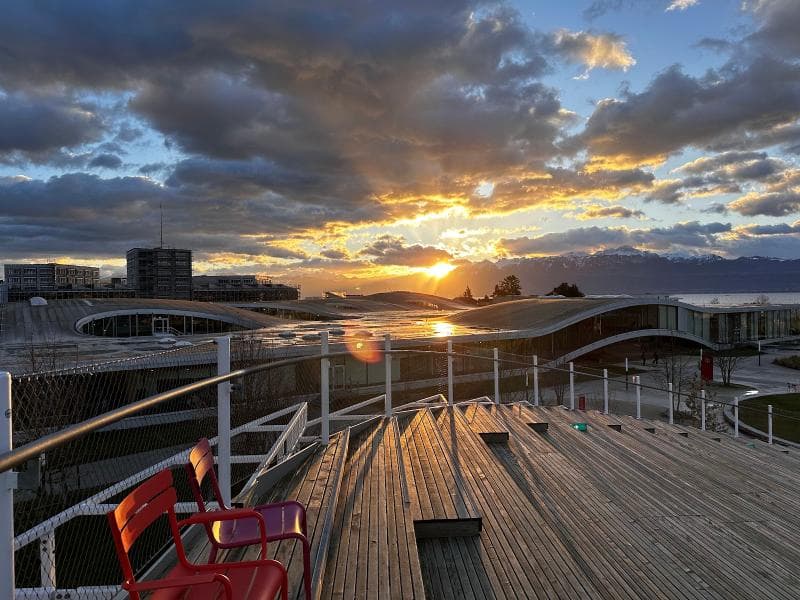
Explore the unique Terraces of the Rolex Learning Center in Lausanne, Switzerland, an architectural marvel by SANAA with undulating floors and open spaces.
Overview
Nestled within the dynamic campus of the École Polytechnique Fédérale de Lausanne (EPFL) in Switzerland, the 'Terraces' are an integral and captivating feature of the iconic Rolex Learning Center. Designed by the renowned Japanese architectural firm SANAA, led by Kazuyo Sejima and Ryue Nishizawa, this architectural marvel opened its doors in 2010. It serves not merely as a building, but as a vibrant learning laboratory, a comprehensive library housing over 500,000 volumes, and a bustling international cultural hub, welcoming both students and the public alike. The entire structure is characterized by a single, fluid, and continuous space, where the concept of traditional floors gives way to a gently undulating landscape of slopes and what are affectionately known as 'terraces'. This innovative design seamlessly integrates diverse functions such as study areas, conference rooms, collaborative workspaces, offices, a bookstore, restaurants, and relaxation zones, all without the confines of rigid walls.
History & Cultural Background
The genesis of the Rolex Learning Center traces back to an international design competition held in December 2004, where SANAA's visionary proposal triumphed over submissions from other architectural luminaries. Construction of this ambitious project spanned from 2007 to 2009, culminating in its official inauguration in 2010. With a budget of 110 million Swiss francs, the building's creation was a collaborative effort, funded by the Swiss government alongside significant private sponsors, most notably Rolex. The timing of its opening was particularly noteworthy as it coincided with SANAA receiving the prestigious Pritzker Prize, a testament to their groundbreaking approach to architecture. The Rolex Learning Center was conceived to embody a new paradigm for learning, emphasizing a continuous, collective, and inspiring environment. Its fundamental purpose was to dismantle the conventional barriers between academic disciplines, fostering an atmosphere where mathematicians could easily interact with engineers, and neuroscientists with microtechnicians, in a shared pursuit of knowledge.
What Makes It Special
What truly sets the Rolex Learning Center apart, and where its 'Terraces' come into their own, is its revolutionary design. The building features an extraordinary undulating floor and roof, meticulously crafted to mimic an artificial topography. These gentle slopes and designated 'terraces' are not just aesthetic elements; they are functionally integrated spaces used for quiet study, informal gatherings, and even housing the center's restaurant. The absence of traditional walls and corridors creates an unparalleled sense of fluidity, encouraging effortless movement and spontaneous interaction throughout the vast space. Large, ovoid 'patios' – essentially open-air courtyards – are carved into the building's footprint, serving a dual purpose: they flood the interior with natural light and organically define different functional areas. Achieving this organic, wave-like form required incredibly complex structural engineering, involving two reinforced concrete shells, underground prestressed cables, and minimal visible supports. For traversing these gentle slopes, visitors can utilize specially designed 'inclined elevators' or 'horizontal elevators,' offering a unique and accessible way to navigate the expansive, rolling interior landscape. The transparency of the design further enhances its distinctiveness, maintaining a constant visual and experiential connection between the interior activities and the surrounding campus environment.
Stories, Fun Facts & Local Details
The Rolex Learning Center's distinctive shape has sparked various descriptive comparisons, with some observers affectionately likening its rectangular form, punctuated by numerous ovoid patios, to a 'slice of Swiss cheese'. A remarkable feat of engineering during its construction involved pouring the concrete for the entire floor continuously over two days to ensure a perfectly seamless, flowing surface. Beyond its academic function, the building has also captured the imagination of filmmakers, serving as a memorable backdrop for the 2014 thriller 'Love is a Perfect Crime'. At its core, the Rolex Learning Center profoundly reflects the EPFL's institutional values, championing innovation and actively breaking down conventional academic and disciplinary barriers. It's common to see students adapt the space to their needs, creatively arranging the numerous beanbag chairs scattered throughout to establish impromptu study zones along the gentle slopes. The former president of EPFL, Patrick Aebischer, famously articulated the building's spirit, describing it as a place where diverse minds—mathematicians, engineers, and neuroscientists—converge, fostering interdisciplinary collaboration to conceive new technologies that enhance lives.
Visitor Perspective
The Rolex Learning Center is notably open to both the academic community and the general public, inviting a broad spectrum of visitors to experience its unique environment. The architectural philosophy encourages free movement and the spontaneous use of its spaces, allowing visitors to interpret and appropriate the areas as they see fit. Indeed, the building is famously accessible for impromptu visits, with observers noting that one can explore it 'on a whim' without being questioned. Moving through the Rolex Learning Center is often described as a magical experience, a departure from traditional architectural movement, challenging the usual vertical or horizontal trajectories. The gentle slopes and integrated 'terraces' provide a diverse range of environments, from secluded, quiet spots ideal for focused study to more open, social areas perfect for collaboration or casual encounters. This design inherently fosters serendipitous meetings and encourages interdisciplinary exchange, creating a dynamic and engaging atmosphere. Throughout the day, the entire interior is bathed in abundant natural daylight, further enhancing the welcoming and open ambiance.
Coordinates: 6.5661, 46.5186
View on Google Maps💬 How Travelers Describe This Place
Based on community votes
Must See
898Photogenic
853Beautiful
667Interesting
190Unique
32
Traveler Stories
Discover memorable experiences shared by travelers who have visited this place.
No traveler stories yet.
Be the first traveler to share what made this place memorable.

Tour
By
Spot
Discover amazing places around the world. Your journey starts here.
Explore
© 2026 TourBySpot. All rights reserved.