Temple of the Frescoes
Cancún, Mexico
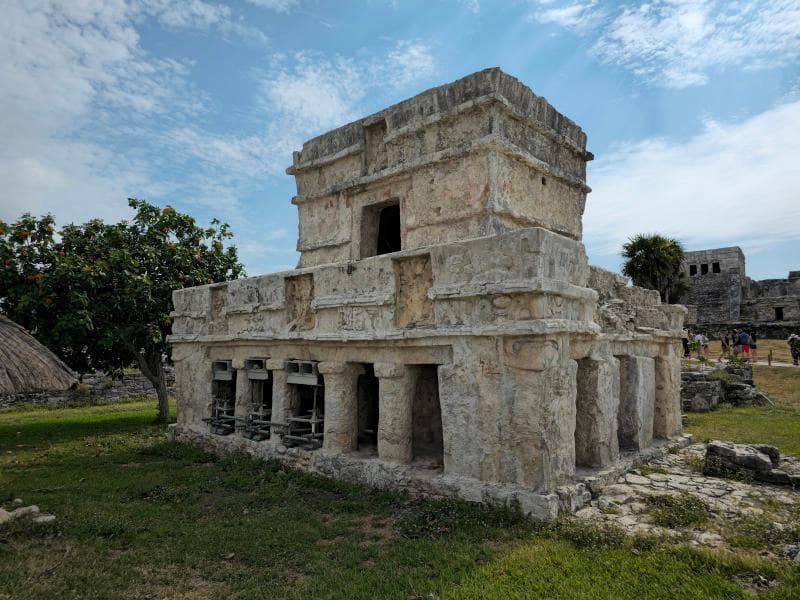

Explore the Temple of the Frescoes, a key structure within the ancient Tulum Ruins in Cancún, Mexico, showcasing stunning Maya murals and astronomical significance.
Overview
Nestled within the breathtaking Tulum Ruins, a significant ancient Maya walled city on Mexico's Caribbean coast, stands the enigmatic Temple of the Frescoes. While perhaps not as imposing as 'El Castillo', this structure holds immense archaeological and cultural importance, serving as a captivating window into the Maya worldview. It earned its name from the remarkably detailed, albeit faded, paintings that adorn its inner walls, offering insights into ancient beliefs and rituals. The temple is one of the most archaeologically significant structures within the site, inviting visitors to ponder the rich history and artistic prowess of the Maya civilization that once thrived here.
Tulum, originally known as Zamá, meaning 'dawn', is strategically positioned on a 12-meter (40-foot) cliff overlooking the turquoise Caribbean Sea, providing not only a stunning backdrop but also a crucial vantage point for trade and defense. The Temple of the Frescoes, though viewed from a distance, plays a vital role in understanding the spiritual and intellectual life of this ancient port city.
History & Cultural Background
The Tulum Ruins, including the Temple of the Frescoes, saw their heyday during the Late Postclassic period, between the 13th and 15th centuries, making it one of the last cities built and inhabited by the Maya. Tulum flourished as a critical trading port, with both maritime and land routes converging here, facilitating extensive commerce across the Yucatán Peninsula and beyond. The city was still inhabited when Spanish conquistadors first arrived in 1518.
The Temple of the Frescoes itself is a two-story building that underwent several construction phases. Its earliest iteration involved a chamber with an altar and murals, followed by a gallery with columns. Later, parts of this gallery were filled to create a base for the upper temple. The structure's facade once featured stucco reliefs, including masks that possibly represented Itzamná, the Maya creator god, and figures of the iconic Descending God, a deity frequently seen throughout Tulum.
What Makes It Special
The true essence of the Temple of the Frescoes lies within its namesake murals. These intricate paintings, though weathered by time and elements, depict a complex cosmology, providing a vivid glimpse into Maya spirituality. They are rendered in shades of black, blue, gray, green, yellow, and red, portraying various deities such as Chaac (the god of rain) and Ixchel (the goddess of the moon and fertility). Beyond deities, the frescoes illustrate symbolic imagery like corn and flowers, intertwined snakes, and offerings.
Archaeologists believe the murals represent three distinct levels of the Maya cosmos: the underworld, the world of the living, and the realm of the creator and rain gods. This multi-layered artistic expression positions the temple as a masterpiece of ancient Maya art and a testament to their deep connection with the spiritual world. Furthermore, the Temple of the Frescoes also functioned as an astronomical observatory. Its precise alignment allowed the Maya priests to mark solstices and equinoxes with remarkable accuracy, using the movements of the sun across the Caribbean horizon to forecast agricultural cycles and divine favor.
Stories, Fun Facts & Local Details
The omnipresent figure of the 'Descending God', depicted headfirst from the heavens, is strongly associated with Tulum and can be found on the Temple of the Frescoes as well as other buildings. Scholars debate the exact representation of this deity, with theories suggesting it could be Venus, the setting sun, the god of rain, or even the god of bees, which was vital for trade. This highlights the Maya's intricate relationship with their environment and cosmos.
Legend speaks of powerful shamans who were said to animate these frescoes during sacred ceremonies, adding a mystical layer to the temple's legacy. The upper level of the temple also displays intriguing red handprints, which archaeologists believe were purely decorative, adding to the temple's unique aesthetic. The particular architectural style of Tulum, characterized by flat roofs supported by columns, offers a contrast to older Maya structures, reflecting the distinct East Coast style prevalent in this late period.
Visitor Perspective
While visitors are not permitted to enter the Temple of the Frescoes to protect its delicate ancient artwork, its exterior still offers a profound experience. The temple's intricate stucco carvings and the visible remnants of its colorful murals can be appreciated from designated viewing paths. Standing before it, one can almost feel the whispers of the past carried by the Caribbean breeze, connecting with the ancient artists and the spiritual life of Tulum.
Many find that the smaller, more intimate structures like the Temple of the Frescoes tell the most compelling stories within the larger Tulum archaeological site. Engaging a knowledgeable guide can significantly enhance the visit, as many details, though not immediately obvious, gain immense depth when explained in context. To fully savor the ambiance and avoid the peak crowds, it is highly recommended to visit the Tulum Ruins, and consequently the Temple of the Frescoes, early in the morning, right when the site opens.
Coordinates: -87.4294, 20.213
View on Google Maps💬 How Travelers Describe This Place
Based on community votes
Photogenic
872Interesting
846Must See
201Beautiful
121Unique
87
Traveler Stories
Discover memorable experiences shared by travelers who have visited this place.
No traveler stories yet.
Be the first traveler to share what made this place memorable.

Tour
By
Spot
Discover amazing places around the world. Your journey starts here.
Explore
© 2026 TourBySpot. All rights reserved.