Suomenlinna Church
Helsinki, Finland
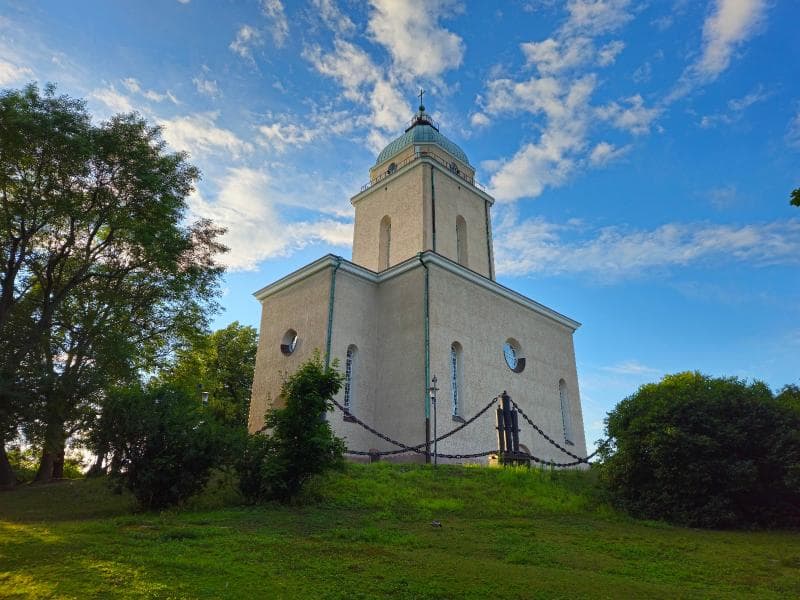
Discover Suomenlinna Church, a historic lighthouse-church on Helsinki's UNESCO-listed Suomenlinna fortress. Explore its Russian Orthodox origins and unique Finnish transformation.
Overview
Perched majestically on the island of Iso Mustasaari within the UNESCO World Heritage-listed Suomenlinna sea fortress, the Suomenlinna Church stands as a remarkable landmark in Helsinki, Finland. This distinctive structure, with its serene grey exterior, is far more than just a place of worship; it is a living testament to Finland's complex history and a beacon for maritime travelers. Originally consecrated in 1854 as an Eastern Orthodox garrison church for Russian troops, it underwent a significant transformation to become an Evangelical Lutheran church following Finland's independence. Its most celebrated feature is its unique dual function: since 1929, the church's central dome has served as an active lighthouse, guiding ships and even air traffic into Helsinki's harbor. Visible from the sea, it offers one of the first welcoming sights to those approaching the Finnish capital by water, embodying both spiritual solace and practical navigation.
History & Cultural Background
The story of Suomenlinna Church is deeply intertwined with Finland's national narrative. Construction began in 1849, culminating in its completion in 1854 as an Eastern Orthodox church, dedicated to Saint/Prince Alexander Nevsky. It was designed by the esteemed Konstantin Thon, an official architect of Imperial Russia, who also contributed to prominent structures like the Cathedral of Christ the Saviour in Moscow. During this period, Finland was a Grand Duchy under Russian rule, and the church was built for the Russian garrison stationed at the Suomenlinna fortress, then known as Viapori. Originally, the church boasted five onion domes and an ornate interior rich with iconography, clearly reflecting its Russian Orthodox heritage.
A significant turning point came after Finland declared its independence in 1917. In 1918, the Orthodox church was converted into an Evangelical Lutheran church, a symbolic act asserting Finland's newfound sovereignty and cultural identity. This conversion led to extensive renovations in the 1920s, overseen by architects Einar Sjöström and Jarl Eklund. The most visible changes included the removal of the four smaller onion domes and the reshaping of the main dome, simplifying the building's exterior to a more Western, classicist style. The original iconography and movable effects were removed, and the interior was pared down. A large church bell, cast in Moscow in 1885 and weighing 6,683 kilograms, which was once Finland's largest, now stands proudly beside the church as a historical artifact.
What Makes It Special
The Suomenlinna Church is celebrated for its remarkable dual functionality as both a spiritual sanctuary and a critical navigational aid. Since its reconsecration in 1929, the church's central dome has ingeniously housed a lighthouse. This makes it one of only a handful of churches globally to serve this dual purpose. The lighthouse, officially known as the Harmaja Range Rear light, works in conjunction with the Harmaja lighthouse further south in the Gulf of Finland. Its signal is truly distinctive: it flashes four consecutive times, spelling out the Morse code for the letter 'H', signifying Helsinki. This unique feature highlights the church's deep connection to the sea and its role in maritime safety. Its prominent position on the highest point of Iso Mustasaari ensures its visibility and symbolic importance. The architectural transformation itself is a poignant symbol, illustrating Finland's journey from Russian influence to independent nationhood.
Stories, Fun Facts & Local Details
Beyond its historical facade, Suomenlinna Church holds many fascinating details. The colossal 6,683-kilogram church bell, once the largest in Finland, now displayed adjacent to the church, offers a tangible link to its Orthodox past. Surrounding the church, visitors can observe a perimeter fence constructed from cannons and chains dating back to the 1870s, a subtle reminder of the fortress's military history. Today, the church is a very popular location for weddings, drawing couples with its historic charm and picturesque setting. It also frequently hosts concerts and cultural events, maintaining its role as a vibrant community hub within the fortress. For those interested in its layered past, the church often features exhibitions, such as 'Glimpses of Light and Hope,' which delve into its history from the 18th century to the present day. Even the recent renovation of its copper roof incorporated recycled material from the original, ensuring the 'spirit of the old copper roof continues into the future.'
Visitor Perspective
Visiting Suomenlinna Church is an integral part of exploring the Suomenlinna sea fortress. Access to the island is easy and scenic, typically by a short 15-20 minute ferry ride from Helsinki's Market Square, with HSL public transport tickets being valid for the journey. Upon arrival at Iso Mustasaari, the church is conveniently located a short, well-signposted walk from the ferry dock. It lies along the popular Blue Route, which guides visitors through the fortress's main sights. While entry to the church itself is generally free, during certain peak summer months, a small entrance fee may apply or be included as part of a combined museum pass, which also grants access to other attractions on the fortress. It is advisable to check the official Suomenlinna website for current opening hours, as these can vary seasonally. The church is also designed with accessibility in mind, offering wheelchair-accessible routes from the ferry. For many arriving in Helsinki by sea, the lighthouse-church is the first welcoming landmark, offering both a historical welcome and practical guidance.
Coordinates: 24.986349, 60.147855
View on Google Maps💬 How Travelers Describe This Place
Based on community votes
Interesting
443Must See
414Unique
310Beautiful
277Photogenic
233
Traveler Stories
Discover memorable experiences shared by travelers who have visited this place.
No traveler stories yet.
Be the first traveler to share what made this place memorable.

Tour
By
Spot
Discover amazing places around the world. Your journey starts here.
Explore
© 2026 TourBySpot. All rights reserved.