Summit Cross
Podgorica, Montenegro
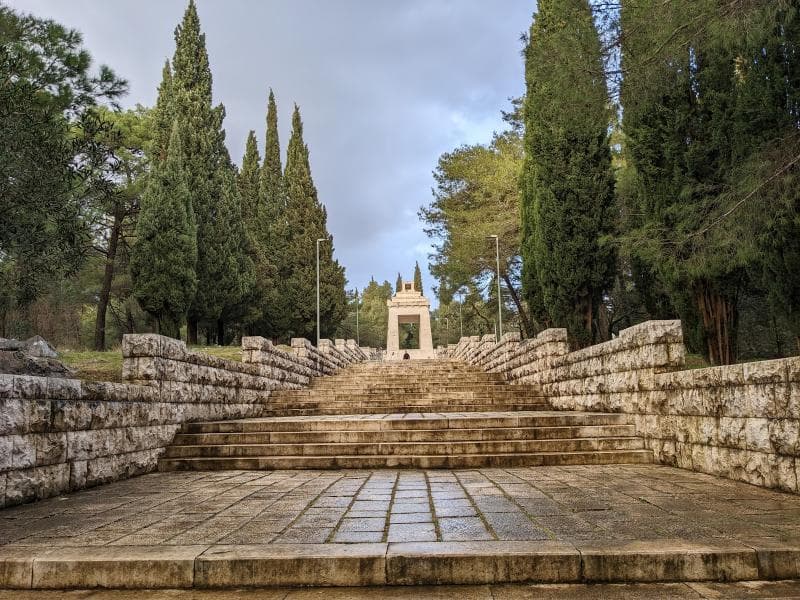
Discover the Summit Cross (Mausoleum to Fallen Partisan Fighters) on Gorica Hill in Podgorica, Montenegro. Explore its history, cultural significance, and panoramic views.
Overview
Perched majestically atop Gorica Hill, a verdant sanctuary in the heart of Podgorica, Montenegro, stands a profound and historically significant landmark often referred to as the 'Summit Cross.' However, its official designation is the Mausoleum to Fallen Partisan Fighters. This commanding structure serves as a poignant memorial, deeply intertwined with the city's identity and the broader history of Montenegro. Gorica Hill itself, which lent its name to the capital city (with 'Podgorica' literally meaning 'under Gorica'), has long been a cherished natural retreat, offering both locals and visitors a refreshing escape from urban life.
Rising approximately 130 meters above the city, Gorica Hill is a protected forest park, spanning around 120 hectares. It boasts dense foliage of oak, hornbeam, and pine, crisscrossed by a network of walking paths. From its summit, visitors are treated to expansive panoramic views of the city below, the winding Morača River, and the vast Zeta plain. This beloved green lung of Podgorica is a popular destination for recreation, known for its clean air and tranquil environment.
History & Cultural Background
The history of Gorica Hill's summit is predominantly defined by the construction and dedication of the Mausoleum to Fallen Partisan Fighters. This monumental memorial complex was officially unveiled on July 13, 1957. This date was deliberately chosen to commemorate the Day of the Uprising of the People of Montenegro against fascist occupiers during the Second World War. The design was a collaborative effort between architect Vojislav Đokić and sculptor Drago Đurović, who together created a powerful and enduring tribute to those who sacrificed for freedom.
The mausoleum serves as the final resting place for 68 revolutionary fighters, including 66 national heroes of Yugoslavia, making it a central memorial to all Montenegrin victims of World War II. In the era of socialist Yugoslavia, when Podgorica was known as Titograd, the mausoleum was a highly significant symbol of the capital. It was prominently featured on postcards promoting the city and even adorned the city's coat of arms, underscoring its importance in the national narrative. The monument was initially designed to be easily visible from the city center, with a processional stairway descending towards what was then the city's main square, though subsequent reforestation has altered this direct view.
What Makes It Special
What makes the 'Summit Cross' on Gorica Hill truly special is its dual nature: it is not a traditional religious cross, but rather a profound secular memorial—the Mausoleum to Fallen Partisan Fighters. Its elevated position ensures it remains a visible landmark, a silent sentinel overlooking the city. Inside the mausoleum, a poignant inscription declares, 'They loved freedom more than life,' encapsulating the ultimate sacrifice made by the national heroes interred there. This powerful message resonates deeply, evoking a strong sense of national pride and remembrance, particularly during significant Montenegrin state holidays.
Beyond its historical gravitas, Gorica Hill itself holds immense significance as 'Podgorica's lungs.' The hill's abundant pine forests, along with cypress, Macedonian oak, and ash trees, play a crucial role in purifying the city's air. The pines, in particular, are known to emit natural chemical substances called 'phytoncides,' which have therapeutic benefits for human health. Recognized for its ecological importance, Gorica Hill was officially declared a protected area in 2022, safeguarding its natural beauty and environmental contribution to the city.
Stories, Fun Facts & Local Details
The very name 'Podgorica' offers a delightful local detail: it literally translates to 'under the little hill,' directly referencing Gorica Hill and highlighting its fundamental connection to the city's identity since ancient times. Gorica Hill is also home to the Church of St. George, one of Podgorica's oldest surviving buildings. Local tradition dates the first chapel on this site to the 9th or 10th century, adding layers of medieval history to the hill's rich past.
During the socialist era, the Mausoleum to Fallen Partisan Fighters was more than just a memorial; it was a vibrant center for national ceremonies. It was here that young recruits of the Yugoslav People's Army would take their military oaths, and new Tito pioneers would proudly receive their iconic red scarves, cementing its place in the collective memory of a generation. Locals affectionately consider Gorica Hill their backyard, utilizing its trails daily for activities such as running, dog walking, and family outings. Scattered throughout the park are even remnants of abandoned Yugoslav bunkers, hinting at its strategic past.
Interestingly, when the Mausoleum was constructed in the mid-1950s, the hill was largely devoid of trees, allowing the monument to be clearly seen from the city center. However, extensive reforestation efforts over the subsequent decades transformed Gorica into the lush green space it is today, obscuring some of the original sightlines but enhancing its role as an urban oasis. The presence of pine trees emitting therapeutic phytoncides is a unique natural detail, contributing to the hill's reputation as a place of healing and well-being.
Visitor Perspective
For visitors, Gorica Hill offers an accessible and enriching experience. There are no entrance fees or ticket offices, allowing free access to its extensive network of walking paths. These trails cater to various fitness levels, from leisurely strolls to more vigorous hikes, making it a perfect spot for recreation. Practical advice for visitors includes bringing water, as natural fountains are not available on the summit trails, and avoiding the intense midday heat of July and August. While paths are generally well-maintained, they can become muddy after winter rains, so appropriate footwear is recommended.
Waymarking on the trails can be sparse, with signs predominantly in Montenegrin, so downloading an offline map is advisable to navigate the various routes effectively. Beyond the Mausoleum itself, visitors can explore the charming Church of St. George, nestled halfway up the southwest slope, or enjoy the family-friendly adventure park located within the hill's embrace. The Mediterranean garden on the hilltop is another highlight, showcasing diverse flora. Whether seeking historical insight, natural beauty, or a tranquil escape, the Summit Cross and Gorica Hill provide a memorable perspective on Podgorica's heritage and environment.
Coordinates: 19.266055, 42.449555
View on Google Maps💬 How Travelers Describe This Place
Based on community votes
Photogenic
722Interesting
698Must See
465Beautiful
276Unique
126
Traveler Stories
Discover memorable experiences shared by travelers who have visited this place.
No traveler stories yet.
Be the first traveler to share what made this place memorable.

Tour
By
Spot
Discover amazing places around the world. Your journey starts here.
Explore
© 2026 TourBySpot. All rights reserved.