St. Nicholas Church
Prague, Czech Republic
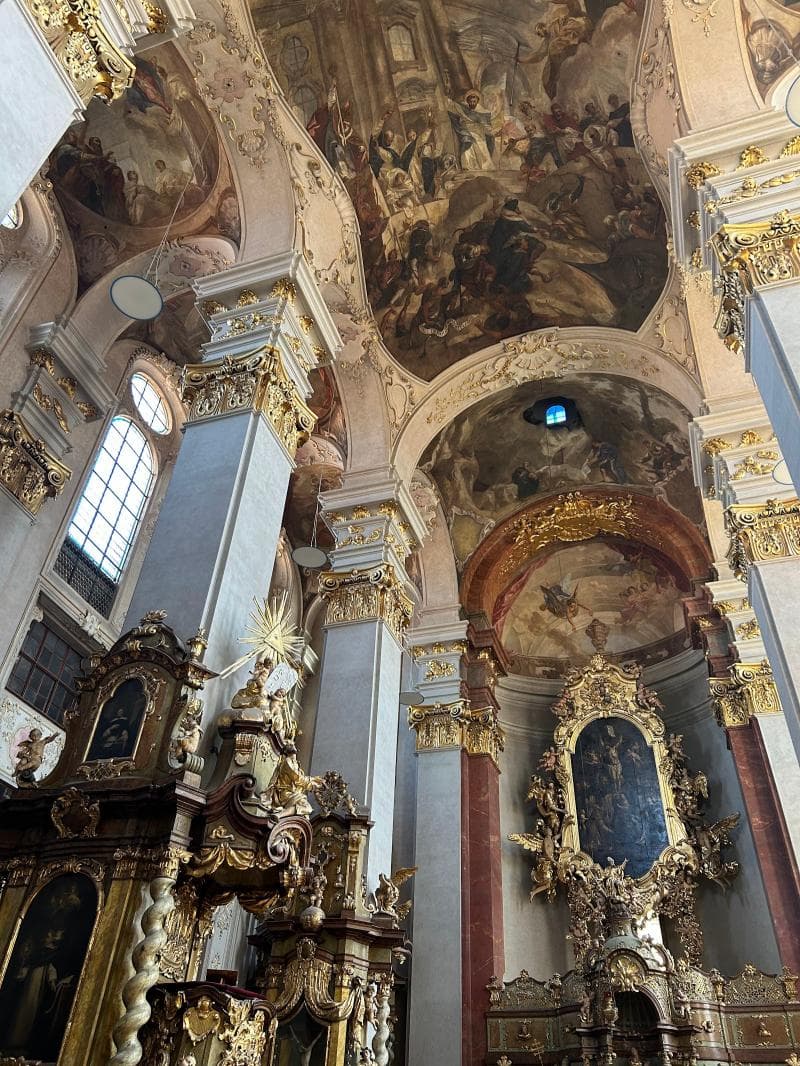
Discover St. Nicholas Church in Prague's Old Town Square, a Baroque gem with a rich history, stunning frescoes, and a magnificent crystal chandelier.
Overview
Nestled in the vibrant north-western corner of Prague's Old Town Square, the Church of St. Nicholas (Kostel sv. Mikuláše) stands as a prominent Baroque masterpiece, captivating visitors with its imposing facade and rich history. While Prague is home to another renowned St. Nicholas Church in Malá Strana, this particular gem distinguishes itself through its unique architectural details and a storied past intrinsically linked to the Old Town. It serves not only as an architectural marvel but also as an active place of worship for the Czechoslovak Hussite Church and a celebrated venue for classical music concerts, renowned for its exceptional acoustics.
History & Cultural Background
The site upon which the current St. Nicholas Church stands has been dedicated to religious use since the 13th century, originally housing a Gothic parish church. This earlier structure played a significant role in Prague's civic and religious life, even serving as a council chamber and a platform for reformist thinkers like Jan Hus. Following a devastating fire in 1689, the Gothic church was eventually demolished to make way for the grand Baroque edifice we see today.
Construction of the present church took place between 1732 and 1737, under the visionary design of the acclaimed Baroque architect Kilian Ignaz Dientzenhofer. Over the centuries, the church's ownership and purpose shifted dramatically. It transitioned from a Catholic diocese to the Benedictine Order, and faced a period of secularization under Emperor Josef II in the late 18th century, when it was stripped of its valuables and used as a granary and archive. Later, in 1871, it became a Russian Orthodox Church. A pivotal moment in its modern history arrived in 1920, when the church became the main seat of the Czechoslovak Hussite Church, which it remains today.
What Makes It Special
The Church of St. Nicholas is celebrated as one of Central Europe's most fascinating Baroque buildings. Its exterior features a striking white facade, crowned by a distinct bronze dome and two tall towers, making it a prominent feature of the Prague skyline. The interior is a feast for the senses, inspired by the Chapel of Saint-Louis-des-Invalides in Paris. Visitors are greeted by intricate stucco work by Bernardo Spinetti and breathtaking ceiling frescoes by Cosmas Damian Asam, which vividly depict scenes from the lives of Saint Nicholas and Saint Benedict, creating remarkable trompe l'œil effects.
Perhaps its most dazzling feature is the colossal crystal chandelier, crown-shaped, measuring 4.5 meters in diameter and weighing approximately 1.5 tonnes (1,400 kilograms). This magnificent piece, crafted by the Harrachov glassworks, was a gift from a Russian Tsar to the Orthodox congregation in 1880, a tangible reminder of a past era.
Stories, Fun Facts & Local Details
An intriguing historical detail reveals that the church's impressive facade was not always as visible as it is today. For centuries, it was partially obscured by other buildings, notably the medieval Krenn House, which was only demolished in 1901. This means much of its grandeur remained hidden from the square for a significant portion of its existence. During the Prague Uprising in 1945, the church also served a clandestine role, used by Czech partisans as a concealed location for Radio Prague, demonstrating its unexpected contribution to wartime efforts.
The church's Baroque organ, adorned with ornate carvings of trumpet-playing angels, is considered among the most beautiful in Prague and is a central element of the many classical concerts held here. These concerts are a long-standing tradition, drawing music lovers who appreciate the church's superb acoustics in its historic setting.
Visitor Perspective
For a curious traveler, the Church of St. Nicholas offers a profound glimpse into Prague's artistic, religious, and historical layers. While it's an active place of worship with Sunday services, it graciously opens its doors to visitors seeking to admire its Baroque splendor. A visit of 20-30 minutes is often sufficient to appreciate its interior, though those attending a classical concert might linger longer to immerse themselves in the music and ambiance. The church's central location in Old Town Square makes it easily accessible and a natural stop when exploring other nearby landmarks like the Astronomical Clock and the Old Town Hall. Even in winter, the church ensures a comfortable experience for concert-goers with heated seats, inviting all to enjoy its cultural offerings year-round.
Coordinates: 14.4195, 50.0857
View on Google Maps💬 How Travelers Describe This Place
Based on community votes
Beautiful
915Interesting
873Photogenic
422Must See
123Unique
53
Traveler Stories
Discover memorable experiences shared by travelers who have visited this place.
No traveler stories yet.
Be the first traveler to share what made this place memorable.

Tour
By
Spot
Discover amazing places around the world. Your journey starts here.
Explore
© 2026 TourBySpot. All rights reserved.