St. Mark’s Square
Zagreb, Croatia
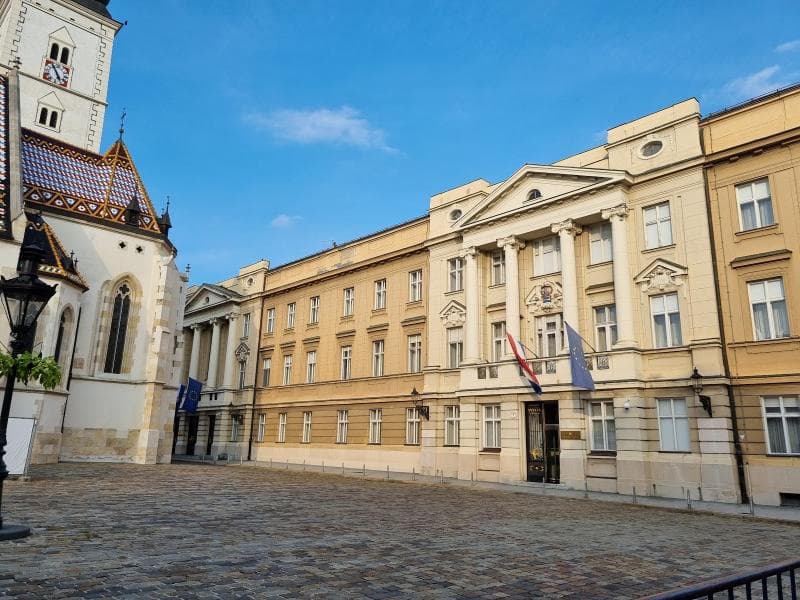
Discover St. Mark's Square in Zagreb, Croatia, home to the iconic St. Mark's Church with its colorful tiled roof and historic governmental buildings.
Overview
St. Mark's Square, or Trg svetog Marka as it's known locally, is the historical and political heart of Zagreb's Upper Town, known as Gornji Grad. Far from being merely a public space, this enchanting square serves as a vibrant outdoor museum, encapsulating centuries of Croatian history and culture. Dominating the square is the iconic St. Mark's Church, instantly recognizable by its spectacularly tiled roof that vividly displays the coats of arms of Croatia, Dalmatia, Slavonia, and the city of Zagreb. But the square is more than just home to this architectural marvel; it is also surrounded by crucial governmental buildings, including the Croatian Parliament (Sabor Palace) and the Government Palace (Banski dvori), underscoring its enduring significance in the nation's civic life.
As you wander through St. Mark's Square, you'll feel the palpable weight of history beneath your feet, on the cobblestones that have witnessed countless pivotal moments. It's a place where medieval charm blends seamlessly with national pride, offering visitors a unique glimpse into the soul of Croatia's capital. The square's elevated position in the Upper Town provides not only picturesque views but also a sense of stepping back in time, away from the bustling pace of modern Zagreb.
History & Cultural Background
The origins of St. Mark's Square trace back to the 13th century, solidifying its status as one of Zagreb's oldest and most historically charged locales. Its development as a central civic hub began in earnest after the 1242 Golden Bull, when King Béla IV granted the settlement of Gradec (now Upper Town) the status of a free royal city. This decree transformed the area into a focal point for administration and public life, a role it continues to uphold today.
The square's most prominent feature, St. Mark's Church, itself boasts a rich history dating back to the 13th century. While retaining some original Romanesque elements, it underwent a significant reconstruction in the 14th century, transforming into a three-nave Gothic structure. Further substantial rebuilding in the Neo-Gothic style occurred in the late 19th century, led by architects Friedrich Schmidt and Herman Bollé. This era saw the addition of the famed colorful tiled roof, which remains a potent symbol of Croatian identity. The church's southern portal, adorned with fifteen sculpted figures, is considered a prime example of Gothic artistry in Central Europe, with some elements attributed to the influential Parler family from Prague.
Beyond the church, the surrounding governmental buildings have housed critical political decisions throughout Croatian history. The Croatian Parliament has convened here since 1737, and it was within these walls that declarations of secession from the Austro-Hungarian Empire in 1918 and from Yugoslavia in 1991 were made.
What Makes It Special
The undeniable allure of St. Mark's Square lies in its unique blend of architectural grandeur, historical depth, and symbolic significance. The chief draw is undoubtedly St. Mark's Church with its magnificent tiled roof. The vibrant tiles, meticulously arranged to depict the medieval coat of arms of the Triune Kingdom of Croatia, Dalmatia, and Slavonia on one side and the emblem of the city of Zagreb on the other, create an unforgettable visual spectacle that sets it apart from any other church in Europe.
Moreover, the square isn't just a place of worship but a nucleus of national governance. Flanked by the Croatian Parliament and the Government Palace, it represents the very heart of Croatia's political landscape. This concentration of power and history in such a picturesque setting imbues the square with a palpable sense of importance and reverence.
The southern portal of St. Mark's Church is another exceptional feature. Its intricate Gothic carvings, featuring statues of the Holy Family, St. Mark, and the Apostles, are masterpieces of medieval sculpture and offer a window into the artistic prowess of the 14th century. Inside, works by renowned Croatian artists like Ivan Meštrović and Jozo Kljaković further enrich the church's cultural value.
Stories, Fun Facts & Local Details
St. Mark's Square is steeped in local lore and fascinating anecdotes. One of the most poignant tales associated with the square involves Matija Gubec, a leader of a great peasant uprising in 1573. Legend has it that Gubec was publicly tortured in St. Mark's Square before his execution, and some believe a face carved on a corner building within the square represents him, a somber reminder of a pivotal moment in Croatian peasant history.
For a brief period after the assassination of Stjepan Radić in 1928, the square was renamed 'Trg Stjepana Radića' in his honor, only to revert to its historical name in 1990. The square has also been the site of presidential inaugurations, though recent security changes have led to adjustments in public access, particularly near the governmental buildings.
While the church interior is generally only accessible during mass, simply admiring the exterior and its surroundings is a truly rewarding experience. Visitors might even catch the daily firing of the Lotrščak Tower cannon, a nearby tradition that adds to the Upper Town's unique atmosphere. The square’s long-standing connection to local life is evident in its past role as a market square for Gradec, and even today, it remains a venue for cultural events, seeking to revive its festive medieval spirit.
Visitor Perspective
Visiting St. Mark's Square is an immersive journey into Zagreb's past and present. It's best experienced by strolling leisurely through the cobblestone streets of Gornji Grad, allowing the history and charm to unfold around you. The square offers numerous vantage points for capturing the stunning details of St. Mark's Church's roof, a perfect photographic opportunity that embodies the city's unique character. While the immediate vicinity of the church and government buildings might have restricted access at times due to security, the sheer presence and beauty of the square are undiminished.
As you stand in the square, take a moment to absorb the intricate details of the church's Gothic portal, imagining the hands that carved its figures centuries ago. Look around at the dignified facades of the Parliament and Government palaces, recognizing the profound historical decisions made within their walls. St. Mark's Square is not just a collection of buildings; it's a living narrative of Zagreb and Croatia, inviting curious travelers to connect with its enduring legacy. It’s a place to reflect, to learn, and to appreciate the rich tapestry of a city that proudly wears its history.
Coordinates: 15.97389, 45.81639
View on Google Maps💬 How Travelers Describe This Place
Based on community votes
Interesting
963Unique
663Must See
653Beautiful
503Photogenic
201
Traveler Stories
Discover memorable experiences shared by travelers who have visited this place.
No traveler stories yet.
Be the first traveler to share what made this place memorable.

Tour
By
Spot
Discover amazing places around the world. Your journey starts here.
Explore
© 2026 TourBySpot. All rights reserved.