St. Blaise Statue
Dubrovnik, Croatia
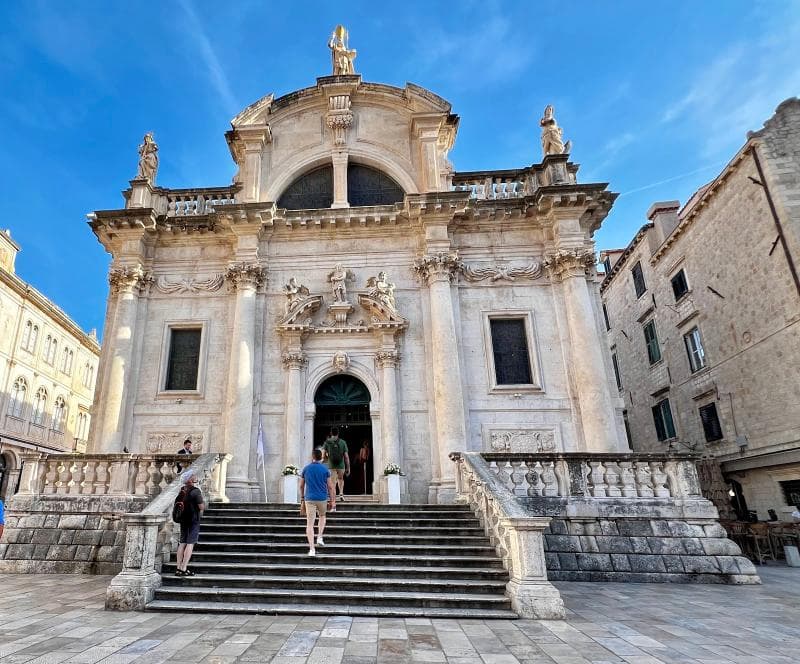
Discover the St. Blaise Statue at Pile Gate, Dubrovnik, Croatia. Learn about the patron saint's legend and his iconic role protecting the city.
Overview
As you approach the ancient walled city of Dubrovnik, Croatia, through the magnificent Pile Gate, your gaze will inevitably be drawn upwards to a serene, watchful figure: the statue of St. Blaise. This venerable sculpture, carved in stone, stands as a silent guardian overlooking all who enter and exit the city's primary western entrance. More than just a decorative element, the statue embodies centuries of Dubrovnik's profound devotion to its patron saint, Sveti Vlaho (St. Blaise), whose presence is woven into the very fabric of the city's identity and history. His gentle countenance, often depicted holding a miniature replica of the city, serves as a poignant reminder of his legendary protection and the deep spiritual connection the people of Dubrovnik have maintained through eras of prosperity and peril alike.
History & Cultural Background
The story of St. Blaise's veneration in Dubrovnik dates back to the 10th century, specifically to the year 971 AD. According to local tradition, the city, then known as the Republic of Ragusa, faced an imminent and unexpected threat from the Venetian fleet. It was said that St. Blaise, appearing in a vision to a local priest named Stojko, revealed the Venetians' true intentions—not merely to resupply, but to launch a surprise attack. Warned in advance, Dubrovnik's citizens were able to prepare their defenses, forcing the Venetian fleet to abandon its plans. This miraculous intervention solidified St. Blaise's role as the city's divine protector, and he was swiftly adopted as the official patron saint.
His image soon became ubiquitous throughout Dubrovnik, appearing on the city's coat of arms, atop city gates like Pile Gate and Ploče Gate, and within numerous churches. The statue at Pile Gate, a 16th-century work that recently underwent careful restoration, is a tangible link to this enduring legacy. It symbolizes a bond of faith and gratitude that has transcended generations, marking St. Blaise not only as a religious figure but also as a powerful civic emblem. His feast day, celebrated annually on February 3rd, remains one of Dubrovnik's most important cultural events, recognized by UNESCO as an Intangible Cultural Heritage of Humanity.
What Makes It Special
The St. Blaise Statue at Pile Gate holds a unique significance as one of the first sights to greet visitors arriving in Dubrovnik's Old Town. Positioned prominently above the archway of the outer gate, it is a constant, watchful presence. While many statues of St. Blaise exist throughout the city, this particular one is integral to the immersive experience of passing through the historic Pile Gate, which itself is a masterpiece of defensive architecture, combining Renaissance and Gothic styles.
The statue often depicts the saint as a wise, bearded bishop, typically holding a crosier and, crucially, a detailed model of Dubrovnik in his hand. This miniature city serves as a powerful visual metaphor for his protective role, illustrating the legend of his timely warning and continuous guardianship over the city's inhabitants. The act of walking beneath his benevolent gaze connects visitors directly to a thousand-year-old tradition of faith and resilience, making the entrance to Dubrovnik an evocative journey into its rich past. The artistic representation captures not just a religious figure but a revered historical character who played a pivotal role in shaping the city's destiny.
Stories, Fun Facts & Local Details
One of the most charming aspects of the St. Blaise Statue is how it brings to life the deep-seated reverence the people of Dubrovnik hold for their patron saint. Locals often refer to him as 'Sveti Vlaho,' and his story is shared with pride. It is a 'fun fact' that the city once relied on his miraculous intervention to save itself from a potential invasion, a tale that gives context to the numerous statues scattered across Dubrovnik. The Feast of St. Blaise is not just a religious observation but a vibrant cultural festival, drawing locals and visitors alike to participate in processions and festivities that have been celebrated for over a millennium. Flags bearing his image are proudly displayed, and the entire city engages in a collective expression of gratitude and heritage. The statue itself, having stood guard for centuries, has witnessed countless historical moments, from the daily lives of citizens to the grand celebrations and resilience through sieges and earthquakes.
Visitor Perspective
For any traveler entering Dubrovnik's Old Town, the St. Blaise Statue at Pile Gate offers an immediate connection to the city's soul. It's often the first landmark that truly signals your arrival into a place steeped in history and tradition. As you pass beneath the archway, the statue encourages a moment of reflection, inviting you to ponder the legends and the profound sense of identity that defines Dubrovnik. It sets the tone for an exploration of the city, hinting at the layers of stories waiting to be discovered within its ancient walls. Observing the statue provides a unique insight into the deep cultural and historical pride of Dubrovnik's citizens, making it an essential, albeit subtle, part of the city's unforgettable welcome.
Coordinates: 18.10685, 42.641738
View on Google Maps💬 How Travelers Describe This Place
Based on community votes
Beautiful
958Interesting
728Must See
719Photogenic
481Unique
382
Traveler Stories
Discover memorable experiences shared by travelers who have visited this place.
No traveler stories yet.
Be the first traveler to share what made this place memorable.

Tour
By
Spot
Discover amazing places around the world. Your journey starts here.
Explore
© 2026 TourBySpot. All rights reserved.