Sponza Palace
Dubrovnik, Croatia
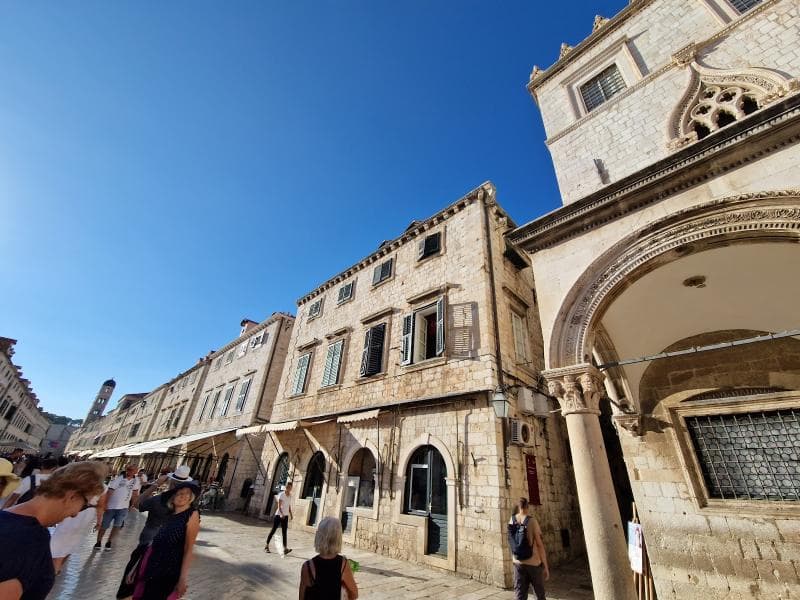
Explore Sponza Palace in Dubrovnik Old Town, Croatia. Discover its Gothic-Renaissance architecture, rich history as a customs house, and priceless State Archives.
Overview
Sponza Palace, known locally as Palača Sponza or Divona, stands as an exquisite architectural jewel within the heart of Dubrovnik's Old Town, Croatia. Nestled beside the grand Bell Tower and facing Orlando's Column and Saint Blaise Church, it is strategically located at the end of Stradun, the city's main thoroughfare, and in Luža Square. This sixteenth-century edifice is celebrated for its distinctive blend of Gothic and Renaissance architectural styles, a harmonious fusion that was characteristic of Dubrovnik during its Golden Age. Its name, 'Sponza', is derived from the Latin word 'spongia', referring to a spot where rainwater was collected, hinting at its practical origins. The alternative name, 'Divona', comes from 'dogana', the Italian word for customs house, reflecting its primary historical function. Remarkably, Sponza Palace is one of the very few buildings in Dubrovnik that survived the catastrophic 1667 earthquake virtually unscathed, preserving its original form and thus offering a rare glimpse into the city's pre-earthquake grandeur. Today, it serves as the home for the Dubrovnik State Archives, one of Europe's richest collections, and also hosts the poignant Memorial Room for the Defenders of Dubrovnik.
History & Cultural Background
The construction of Sponza Palace took place between 1516 and 1522, a period of flourishing trade and culture for the Republic of Ragusa (Dubrovnik). Master builder Paskoje Miličević Mihov designed this rectangular structure with an inner courtyard, while the loggia and intricate sculptures were largely crafted by the skilled Andrijić brothers from Korčula and other stonecutters. Initially, the palace's primary role was that of a customs office and bonded warehouse, a vital function for a maritime trading republic like Dubrovnik. Its arcaded atrium bustled daily with merchants, sailors, and businessmen, serving as a lively commercial hub. Over the centuries, Sponza Palace adapted to various crucial civic roles, housing the state mint, treasury, bank, armory, and even the city's first school. In the late sixteenth century, it blossomed into a significant cultural center, becoming the home of the Academia dei Concordi, Dubrovnik's first literary institution, where scholars and poets gathered to discuss literature, art, and science. The palace's survival of the devastating 1667 earthquake was a pivotal moment, enabling the continuation of state affairs when much of the city lay in ruins. Today, the Dubrovnik State Archives within the palace preserve an invaluable collection of historical documents, with some records dating back to the twelfth century, the earliest from 1022. This archive holds more than 7,000 volumes of manuscripts and around 100,000 individual scripts, including significant records like the Dubrovnik Statute of 1272.
What Makes It Special
Sponza Palace's enduring charm lies in several distinct features. Its architectural design, a seamless blend of Gothic and Renaissance elements, captivates visitors with its elegant courtyard, ornate stone carvings, and delicate arches. This stylistic harmony makes it a unique example of secular architecture from the era. Most significantly, Sponza Palace's miraculous survival of the great 1667 earthquake sets it apart; while many of Dubrovnik's grand buildings were destroyed, Sponza stood firm, preserving its original beauty and historical integrity. A testament to its role as a center of fair commerce is the famous Latin inscription above an arch in its atrium: 'Fallere nostra vetant et falli pondera; meque pondero cum merces ponderat ipse deus.' This translates to 'Our weights do not permit cheating, nor being cheated; when I weigh goods, God Himself weighs them with me,' serving as a powerful reminder of the Republic's ethical standards in trade. Beyond its historical weight, the palace remains a vibrant cultural venue. The square in front of Sponza Palace is traditionally the site for the opening ceremony of the renowned Dubrovnik Summer Festival, and the palace itself often serves as a performance venue, breathing life into its ancient stones each year.
Stories, Fun Facts & Local Details
The palace's dual naming as 'Divona' and 'Sponza' offers a glimpse into its practical and symbolic roles. 'Divona' directly referenced its function as a 'dogana' or customs house, a place where goods were inspected and taxes collected. The name 'Sponza', linked to rainwater collection, might seem less grand, but it points to the ingenious water management systems of the era. Inside, a beautiful relief created by the French sculptor Bertrandus Gallicus depicts Christ's initials flanked by angels and laurels, showcasing the artistic influences of the time. Imagining the bustling atrium in its prime, filled with merchants from across the Mediterranean, exchanging goods and engaging in lively discussions, adds a layer of vibrant history to the tranquil space seen today. The meticulous preservation of documents within the State Archives includes treasures like the Dubrovnik Statute of 1272, offering an unparalleled insight into the legal and administrative workings of the Republic of Ragusa. For those seeking intriguing historical narratives, stories whisper of the palace's basement dungeon, famously including a 'Dragon cell' where traitors were held, reportedly named for an engraved dragon figure on its door. During the Dubrovnik Summer Festival, actors on the upper terrace of the palace sometimes recreate scenes, portraying the Rector and members of the Council Minor, evoking the glorious days of the Republic.
Visitor Perspective
For curious travelers exploring Dubrovnik's Old Town, Sponza Palace is an essential stop. Its central location in Luža Square makes it easily accessible on foot, a natural part of any stroll through the historic streets. Visitors are often captivated primarily by the palace's impressive exterior and its elegant courtyard, which perfectly encapsulate the architectural beauty of Dubrovnik. While the State Archives within might appeal most to dedicated history buffs and researchers, offering a deep dive into centuries of documents, the general ambiance and historical significance resonate with everyone. The Memorial Room for the Defenders of Dubrovnik provides a powerful and moving experience, offering a somber but important reflection on the city's recent past. To truly appreciate Sponza Palace without the busiest crowds, consider visiting early in the morning or later in the afternoon. It also serves as an excellent indoor retreat on a rare rainy day, allowing for a contemplative exploration of its halls and history. The palace is frequently included in guided walking tours of Dubrovnik, providing expert commentary that brings its stories to life.
Coordinates: 18.11056, 42.64111
View on Google Maps💬 How Travelers Describe This Place
Based on community votes
Unique
674Beautiful
356Must See
261Interesting
182Photogenic
76
Traveler Stories
Discover memorable experiences shared by travelers who have visited this place.
No traveler stories yet.
Be the first traveler to share what made this place memorable.

Tour
By
Spot
Discover amazing places around the world. Your journey starts here.
Explore
© 2026 TourBySpot. All rights reserved.