Southern Palace Facade
Split, Croatia
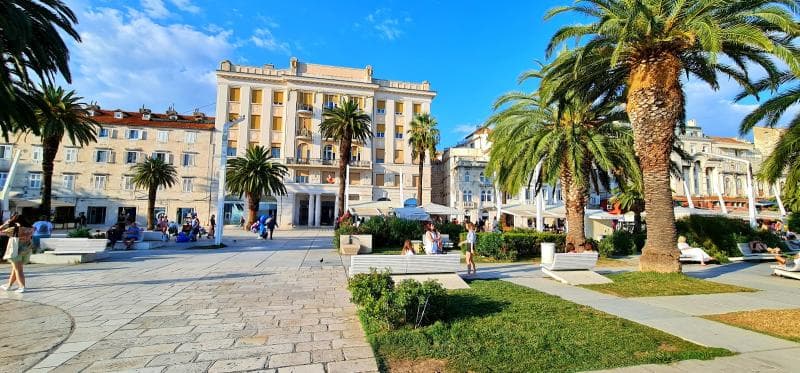
Explore the Southern Palace Facade in Split, Croatia. Discover the ancient Roman architecture of Diocletian's Palace along the Riva Promenade.
Overview
Standing majestically along Split's vibrant Riva Promenade, the Southern Palace Facade is not merely a wall but the seaward face of Diocletian's Palace, a UNESCO World Heritage site and the living heart of the city. This ancient Roman structure, built in the early 4th century CE, presents a breathtaking blend of imperial grandeur and architectural innovation. The facade stretches for hundreds of meters, forming a dramatic backdrop to the bustling Riva, which serves as Split's primary public space and waterfront hub. Unlike the palace's other, more fortified sides, the southern facade was originally open to the sea, reflecting its purpose as the emperor's private quarters and ceremonial entrance. Today, it encapsulates centuries of history, inviting visitors to step between the Roman era and modern Croatian life.
History & Cultural Background
Diocletian's Palace was constructed between 295 and 305 CE for the Roman Emperor Diocletian, who intended it as his lavish retirement residence. The southern facade held a unique significance; in Diocletian's time, the Adriatic Sea lapped directly against its foundations. This allowed the emperor to arrive by ship, entering his private quarters through what is now known as the Bronze Gate (Porta Meridionalis). This original design, featuring an elegant arcaded gallery on its upper level, sharply contrasts with the more austere and fortified appearance of the palace's land-facing walls. Over the centuries, land reclamation gradually pushed the shoreline outwards, leading to the creation of the Riva Promenade in the early 19th century under Napoleonic rule. The palace itself has been continuously inhabited since 305 AD, evolving into the vibrant urban core of Split and earning its place on the UNESCO World Heritage List in 1979.
What Makes It Special
The Southern Palace Facade is distinguished by its unique architectural design, which sets it apart from the rest of Diocletian's Palace. While the northern, eastern, and western walls were built with defensive towers and a more fortress-like appearance, the southern facade, facing the sea, was largely unfortified. Instead, it showcased an elaborate arcaded gallery on its upper floor, once serving as the emperor's private loggia from which he could survey the sea. This sophisticated design is a rare and extensive example of late Roman imperial architecture. Furthermore, the palace's substructures, or basement halls, located directly behind the Southern Facade, are remarkably well-preserved. These subterranean spaces offer a tangible glimpse into the original layout and grandeur of the imperial apartments above, providing a unique archaeological experience that reveals the palace's ingenious construction.
Stories, Fun Facts & Local Details
Imagine Emperor Diocletian sailing directly into his palace, with ships docking at the very walls, transporting goods and perhaps even the emperor himself, without ever needing to disembark from his vessel. This was the original function of the Bronze Gate, a simpler, less ornate entrance compared to the palace's other gates, likely used for the emperor's private access or for receiving supplies. During the Middle Ages, this gate gained a new significance, becoming known as the 'Security Gate' because it provided a crucial escape route to the sea during times of conflict or siege. Today, the area in front of the Southern Facade, the Riva Promenade, is affectionately called Split's 'living room.' It is a place where daily life unfolds, from morning coffee rituals to leisurely evening strolls known as 'korzo.' Locals and visitors alike gather here to socialize, people-watch, and enjoy the Mediterranean atmosphere. The Riva itself underwent a significant modernization in 2007, resulting in the clean, white-stone appearance seen today.
Visitor Perspective
For visitors to Split, the Southern Palace Facade, viewed from the Riva Promenade, offers an unparalleled experience. It's a place where you can visually connect with Roman history while immersed in the contemporary pulse of the city. Strolling along the Riva, lined with palm trees and bustling cafes, you'll find yourself constantly drawn to the imposing yet elegant ancient wall. The facade provides a stunning backdrop for photographs and a picturesque setting for simply relaxing and observing the world go by. From here, you can appreciate the intricate architectural details of the Roman structure, including the rhythmic arches of the former imperial loggia. The Riva is freely accessible 24/7, inviting you to experience the facade's majesty at different times of day – perhaps catching the golden light of sunrise or the dramatic ambiance of sunset over the Adriatic. A visit through the Bronze Gate leads directly into the palace's substructures, offering a cool, atmospheric journey beneath the ancient imperial residence, providing a deeper historical context to the facade above.
Coordinates: 16.43915, 43.50891
View on Google Maps💬 How Travelers Describe This Place
Based on community votes
Photogenic
965Must See
894Beautiful
862Unique
443Interesting
184
Traveler Stories
Discover memorable experiences shared by travelers who have visited this place.
No traveler stories yet.
Be the first traveler to share what made this place memorable.

Tour
By
Spot
Discover amazing places around the world. Your journey starts here.
Explore
© 2026 TourBySpot. All rights reserved.