South Tower
Antalya, Turkey
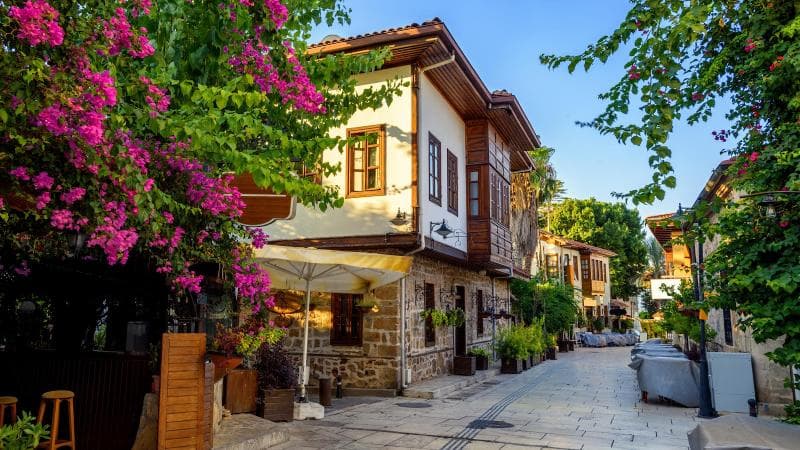
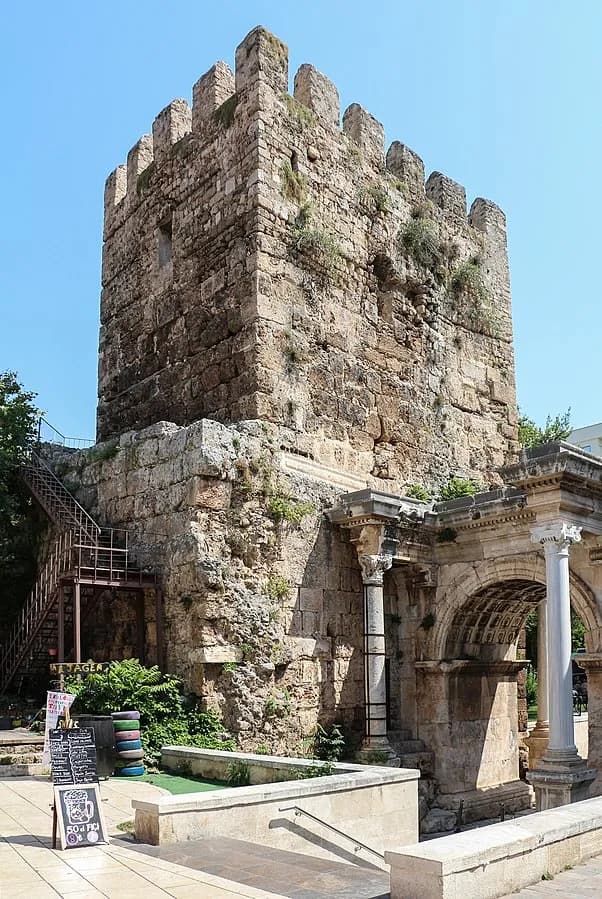
Discover Antalya's historic South Tower (Tower of Julia Sancta) at Hadrian's Gate, a Roman relic leading into Kaleiçi, Turkey.
Overview
As you approach Hadrian's Gate in Antalya, Turkey, a monumental Roman triumphal arch guarding the entrance to the city's historic Kaleiçi district, your gaze is inevitably drawn to its impressive flanking towers. Among these, the South Tower, famously known as the Tower of Julia Sancta, stands as a distinctive piece of history. Unlike the main gate, which was erected in 130 CE to commemorate Emperor Hadrian's visit, the South Tower, though also dating back to the Roman era, was constructed independently. This architectural individuality immediately sets it apart, hinting at a different purpose or perhaps a slightly earlier or later addition to the city's defenses and grand entrance. Serving as a guardian of the past, the South Tower, alongside its northern counterpart, frames the three majestic arches of Hadrian's Gate, inviting visitors to step through nearly two millennia of history into Antalya's charming old town.
History & Cultural Background
The story of the South Tower is intertwined with the broader history of Hadrian's Gate and the ancient city of Attaleia, the Roman name for Antalya. Hadrian's Gate itself was built in 130 CE, during a period of relative peace known as the Pax Romana, not primarily as a defensive fortification but as a ceremonial arch to honor Emperor Hadrian's journey through the eastern provinces. The South Tower, or the Tower of Julia Sancta, emerged from the same imperial period but with its own architectural character, suggesting it was not an original component of the gate's initial design but rather an independent addition. Its significance is amplified by a surviving Roman stone inscription embedded within its structure, which refers to Julia Sancta. More intriguingly, some sources connect the inscription to Domitia Paulina, who was Emperor Hadrian's sister, adding a rare personal dimension to this public monument. While the main gate stood as a beacon of Roman grandeur, the city walls eventually grew around it, absorbing and thereby preserving the gate and its towers from the ravages of time. The existence of a largely rebuilt North Tower, from the Seljuk period in the 13th century, further emphasizes the South Tower's ancient Roman origins and the continuous layers of history that have shaped this important landmark.
What Makes It Special
The South Tower's unique appeal lies in its distinct Roman provenance and architectural style, which contrasts subtly with the main structure of Hadrian's Gate. Its robust construction, dating from the Roman era, provides a tangible link to the ancient period of Antalya's past. The inscription associated with Julia Sancta, and potentially Domitia Paulina, transforms the tower from a mere stone edifice into a vessel of human history, hinting at noble Roman women who once played a role in the city's identity. While the gate itself is a stunning example of Roman triumphal architecture, with its white marble, granite columns, and intricate floral and rosette carvings, the South Tower represents a slightly different chapter of Roman construction, yet one that has endured equally well. Its survival through centuries, protected by the subsequent city walls that enveloped it, is a testament to its enduring strength and historical value, allowing today's visitors to witness a truly ancient piece of engineering.
Stories, Fun Facts & Local Details
Hadrian's Gate, affectionately known by locals as 'Üçkapılar' or 'The Three Gates,' has always been a focal point of Antalya, and the South Tower is an integral part of its lore. One popular myth recounts Queen Sheba passing through this very gate on her way to visit King Solomon, though historical timelines place her nearly a millennium before the gate's construction. Nevertheless, such stories highlight the deep cultural resonance of the site. The South Tower's identity as the 'Tower of Julia Sancta,' named after a Roman inscription, lends it a personal touch that transcends its monumental scale. Interestingly, the main gate once boasted a second story adorned with statues of the emperor and his family, a feature that has since been lost to time but adds to the gate's grand original vision. Today, the tower, like the rest of Hadrian's Gate, acts as a symbolic threshold, where the bustling modernity of Antalya seamlessly gives way to the narrow, enchanting cobblestone streets of Kaleiçi. Passing through it, one can almost hear the echoes of ancient footsteps and horse-drawn chariots, especially when observing the deep ruts worn into the original Roman pavement, visible through protective glass panels, a unique historical detail.
Visitor Perspective
For any traveler exploring Antalya, a visit to the South Tower and Hadrian's Gate is a journey back in time and an essential starting point for discovering the charming Kaleiçi district. The gate is accessible 24/7 and is beautifully illuminated at night, offering different visual experiences depending on the time of day. Many visitors prefer to come in the early morning or late afternoon to enjoy softer light for photography and to avoid the midday crowds and heat, especially during warmer months. Walking through the arches, flanked by the ancient South Tower, creates a powerful sense of transition from the contemporary city to its historical core. While there are no English-language interpretation panels directly on-site for the tower or gate, the sheer presence of these Roman structures speaks volumes. It is recommended to wear comfortable shoes, as the exploration of the surrounding Kaleiçi old town involves navigating uneven cobblestone paths. The South Tower and Hadrian's Gate are not just historical relics; they are living testaments to Antalya's layered past, offering an immersive cultural experience that connects visitors directly to the legacy of the Roman Empire in this vibrant Turkish city.
Coordinates: 30.70851, 36.88523
View on Google Maps💬 How Travelers Describe This Place
Based on community votes
Beautiful
826Must See
387Unique
242Photogenic
125Interesting
82
Traveler Stories
Discover memorable experiences shared by travelers who have visited this place.
No traveler stories yet.
Be the first traveler to share what made this place memorable.

Tour
By
Spot
Discover amazing places around the world. Your journey starts here.
Explore
© 2026 TourBySpot. All rights reserved.