Shanghai Tower
Shanghai, China
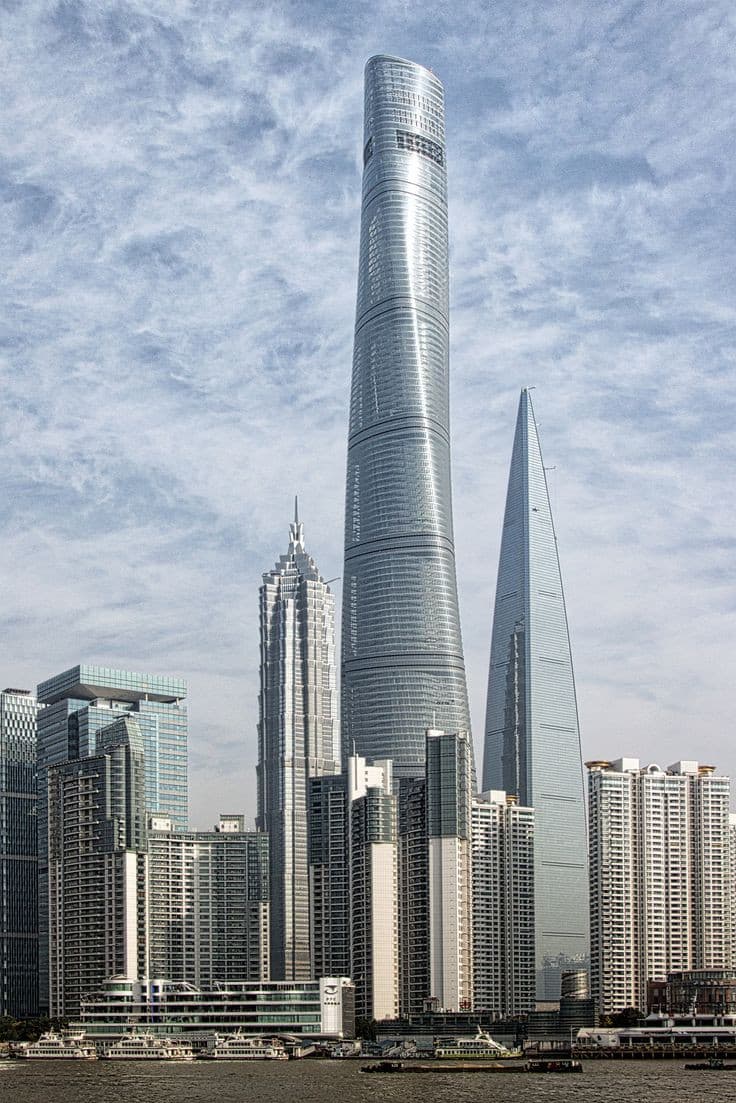
Explore Shanghai Tower, China's tallest skyscraper, offering unparalleled views of Shanghai. Discover its unique twisted design, sustainable features, and high-speed elevators in this iconic landmark.
Overview
Soaring majestically above the vibrant metropolis of Shanghai, China, stands the Shanghai Tower, an architectural marvel and a defining feature of the city's futuristic skyline. Located in the heart of the Lujiazui financial district in Pudong, this megatall skyscraper reaches an impressive height of 632 meters (2,073 feet). With 128 stories above ground and five below, it currently holds the title of China's tallest building and ranks as the third tallest building in the world by architectural top. Designed by the renowned American architectural firm Gensler, the tower is a mixed-use development featuring offices, a luxury hotel, retail spaces, and spectacular observation decks. Its distinctive twisted form and double-skin facade are not just aesthetically striking but also embody advanced engineering and sustainability. The Shanghai Tower stands as a powerful symbol of China's dynamic economic growth, innovation, and modernity, showcasing Shanghai's ambition on the global stage.
History & Cultural Background
The vision for the Shanghai Tower emerged as part of a grand plan laid out in 1993 by Shanghai authorities to create a cluster of three supertall skyscrapers in Lujiazui. These three towers, including the earlier Jin Mao Tower and Shanghai World Financial Center, were intended to symbolize Shanghai's past, present, and future. Construction of the Shanghai Tower officially commenced in November 2008, with the formidable task of building upon Shanghai's soft alluvial ground. The foundation alone required a massive concrete pour that lasted 63 consecutive hours, utilizing 450 mixer trucks to create a six-meter-thick mat supported by 947 bore piles. The tower structurally topped out in August 2014 and was completed in 2015, officially opening to the public in 2016. The project, owned by the Shanghai city government, cost an estimated $2.4 billion (CN¥15.9 billion). Gensler's design team was led by Shanghainese architect Jun Xia, who envisioned a structure that would harmoniously complement its predecessors while representing the city's future. Culturally, the Shanghai Tower has become a significant emblem of China's rapid urban transformation and its commitment to sustainable development.
What Makes It Special
The Shanghai Tower is a triumph of modern engineering and sustainable design. Its most visually striking feature is its unique, spiraling form, which twists 120 degrees as it ascends. This ingenious design significantly reduces wind loads on the building by up to 24 percent, a crucial factor in a city prone to typhoons. This wind-mitigating twist also allowed for a reduction in construction materials, saving 25 percent in structural steel compared to a conventional design of similar height. Another groundbreaking aspect is its double-skin glass facade, which wraps around the entire structure, creating nine distinct vertical zones. This transparent second skin acts as a thermal buffer, modulating temperatures and reducing the need for excessive heating and cooling, thereby enhancing the tower's energy efficiency. The Shanghai Tower is a highly sustainable building, having achieved both LEED Platinum certification and a China Green Building Three-Star rating. It incorporates 270 wind turbines near its crown, which generate renewable energy used for the tower's exterior lighting. Visitors to the observation deck experience one of the world's fastest elevators, which once held the global record. These ultra-high-speed lifts can transport guests to the 118th floor in just 55 seconds, traveling at a remarkable speed of 20.5 meters per second (73.8 kilometers per hour).
Stories, Fun Facts & Local Details
More than just a skyscraper, the Shanghai Tower is conceptualized as a 'vertical city.' This innovative design integrates nine distinct vertical zones or 'neighborhoods,' each serving as a public space with its own atrium, lush gardens, cafes, and retail areas. These sky gardens provide a human-scaled experience within the immense structure, offering panoramic views of the city. The tower's elegant spiraling shape is often said to resemble a traditional Chinese dragon, symbolizing the nation's dynamic growth and ambition. On the 118th floor, visitors can find a unique Sky Post Office, where they can send postcards from one of the highest points in the world, with special stamps from the tower. Another fascinating feature is the massive tuned mass damper, affectionately known as the 'Shanghai Eye,' located on the 126th floor. This 1,000-ton engineering marvel is crucial for stabilizing the tower against wind and seismic activity and can be experienced through immersive multimedia light shows. The Shanghai Tower, alongside the Jin Mao Tower and the Shanghai World Financial Center, forms a striking trio that, according to local interpretations, represents Shanghai's journey through time – past, present, and future, respectively. The sheer scale of the tower means it can accommodate up to 16,000 people daily, combining office workers, hotel guests, shoppers, and tourists.
Visitor Perspective
Visiting the Shanghai Tower offers an unforgettable journey into the clouds and a truly unique perspective of Shanghai. The 'Top of Shanghai Observatory' on the 118th and 119th floors provides breathtaking 360-degree panoramic views, encompassing the winding Huangpu River, the historic Bund, and the surrounding futuristic cityscape. For the most spectacular experience, many recommend timing your visit around sunset to witness the city transition from daylight to the dazzling array of night lights. Clearer views are also often enjoyed after periods of rainfall. The exhilarating high-speed elevator ride itself is a highlight, whisking visitors up hundreds of meters in less than a minute. Once on the observation deck, visitors can explore various interactive exhibits, enjoy snacks and beverages at the cafes, and browse souvenirs at the gift shop. It is highly advisable to book tickets online in advance to secure timed entry slots, often with a discount, and to bypass potentially long queues, especially during peak hours, weekends, or holidays. Valid identification, such as a passport, may be required for entry. The tower is fully wheelchair accessible, ensuring a comfortable experience for all visitors. Situated in the bustling Lujiazui financial district, the Shanghai Tower is conveniently accessible via Metro Line 2, exiting at Lujiazui station (Exit 6), or by taking a short ferry ride from the Bund. Most visitors typically spend between 1 to 1.5 hours exploring the observatory and its offerings.
Coordinates: 121.50044, 31.23546
View on Google Maps💬 How Travelers Describe This Place
Based on community votes
Photogenic
846Must See
564Beautiful
201Unique
121Interesting
87
Traveler Stories
Discover memorable experiences shared by travelers who have visited this place.
No traveler stories yet.
Be the first traveler to share what made this place memorable.
Things to see at Shanghai Tower



Tour
By
Spot
Discover amazing places around the world. Your journey starts here.
Explore
© 2026 TourBySpot. All rights reserved.