Sculptures
Minsk, Belarus
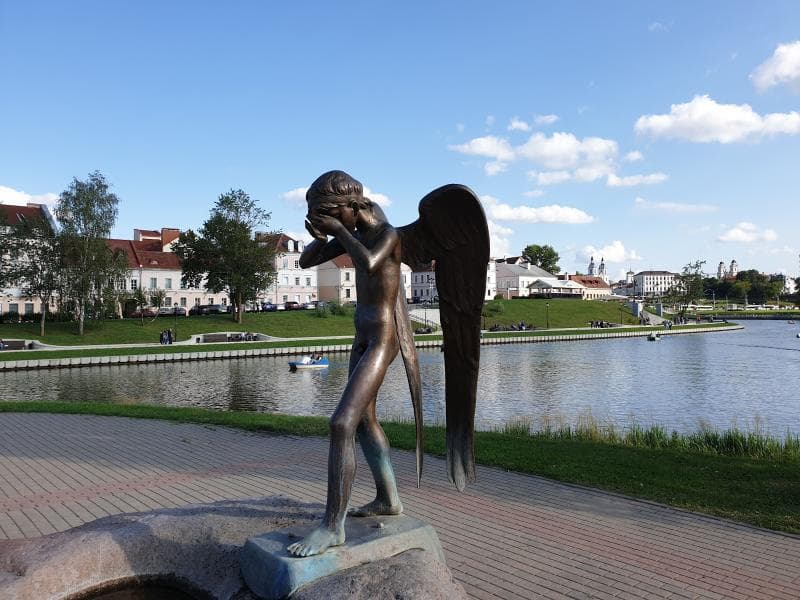
Discover the profound sculptures at the Island of Tears in Minsk, Belarus—a moving memorial honoring soldiers lost in the Soviet-Afghan War.
Overview
Nestled on an artificial islet in the Svislach River, a stone's throw from Minsk's historic Trinity Suburb, lies the poignant memorial known as the Island of Tears, or officially, the 'Island of Courage and Sorrow'. This solemn complex is a profound tribute to the Belarusian soldiers who perished in the Soviet-Afghan War (1979-1989), yet its symbolism extends to honor all Belarusian service members lost in conflicts beyond their homeland.
The island is accessible via a picturesque footbridge, inviting visitors into a space designed for quiet contemplation and remembrance. At its heart stands a chapel, surrounded by a collection of powerful sculptures that collectively weave a narrative of loss, grief, and enduring memory. The entire complex acts as a powerful reminder of the human cost of war, etched into the cultural landscape of Minsk.
History & Cultural Background
The genesis of the Island of Tears began during the Soviet-Afghan War itself, with construction commencing as early as 1985 or 1988. It was a collective effort, partly funded by donations from across the Soviet Union, some of which were collected in spent shell casings, a poignant detail reflecting the war's immediacy and personal impact. The memorial complex was officially unveiled on August 3, 1996.
The primary dedication is to the 771 Belarusian soldiers who lost their lives in Afghanistan, out of an estimated 30,000 who participated in the conflict. The central chapel, a cornerstone of the memorial, draws its architectural inspiration from the revered 12th-century Church of Euphrosyne of Polotsk, blending historical Orthodox forms with a contemporary memorial purpose. The memorial was designed by a team of artists including sculptor Yuri Pavlov and architects M. Korolev and T. Koroleva-Pavlova.
What Makes It Special
The sculptures at the Island of Tears are its emotional core, conveying the profound sorrow of a nation. Foremost among them is the bronze figure of a 'Weeping Angel', positioned near the entrance. This angel is depicted crying, symbolizing its inability to save the Belarusian soldiers from death and the lasting trauma experienced by those who returned. A striking feature is the water that continuously trickles from the angel's eyes, a perpetual representation of tears.
Around the base of the central chapel, several larger-than-life statues depict grieving women. These figures powerfully embody the mothers, sisters, and wives who endured the agonizing loss of their loved ones. Some are shown holding icons, others clutching portraits of their sons, each pose capturing a unique facet of sorrow and remembrance. Before entering the main structure, visitors encounter a boulder bearing a bronze icon of the Mother of God, inscribed with a message in both Belarusian and Russian dedicating the memorial to the sons lost in Afghanistan.
Inside the chapel, the names of the 771 fallen soldiers are meticulously carved into the walls, creating a powerful registry of lives lost. Biblical scenes are depicted in paintings within the chapel, and bronze icons adorn the altars. A unique detail is the chapel's floor, which slopes inward like the deck of a sinking ship, a disorienting design choice meant to mirror the chaos and tragedy of war.
Stories, Fun Facts & Local Details
Beyond its historical gravitas, the Island of Tears is interwoven with local lore and traditions. A deeply touching local legend suggests that the 'Weeping Angel' sheds actual tears whenever a Belarusian soldier dies in war, further deepening its symbolic power for many.
It has also become a place of cultural significance for local customs. Newlyweds in Minsk often visit the memorial to lay flowers, a gesture believed to bring good fortune and protect the husband from harm. There's even a folk belief that brides who gently touch a certain part of the angel's statue might increase their chances of bearing a son, although this particular detail is recounted with varying emphasis across sources. Another symbolic element is the red ruby embedded within the cross atop the chapel, representing the blood of both Christ and the warriors who sacrificed their lives. A time capsule containing soil from Afghanistan, brought by the mothers of the fallen, is also interred within the chapel, physically connecting the memorial to the distant land where so many lives were lost.
Visitor Perspective
The Island of Tears offers a profoundly moving experience for any traveler. It is open year-round, allowing for visits in any season, though spring and autumn often provide the mildest weather for exploration. There is no entry fee, making this significant historical site accessible to all. Visitors typically approach the island via a serene footbridge from the nearby Trinity Suburb, immediately entering an atmosphere of quiet reflection and respect.
The memorial encourages contemplation, with many visitors choosing to leave flowers or light candles in memory of the fallen. It is a place where one can connect with a nation's collective grief and resilience, understanding the enduring impact of conflict through powerful artistic expression. The tranquil setting, surrounded by the Svislach River, enhances the introspective mood, making it a powerful and unforgettable stop on any journey through Minsk.
Coordinates: 27.5545, 53.9097
View on Google Maps💬 How Travelers Describe This Place
Based on community votes
Beautiful
912Must See
820Photogenic
771Unique
479Interesting
181
Traveler Stories
Discover memorable experiences shared by travelers who have visited this place.
No traveler stories yet.
Be the first traveler to share what made this place memorable.

Tour
By
Spot
Discover amazing places around the world. Your journey starts here.
Explore
© 2026 TourBySpot. All rights reserved.