Sculptural Balconies
Riga, Latvia
Discover the stunning sculptural balconies of Riga's Art Nouveau District in Latvia. Explore ornate facades, mythical figures, and floral motifs.
Overview
Stepping into Riga's Art Nouveau District, particularly along streets like Alberta iela and Elizabetes iela, is an immersion into a world where architecture transcends mere structure to become vibrant, sculptural art. Among the myriad decorative elements adorning these early 20th-century buildings, the sculptural balconies stand out as exceptional focal points. They are not merely functional extensions but intricate masterpieces, telling stories and expressing the artistic fervor of the Art Nouveau (or Jugendstil) movement that swept through Europe. Riga proudly hosts one of the largest and most concentrated collections of Art Nouveau buildings globally, with nearly a third of its city center constructed in this distinctive style, making its sculptural balconies a prominent feature of its architectural identity.
History & Cultural Background
The flourishing of Art Nouveau in Riga coincided with a period of unprecedented economic prosperity and rapid urban expansion between the late 19th and early 20th centuries. From 1897 to 1913, Riga's population grew by an astounding 88%, necessitating extensive new construction. As the city dismantled its medieval fortifications, a 'blank canvas' emerged for architects to experiment with this new, expressive style. The Art Nouveau movement, known as Jugendstil in German-influenced regions like Riga, offered a departure from historical revival styles, emphasizing individuality, local attachment, and a more rational approach to architecture. Architects like Mikhail Eisenstein and Konstantīns Pēkšēns were central to shaping Riga's Art Nouveau landscape, particularly in the Quiet Centre where entire streets, such as Alberta iela, were developed in a remarkably short period, between 1901 and 1908. These architects masterfully incorporated elaborate sculptural details into facades, including the ornate balconies.
What Makes It Special
The sculptural balconies of Riga's Art Nouveau District are extraordinary due to their thematic boldness, abundance, and artistic integration. Unlike mere decorative additions, these balconies are integral to the buildings' overall narrative and aesthetic. Architects often covered entire facades with plasterwork, creating three-dimensional compositions of unparalleled density, with human faces, mythological beings, and symbolic figures dominating the architectural expression. You'll encounter mascarons (sculpted faces), flowing floral motifs, mythical creatures, and intricate geometric patterns on railings and balustrades. The balconies serve as stages for these rich sculptural programs, varying widely across the different Art Nouveau sub-styles prevalent in Riga: Eclectic (highly decorative with classical influences), Perpendicular (emphasizing vertical lines and streamlined forms), and National Romantic (blending Jugendstil with Baltic motifs and national symbolism). Mikhail Eisenstein's buildings, for example, are known for their flamboyant, expressive sculptures and ornate balconies that give facades a theatrical presence. The balconies at locations like Elizabetes iela 10b, an Eisenstein creation, are particularly striking with their intricate designs.
Stories, Fun Facts & Local Details
Many of Riga's Art Nouveau buildings on streets like Alberta iela and Elizabetes iela seem to engage in an architectural competition, each striving to outshine the next with their creativity. Interestingly, Mikhail Eisenstein's own son, the famous film director Sergei Eisenstein, reputedly referred to his father's exuberant sculptural ornamentation as 'all that whipped cream,' suggesting a playful yet critical perspective on the decorative excess. Despite this, Eisenstein's works remain some of the most photographed in Riga. You might spot sphinxes guarding entrances, symbols of security, or women holding torches, embodying various allegories. Nature motifs are particularly prevalent, with sculptural elements depicting vines, flowers, leaves, and various living things appearing to grow organically from the building surfaces. Even pine cones and pine needles are found covering balconies, as seen on Konstantīns Pēkšēns' building at Alberta iela 12, which also houses the Riga Art Nouveau Museum. This attention to detail and symbolic storytelling makes every balcony a small discovery.
Visitor Perspective
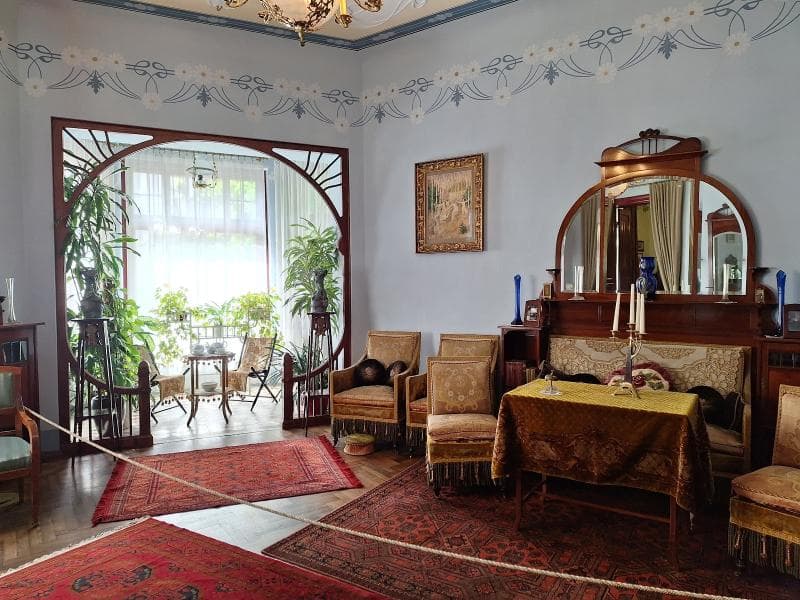
For any curious traveler, exploring the sculptural balconies of Riga's Art Nouveau District is like embarking on an open-air treasure hunt. The best way to experience these architectural wonders is simply to look up and allow ample time to stroll along streets such as Alberta iela, Elizabetes iela, and Strēlnieku iela. Each building facade, with its unique balconies, offers a new visual delight, from dramatic mascarons to intricate wrought-iron railings and ceramic tiles. The district feels quiet and elegant, perfect for architectural enthusiasts and photographers seeking to capture the intricate details under the best lighting, often in the morning or late afternoon when sunlight highlights the sculptures. To gain a deeper understanding of the period and the lives of those who commissioned and created these masterpieces, a visit to the Riga Art Nouveau Museum, located in Konstantīns Pēkšēns' former residence at Alberta iela 12, is highly recommended. The museum offers an immersive experience, recreating a fully restored Art Nouveau apartment and providing context for the external grandeur visible on the sculptural balconies throughout the district.
Coordinates: 24.108431, 56.959375
View on Google Maps💬 How Travelers Describe This Place
Based on community votes
Beautiful
836Unique
797Photogenic
396Interesting
286Must See
255
Traveler Stories
Discover memorable experiences shared by travelers who have visited this place.
No traveler stories yet.
Be the first traveler to share what made this place memorable.

Tour
By
Spot
Discover amazing places around the world. Your journey starts here.
Explore
© 2026 TourBySpot. All rights reserved.