Roman Garden
Bucharest, Romania
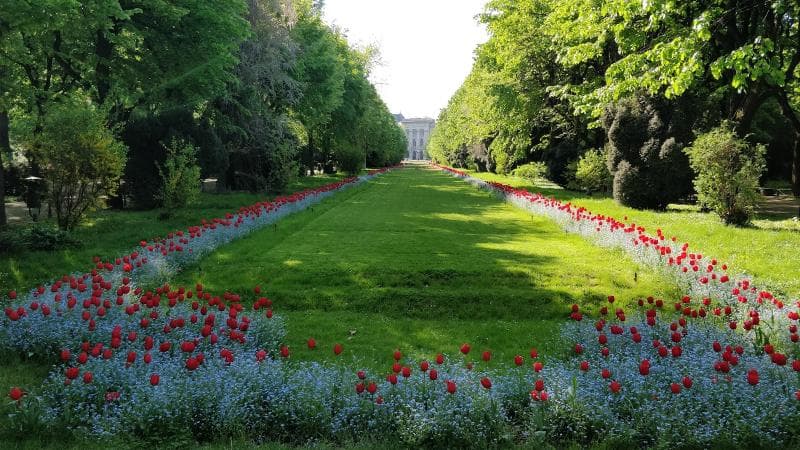
Discover the Roman Garden (Writers' Rotunda) in Cișmigiu Gardens, Bucharest, Romania. Explore busts of literary greats in this historic oasis.
Overview
Nestled within the venerable Cișmigiu Gardens in the heart of Bucharest, Romania, lies a captivating sub-spot often referred to as the Roman Garden. While its formal names are the 'Rondul Român' (Romanian Round) or 'Rotonda Scriitorilor' (Writers' Rotunda), this tranquil circular alley is a cherished cultural landmark, celebrating the literary heritage of Romania. Cișmigiu Gardens itself, established in 1847, stands as the oldest public garden in Bucharest, a sprawling 14.6 to 17-hectare green oasis amidst the bustling capital. The Roman Garden, with its dignified collection of stone busts, offers a serene escape and a profound connection to the country's intellectual past, inviting visitors to reflect and wander amidst the whispers of Romanian literature.
History & Cultural Background
The story of Cișmigiu Gardens begins long before its official inauguration. The area was once a marshland known as 'Lacul lui Dura neguțătorul' (the 'Lake of Dura the merchant'), a popular fishing spot that later housed vineyards. In the late 18th century, Wallachian ruler Alexandru Ipsilanti ordered the construction of public fountains, and the term 'cișmigiu,' derived from the Turkish 'çeșme' (fountain), came to denote the person responsible for their upkeep. This term eventually gave the gardens their name.
The transformation into a public garden commenced in the 1830s and 1840s under Russian administration, with city property status declared in 1845. Austrian landscape architect Carl Friedrich Meyer, formerly director of the Vienna Imperial Gardens, was instrumental in draining the marshland and designing the park in an English style, planting over 30,000 trees and various plant species. The gardens officially opened between 1847 and 1854, with public access beginning in 1860.
The Roman Garden, or Writers' Rotunda, was established much later, in 1943. It was conceived as a tribute to Romania's most influential literary figures. The circular arrangement of busts was a conscious effort to immortalize the intellectual giants who shaped Romanian culture and language, providing a physical space where their legacy could be appreciated by future generations.
What Makes It Special
The Roman Garden's distinctive charm lies in its harmonious blend of nature and intellect. It is a circular alley featuring stone busts of twelve prominent Romanian writers. Among these celebrated figures are Mihai Eminescu, Alexandru Odobescu, Titu Maiorescu, Ion Luca Caragiale, George Coșbuc, Ștefan Octavian Iosif, Ion Creangă, Alexandru Vlahuță, Duiliu Zamfirescu, Bogdan Petriceicu Hasdeu, Nicolae Bălcescu, and Vasile Alecsandri. These literary masters, whose works span poetry, prose, and criticism, collectively form a powerful narrative of Romanian identity and artistic expression. The busts, each a work of art in itself, transform a simple walkway into an open-air gallery, fostering a deep appreciation for the country's literary tradition.
Beyond its cultural significance, the Roman Garden contributes to the overall romantic and serene atmosphere of Cișmigiu. The thoughtful placement of these artistic treasures within the lush greenery creates a contemplative space, setting it apart from other areas of the park. It is a place where history feels tangible, and the creative spirit of Romania's past is palpably present.
Stories, Fun Facts & Local Details
The Cișmigiu Gardens, and by extension the Roman Garden, are steeped in local lore and have played a significant role in Bucharest's cultural fabric. The park has been a muse for many writers, including Ion Luca Caragiale, whose satirical sketches often featured the gardens as a backdrop for the everyday lives and foibles of Bucharesters. One famous colloquialism, 'chasing flies out of Cișmigiu,' humorously described someone laid off from their job, implying a leisurely idleness in the park.
It is said that Romania's national poet, Mihai Eminescu, was a frequent visitor to Cișmigiu, finding inspiration near a specific spring, which was later named 'Izvorul lui Eminescu' (Eminescu's Spring) in his honor. In its early days, the park had strict regulations, prohibiting loud speech, hateful remarks, and even commercial activities, aiming to preserve its tranquil and refined ambiance. These rules underscore the park's historical role as a genteel gathering place for the city's elite.
A less known fact is that Cișmigiu Gardens hosted Romania's first beauty contest in 1912. The park also suffered considerable damage during both World Wars, with kiosks destroyed for fuel and aviary birds consumed for survival, highlighting its resilience and subsequent restoration efforts.
Visitor Perspective
Visiting the Roman Garden within Cișmigiu is an experience that resonates deeply with those who appreciate history, literature, and moments of quiet beauty. As you stroll along the circular path, you can pause at each bust, allowing the stories of these great Romanian writers to unfold in your imagination. The shade provided by the ancient trees, the gentle rustle of leaves, and the distant sounds of city life fading into the background create an atmosphere of peaceful contemplation.
It's a favored spot for locals seeking respite from urban intensity, where you might see students studying near a literary hero, elderly residents enjoying a quiet read, or couples taking a romantic walk. The Roman Garden offers not just a glimpse into Romania's literary past, but also a chance to connect with the present-day rhythms of Bucharest life in a setting of timeless elegance. It is a unique place where art, history, and nature converge, offering a truly enriching experience for any curious traveler.
Coordinates: 26.0905, 44.4369
View on Google Maps💬 How Travelers Describe This Place
Based on community votes
Interesting
443Must See
414Unique
310Beautiful
277Photogenic
233
Traveler Stories
Discover memorable experiences shared by travelers who have visited this place.
No traveler stories yet.
Be the first traveler to share what made this place memorable.

Tour
By
Spot
Discover amazing places around the world. Your journey starts here.
Explore
© 2026 TourBySpot. All rights reserved.