Pazzi Chapel
Florence, Italy
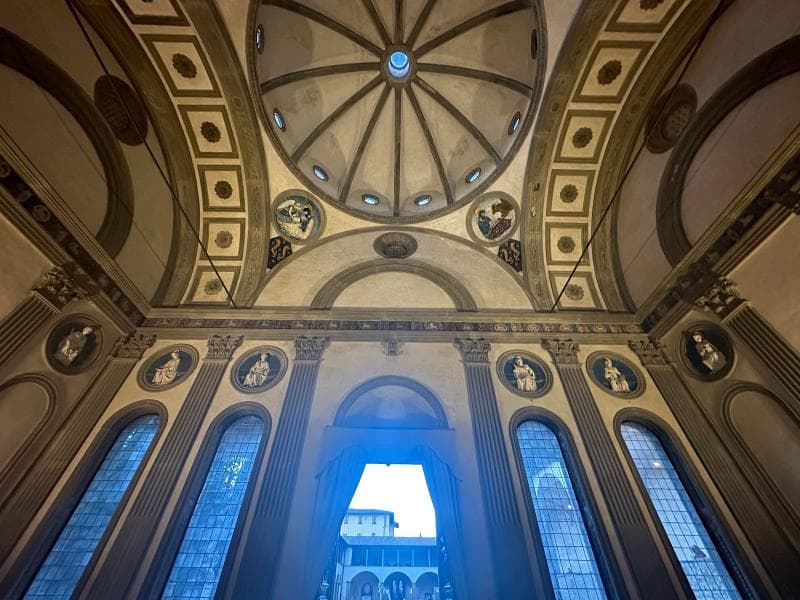
Explore the Pazzi Chapel, a masterpiece of Early Renaissance architecture nestled within the Basilica di Santa Croce in Florence, Italy.
Overview
Tucked away within the sacred confines of Florence's sprawling Basilica di Santa Croce lies the Pazzi Chapel, an exquisite architectural marvel often hailed as a quintessential masterpiece of the Early Renaissance. Commissioned by the influential Pazzi family, this chapel served a dual purpose: as a private family chapel for burial and as a chapter house, a meeting room for the Franciscan monks of Santa Croce. Its serene beauty and revolutionary design mark it as a pivotal work in the history of architecture, offering a harmonious blend of classical forms and innovative spatial concepts.
Visitors stepping into this sacred space are immediately struck by its elegant simplicity and the profound sense of order that pervades its every detail. Its presence within the larger, Gothic-era Basilica of Santa Croce creates a striking contrast, emphasizing its forward-thinking Renaissance ideals.
History & Cultural Background
The story of the Pazzi Chapel begins after a fire damaged a section of the Santa Croce complex in 1423. Andrea de' Pazzi, head of one of Florence's wealthiest families, seized the opportunity to commission a new structure, entrusting its design to Filippo Brunelleschi, the visionary architect behind Florence's Duomo.
While funds were assembled by 1429, construction did not commence until around 1442. Brunelleschi oversaw the initial stages until his death in 1446, though the chapel was not fully completed until 1478. The building's history is intertwined with the Pazzi family's ambition; they sought to underscore their wealth and power in Florence, a motivation second only to their Medici rivals.
However, the project was dramatically interrupted in 1478 due to the infamous Pazzi Conspiracy, a plot by the family against the ruling Medici. This event led to the Pazzi family's exile and effectively halted the chapel's construction, leaving certain elements, such as the portico, subject to later additions and design alterations.
What Makes It Special
The Pazzi Chapel stands as a testament to the principles of Renaissance architecture, characterized by its emphasis on proportion, geometry, and classical motifs. Brunelleschi's design introduced a modular system, establishing a harmonious relationship between all parts of the building. The interior features a central cube surmounted by an umbrella dome, flanked by symmetrical barrel-vaulted wings.
A defining feature is the striking use of 'pietra serena,' a grey sandstone, which highlights structural elements like arches, entablatures, and pilasters, creating a stark and elegant contrast against the white plaster walls. This minimalist approach allows the viewer to appreciate the pure forms and rational design.
The chapel's decorative elements, while subordinate to its architecture, are equally significant. Twelve glazed terracotta tondi depicting the Apostles, created by Luca and Andrea della Robbia between 1450 and 1470, adorn the interior. Polychrome terracotta tondi of the Evangelists are set in the squinches of the dome, sometimes attributed to Brunelleschi himself.
Stories, Fun Facts & Local Details
One of the most debated aspects of the Pazzi Chapel is the extent of Brunelleschi's direct involvement. While he is commonly credited with the design, some scholars suggest he provided the initial plan but not the full execution or detailing, especially given his death in 1446, long before completion. The chapel's elegant portico, for instance, is thought to have been added after his passing.
An intriguing detail within the chapel is the frescoed dome above the raised chancel. It depicts the constellations present in the night sky over Florence on July 4, 1442. This specific astronomical representation provides a fascinating glimpse into Renaissance knowledge and its integration into art and architecture.
The Pazzi Chapel's serene and rationally ordered space was a radical departure from the ornate Gothic style prevalent before the Renaissance. Its design, with a square base topped by a circular dome, invited individuals to perceive themselves as centered between heaven and earth, reflecting the era's humanist philosophy that celebrated the greatness of man.
Visitor Perspective
Visiting the Pazzi Chapel offers a unique opportunity to immerse oneself in the pure principles of Early Renaissance architecture. As you step from the bustling cloister into its quiet interior, a sense of calm and clarity envelops you. The deliberate use of geometry and proportion creates a space that feels inherently balanced and intellectually stimulating.
The subtle interplay of the grey pietra serena and white plaster guides the eye, allowing the architectural forms themselves to become the primary aesthetic experience. Standing beneath the central dome, one can almost feel the mathematical precision and thoughtful design that went into its creation, a physical manifestation of Renaissance ideals. The chapel, with its benches along the walls, was designed as a functional chapter house for monks to gather, pray, and conduct business, providing excellent acoustics for chanting.
It's a place not just to observe, but to experience—a tangible connection to a pivotal moment in art history when human intellect and classical wisdom converged to reshape the built environment of Florence. The chapel's enduring beauty lies in its elegant restraint, inviting contemplation and a deeper appreciation for the genius of its creators.
Coordinates: 11.26299, 43.76801
View on Google Maps💬 How Travelers Describe This Place
Based on community votes
Photogenic
886Unique
443Beautiful
310Must See
277Interesting
233
Traveler Stories
Discover memorable experiences shared by travelers who have visited this place.
No traveler stories yet.
Be the first traveler to share what made this place memorable.

Tour
By
Spot
Discover amazing places around the world. Your journey starts here.
Explore
© 2026 TourBySpot. All rights reserved.